Article
AI in Market Research: 2026 Guide & Best Practices
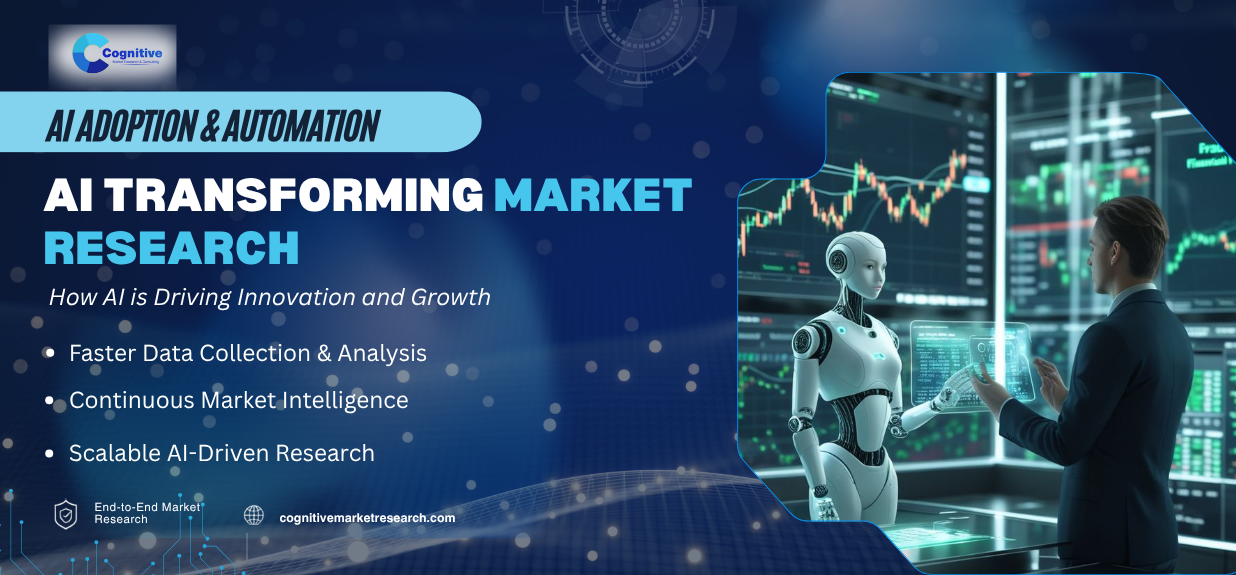
Market research used to mean waiting. You'd commission a study, wait weeks for fieldwork, then wait again for analysis. By the time the report landed, it was sometimes already outdated. That's changing and it's changing for the better. AI now touches nearly every stage of research, from study design to data collection to final reporting, and it's making the whole process faster, sharper, and more accessible than ever.
Generative AI adoption among market researchers has grown rapidly, with a large and fast-growing share of teams now using it to analyze transcripts, summarize findings, and accelerate reporting. The global market research industry long valued near $140 billion is being reshaped by this shift, with both established firms and innovative new platforms competing to deliver faster, smarter insight. This guide draws on Cognitive Market Research's experience running AI-assisted and human-led studies across 30+ industries to show what's working well today, and how to choose the right approach for your business.
What Is AI in Market Research?
AI in market research means using machine learning, natural language processing, and generative AI to handle tasks researchers once did entirely by hand: data collection, analysis, pattern detection, and forecasting. It's best understood as a spectrum of capability rather than one single tool.
At one end is AI-assisted research AI speeds up a human-led process, like summarizing hundreds of open-ended survey responses instead of reading them manually. In the middle is AI-automated research, where AI runs entire steps independently, such as adaptive surveys that change questions in real time based on how someone responds. At the far end is fully synthetic research AI simulates consumer responses or digital twins, giving teams fast, directional signal for early-stage thinking before committing to a full study.
In our own work at Cognitive, the strongest engagements blend AI speed with analyst judgment at the points where judgment adds the most value a principle built directly into Athenaeum AI's design.
Have you read?
AI Adoption and Automation in Education and Training Industry: The 2026 Outlook
AI Adoption in Digital Marketing & Growth Consulting by Cognitive Market Research and consulting
Why Adoption Is Accelerating
The market research industry is entering one of its most exciting periods of growth and innovation. AI is unlocking capabilities that simply weren't possible a few years ago, and businesses of every size are taking notice.
A few forces are driving the momentum:
- Speed. Analysis that once took weeks now happens in hours, giving teams the freedom to move at the pace of the market.
- Cost efficiency. AI reduces the labor and turnaround time involved in traditional panel recruitment, making quality research more affordable.
- Data volume. Reviews, support tickets, and social conversations generate an enormous amount of signal and AI makes it possible to actually use all of it.
- Real-time decisions. Leadership teams can now access continuous insight instead of waiting on quarterly reports, supporting faster, more confident decisions.
Where AI Shows Up in the Research Process
Walking through the research lifecycle shows exactly how AI adds value at every stage and where human analysts continue to bring essential expertise.
-
AI in Research design
AI synthesizes existing literature and surfaces gaps in current market understanding, turning a blank page into a guided, well-informed starting point.
-
AI in Data collection
AI chatbots run adaptive, conversational surveys that adjust in real time based on responses, creating a more engaging experience for participants. AI also continuously gathers reviews, forum discussions, and social mentions, giving researchers a richer, always-on view of sentiment.
-
AI in Data analysis
This is where AI shines brightest. Natural language processing turns thousands of open-ended responses into clear themes within minutes, and predictive models help forecast where a market is headed by surfacing patterns that would take much longer to find manually.
-
AI in Synthetic data and digital twins
AI generated personas simulate how a segment might respond to a new product or message, giving teams a fast, low-cost way to explore early-stage ideas before investing in full-scale research.
-
AI Reporting
AI turns dense datasets into clear, presentation-ready summaries an executive overview for leadership and a detailed appendix for analysts, generated from the same underlying data in a fraction of the time it used to take.
Benefits of AI Automation
- Speed: months-long research cycles can shrink to days.
- Cost efficiency: less reliance on large panels and manual labor means better value for every research dollar.
- Scalability: AI handles massive datasets and narrow niche segments with equal ease.
- Sharper pattern detection: algorithms surface subtle trends across huge volumes of data, often faster than a human team could on its own.
- Continuous insight: research becomes an ongoing stream rather than a one-time snapshot, keeping teams closer to real market conditions.
- Greater accessibility: smaller teams and growing businesses now have a realistic path to enterprise-grade research.
Getting the Most Out of AI in Market Research
AI delivers the best results when it's paired thoughtfully with human expertise and the good news is that doing this well is more achievable than ever. A few simple practices help teams get the most value:
Validate AI-generated insights with experienced analysts
especially for high-stakes or highly technical markets, to add the context and nuance that make findings truly actionable.
Use synthetic data and digital twins as a head start
not a final answer, they're excellent for fast directional thinking ahead of a full study.
Keep data practices transparent and well-governed
particularly for global projects spanning multiple regions, so insights are trustworthy as well as fast.
Teams that combine AI's speed with this kind of thoughtful oversight consistently get the richest, most reliable results and it's exactly the model behind Athenaeum AI.
How Enterprises Are Adopting AI Platforms
Static PDFs are giving way to interactive dashboards, and it's a welcome shift. Enterprises now want a living platform they can query and filter on demand by region, segment, or competitor without commissioning a new study each time they need an update.
The platforms gaining the most traction combine AI's speed and scale with human expertise for validation and context. This hybrid approach gives teams the best of both worlds: fast answers they can trust.
Athenaeum AI: Human-Led, AI-Powered
Athenaeum AI is Cognitive Market Research and Consulting's enterprise-grade platform-as-a-service, built on the company's Full Truth philosophy of triangulating field research with proprietary databases and AI-powered analytics. Cognitive holds ISO 9001:2015, ISO 27001:2022, and ISO 20252 certifications and is an active ESOMAR and MRSI member credentials that reflect the rigor behind every Athenaeum dashboard.
The platform includes four offerings: Competitor Athenaeum for granular competitor intelligence, Industry Athenaeum for a 360° view across 30+ industries, Investors Athenaeum for forecast-driven investment decisions, and Athenaeum Market Survey for field-verified primary data.
Key features include a centralized workspace, an agentic Athenaeum AI Assistant for instant summaries, collaborative team access, multi-currency and multilingual support, custom regional modeling, executive-ready reporting, and on-demand sessions with Cognitive's research analysts, the team behind 9+ years of cross-industry market research.
This human-led, AI-powered model gives users exactly what makes AI research work best: the Athenaeum AI Assistant brings speed and scale, while direct analyst access brings the validation and context that turn fast answers into confident decisions.
Choosing the Right Approach
Research objective: exploratory work is a great fit for more automation, while go/no-go decisions benefit from added human input.
Budget and timeline: tight deadlines are a strength for AI-assisted or hybrid methods.
Need for nuance: unfamiliar or highly specialized markets benefit from extra analyst involvement.
Data sensitivity: regulated industries should choose platforms with strong governance and certifications.
Team AI literacy: newer teams often get the most value from a platform with built-in analyst support.
Key Takeaways
- AI now adds value across the entire research lifecycle, from design to final reporting.
- Adoption is accelerating quickly, and the results such as speed, cost savings, and richer insight are already paying off for businesses of every size.
- AI works best paired with experienced analysts, especially for nuanced or high-stakes markets.
- Hybrid, ESOMAR-certified platforms like Athenaeum AI combine the speed of automation with the judgment of experienced analysts giving teams the best of both.

 X
X
Article Details
-
Author Anuja Bawaskar
-
Published 30 Jun 2026
-
Last Updated 07 Jul 2026
-
Reading Time~3 minutes
Get a Custom Report
Interested in a similar analysis for your market? Our experts can deliver a customized report.
Contact Our ExpertsMore Articles
Explore all published articles across 30+ industry verticals.
View All Articles