Article
Introduction
A nursing student at Rasmussen University logs into her course portal and, instead of a static syllabus, finds an AI study companion that already knows where she struggled last week. A software engineer at a 250-person firm in San Diego practices responding to a simulated client crisis, coached in real time by an AI system that adjusts the difficulty as he improves. Neither of these moments would have been routine three years ago. In 2026, they are simply how learning happens.
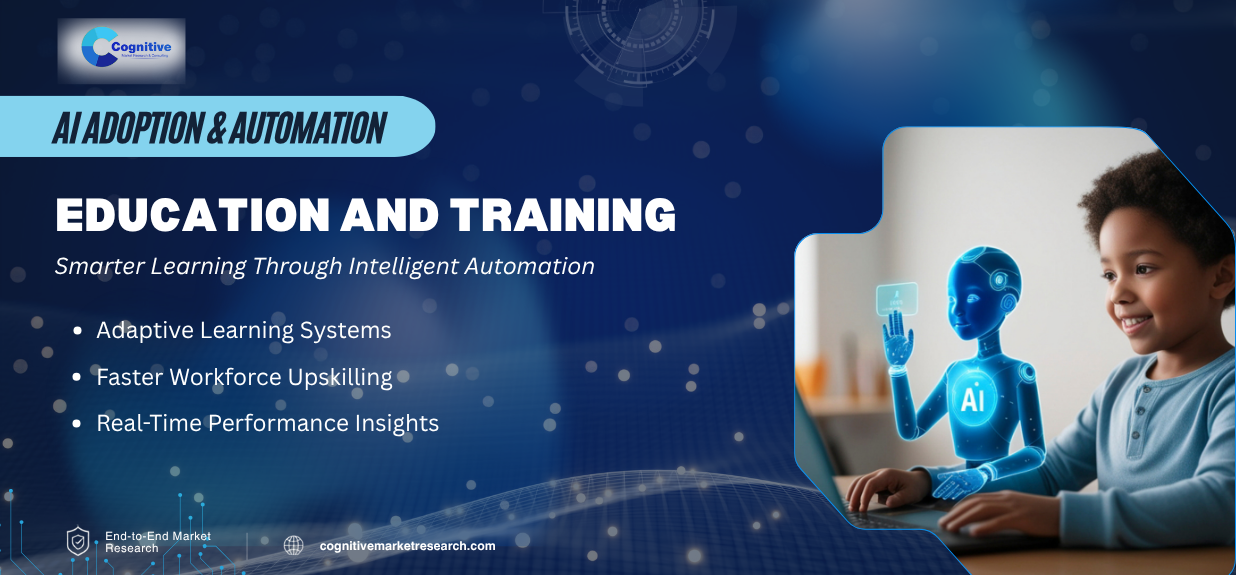
The education and training industry, long considered one of the slower movers in digital transformation, is now in the middle of one of its fastest structural shifts in decades. The global AI in education market was valued at approximately USD 7.05 billion in 2025 and is projected to reach roughly USD 136.79 billion by 2035, growing at a compound annual rate near 35%. That is not incremental change. It is a near-twenty-fold expansion within a decade, and it is being driven by three forces converging at once: learners who expect personalization, institutions under cost pressure, and employers who can no longer wait years to close skills gaps.
For manufacturers of learning technology, the opportunity is obvious. For the everyday learner, parent, teacher, or employee, the more pressing question is simpler: is this actually making learning better, or just faster to sell?
Why Is AI Adoption Accelerating So Quickly in Education and Training Right Now?
The honest answer is that AI finally solved a problem the industry had quietly accepted as unsolvable, personalization at scale. For decades, a tenured employee and a first-year hire sat through identical onboarding modules, and a struggling ninth-grader and a gifted classmate worked through the same worksheet at the same pace, because building a different path for each person was logistically impossible. Industry forecasts suggest that by 2026, a much larger share of enterprise learning applications will rely on task-specific AI agents, up sharply from just a few years ago, and these are not simple chatbots but systems that actively monitor learner struggle and adapt content before a learner even asks for help.
The classroom data backs this up. A January 2026 national survey by the American Association of Colleges and Universities found that faculty concerns about AI are running high, with a majority of faculty reporting they have personally handled academic integrity issues tied to student AI use. Yet the same period shows rising confidence in outcomes: the Coursera AI in Higher Education Report released in February 2026 found that four in five students say AI has improved their academic performance, and most report using it to supplement rather than replace their own thinking. Adoption, in other words, is racing ahead of policy, and institutions are being forced to catch up rather than lead.
Have you Read?
AI Adoption in Digital Marketing & Growth Consulting by Cognitive Market Research and consulting
What Recent Incidents Show Us About AI Adoption in Practice
Three developments from the past year capture how fast this is moving, and how unevenly.
First, institutional infrastructure is being replaced wholesale, not patched. D2L announced that Rasmussen University, a 125-year-old institution with campuses across six states, selected D2L Brightspace to replace its legacy Blackboard platform, with the rollout deploying AI-native personalized study recommendations and an AI tutor across nursing education first. This matters because it signals that AI is no longer an add-on bolted to old learning management systems; it is becoming the foundation those systems are built around.
Second, governance is scrambling to keep pace with usage. The State University of New York system adopted a formal AI policy across all 64 campuses, requiring training in responsible use and embedding AI literacy into general education for incoming undergraduates starting in Fall 2026. That is a positive step, but a separate report notes that only about one in five universities currently has a formal AI policy in place, leaving most institutions exposed to the same integrity disputes and inconsistent rules that triggered SUNY's overhaul in the first place.
Third, and perhaps most telling for the corporate side, the market has started rejecting shallow AI training. By mid-2026, corporate spending on unverified, mass-market AI courses dropped significantly, as leaders realized that teaching employees general facts about AI was not translating into better decision-making or secure system operations. In response, Accenture and Carnegie Mellon's Software Engineering Institute launched an AI Adoption Maturity Model, motivated by research showing that while most C-suite leaders planned to increase tech spending in 2026, only a small fraction of organizations were successfully rebuilding their actual workflows around it. A real-world example of the alternative approach: a San Diego software firm building role-based AI learning paths through a structured program took relevant teams from roughly 10% AI adoption to nearly full adoption within six months, alongside a meaningful jump in project efficiency and a sharp reduction in skill gaps.
How Is This Reshaping Corporate Training Specifically?
Corporate learning and development has historically been the part of any business that gets cut first and modernized last.
That is changing because the economics finally favor it. More than 90% of global enterprises are projected to face critical AI skills shortages, with sustained gaps risking trillions of dollars in cumulative losses, and while a large majority of enterprise leaders now provide some form of AI training, a majority still report a persistent skills gap. The companies closing that gap are not the ones buying the most licenses; organizations that invest in structured AI upskilling programs report roughly double the AI return on investment compared to those without formal programs.
This is also changing what a trainer does. As AI takes over routine content delivery and assessment, human instructors are shifting from being content transmitters to learning facilitators, coaches, and mentors, a higher-value role rather than a diminished one, and research on blended approaches shows this combination of AI personalization with human facilitation consistently outperforms either approach alone.
What Does All This Mean for the Everyday Learner or Parent, Not Just the Manufacturers?
This is the part that gets lost in market-size headlines. If you are a parent, the relevant fact is not a CAGR; it is that a children's digital safety platform serving 20 million students across 26,000 schools recently launched a feature giving parents direct visibility into how their kids use AI on school devices, precisely because most parents currently have none. If you are an employee anxious about being replaced, the more useful data point is that organizations are increasingly using AI to train people on AI itself, accelerating how fast a workforce can build capability rather than simply automating people out of a job. And if you are a student wondering whether any of this actually works, a peer-reviewed randomized controlled trial published in 2025 found an AI tutor outperformed traditional in-class active learning by a substantial margin, with students reaching higher scores in less time than their classroom peers.
The honest takeaway for 2026 is that AI adoption in education and training is no longer a question of if. It is a question of whether institutions and employers build the policy, oversight, and human judgment around it fast enough to match how quickly learners and employees are already using it. The technology has outrun the rulebook. Closing that gap, not the next funding round, is what will separate the platforms and organizations that last from the ones that were simply first.

 X
X
Article Details
-
Author Aarti Bagekari
-
Published 26 Jun 2026
-
Last Updated 29 Jun 2026
-
Reading Time~3 minutes
Related Reports
Get a Custom Report
Interested in a similar analysis for your market? Our experts can deliver a customized report.
Contact Our ExpertsMore Articles
Explore all published articles across 30+ industry verticals.
View All Articles