Blog Content
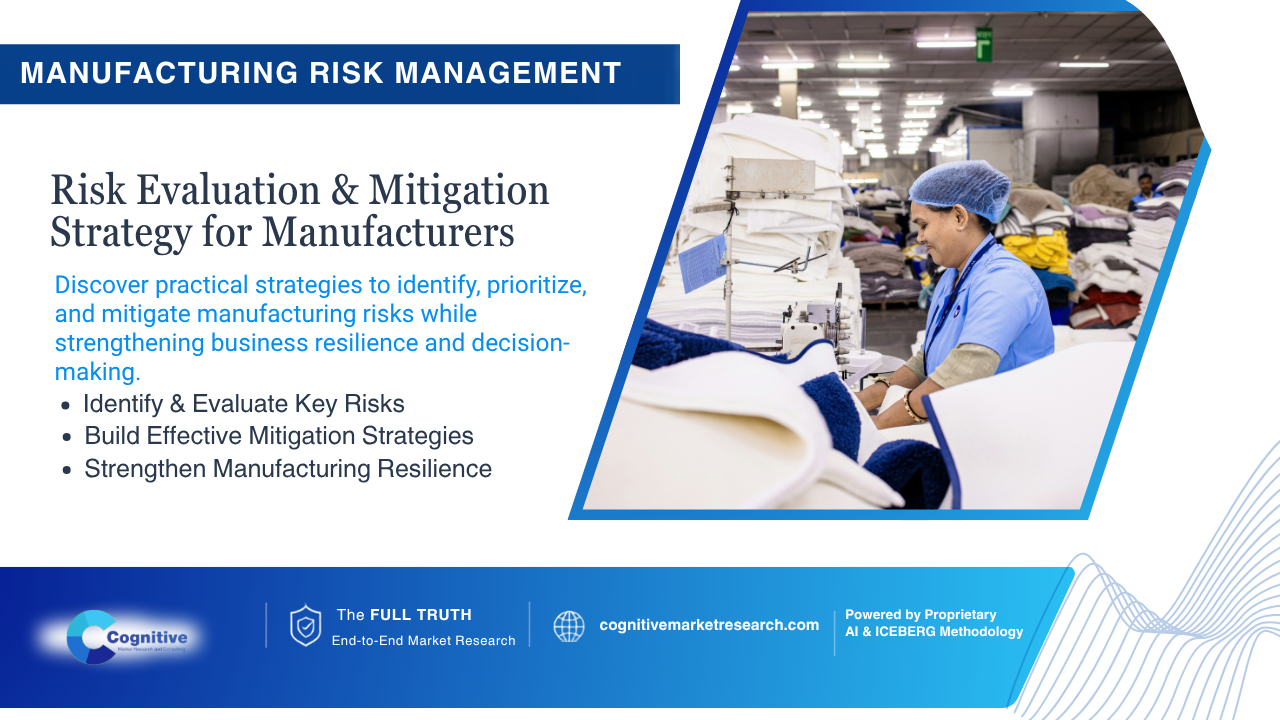
Risk Evaluation and Mitigation Strategy: A Practical Guide for Manufacturers
Manufacturing businesses operate in an environment where operational disruptions, supply-chain challenges, changing customer demand, regulatory requirements, equipment failures, and market uncertainty can significantly affect business performance. A structured risk evaluation and mitigation strategy enables organizations to identify potential threats, understand their business impact, and develop appropriate responses before risks become major problems. For manufacturers, this approach is particularly important because operational and market risks are often interconnected and can directly influence production, costs, profitability, and customer relationships.
What Is a Risk Evaluation and Mitigation Strategy?
A risk evaluation and mitigation strategy is a structured process used to identify potential risks, assess their likelihood and impact, prioritize them, and determine appropriate actions to control or reduce their consequences. While risk evaluation focuses on understanding the seriousness of a potential threat, mitigation focuses on deciding what the organization should do to manage that threat.
For example, a manufacturer may identify dependence on a single raw-material supplier as a significant business risk. The risk evaluation would consider the likelihood of supply disruption and its potential effect on production. The mitigation strategy could then involve developing alternative suppliers, maintaining appropriate inventory levels, and establishing contingency sourcing arrangements. This approach transforms risk identification into practical business action.
Why Is Risk Evaluation Important for Manufacturers?
Manufacturers face multiple forms of risk simultaneously. Supply shortages can interrupt production, equipment failures can cause downtime, quality problems can result in rejected products, and changes in customer demand can leave businesses with excess inventory or insufficient capacity. Because these risks can influence one another, businesses need a structured approach to evaluate their potential consequences.
Risk evaluation helps manufacturers determine which risks require immediate attention and which can be monitored. Instead of treating every potential problem equally, management can prioritize risks according to their probability, potential financial impact, operational consequences, and strategic importance. This allows organizations to direct resources toward the risks that could have the greatest effect on business performance.
Risk Evaluation in Manufacturing
Risk evaluation begins with identifying potential sources of uncertainty across the organization. Manufacturers should examine production processes, suppliers, logistics, workforce availability, technology, quality systems, regulatory requirements, customer demand, competitors, and financial conditions.
Once risks are identified, thei
r likelihood and potential impact should be assessed. A risk that has a low probability but could completely stop production may deserve greater attention than a frequently occurring issue with minimal consequences. This evaluation provides management with a clearer understanding of where vulnerabilities exist and which areas require preventive action.
For example, consider a manufacturing company that depends on one supplier for an essential component. If that supplier experiences a prolonged production problem, the manufacturer may be unable to fulfill customer orders. During the risk evaluation process, the company can assess supplier reliability, alternative sourcing options, lead times, inventory availability, and the financial consequences of a disruption.
Mitigation Strategy for Business and Manufacturing Risks
After risks have been evaluated and prioritized, organizations need to develop a mitigation strategy. The objective is not necessarily to eliminate every risk because eliminating certain risks may be impossible or economically impractical. Instead, businesses should determine how to reduce the probability of the risk occurring or minimize its potential impact.
A manufacturing company facing supplier concentration risk, for example, could establish relationships with additional suppliers. It could also introduce supplier performance monitoring, maintain strategic inventory for critical materials, or develop contingency procurement plans. These actions can reduce dependence on a single source and improve business resilience.
An effective mitigation strategy should also identify who is responsible for implementing the response. Assigning ownership ensures that risk-management activities are not treated as theoretical recommendations but become part of everyday business operations.
How to Develop a Risk Evaluation and Mitigation Strategy
Developing an effective risk evaluation and mitigation strategy requires a systematic approach. The first step is to identify the major risks that could affect business objectives. This can include operational risks, supply-chain risks, financial risks, quality risks, technology risks, regulatory risks, and market risks.
The next step is to evaluate each risk based on its probability and potential impact. Businesses can use risk matrices or scoring frameworks to prioritize risks. High-impact and high-probability risks should generally receive greater attention and more immediate mitigation planning.
After prioritization, management should determine the most appropriate response. Depending on the situation, the organization may choose to avoid the risk, reduce its likelihood, minimize its impact, transfer the risk, or accept it with appropriate monitoring. The selected mitigation strategy should be realistic, measurable, and aligned with the company's available resources.
Finally, risks should be continuously monitored. Business environments change rapidly, meaning a risk considered relatively minor today could become significant in the future. Regular reviews allow organizations to update their risk evaluation and mitigation strategy as market conditions, technologies, suppliers, customer requirements, and competitive pressures change.
The Role of Market Research in Risk Evaluation
Risk management is not limited to internal manufacturing operations. Market uncertainty can also create significant risks for businesses planning investments, launching products, entering new regions, or expanding production capacity. Market research can provide valuable information for evaluating these external risks.
Manufacturers can use market intelligence to understand demand patterns, competitor activity, customer preferences, technology adoption, pricing conditions, industry developments, and regional opportunities. This information can help decision-makers evaluate whether a planned investment or expansion aligns with market conditions.
For instance, before investing in additional production capacity, a manufacturer can assess market demand, competitive intensity, emerging technologies, customer requirements, and future industry trends. Combining these insights with operational analysis creates a more comprehensive risk evaluation and mitigation strategy and can help businesses make more informed investment decisions.
Common Challenges in Risk Management
One of the most common challenges businesses face is treating all risks equally. Not every risk requires the same level of investment or management attention. Prioritization is therefore essential for an effective risk evaluation and mitigation strategy.
Another challenge is relying heavily on assumptions. Risk decisions become stronger when they are supported by reliable operational data, market intelligence, supplier information, historical performance, and industry analysis. Businesses should also avoid creating risk registers that are never reviewed. Continuous monitoring is necessary because business conditions and risk exposure can change over time.
Conclusion
A well-developed risk evaluation and mitigation strategy provides manufacturers with a structured framework for identifying uncertainty, evaluating potential consequences, and taking proactive action. Risk evaluation helps organizations understand which threats are most important, while a mitigation strategy converts those findings into practical measures designed to reduce exposure and protect business performance.
For manufacturers operating in increasingly competitive and uncertain markets, combining operational risk management with reliable market intelligence can strengthen strategic decision-making. Cognitive Market Research & Consulting can support organizations with research-driven market insights that help businesses understand industry trends, competitive conditions, market opportunities, and potential areas of uncertainty.