Article
Introduction to the STATCOM UPS Market
The STATCOM UPS (Static Synchronous Compensator Uninterruptible Power Supply) market is experiencing rapid growth due to rising demand for power quality management and enhanced grid stability across sectors such as data centers, manufacturing plants, healthcare, and utility operations. According to Cognitive Market Research, the global STATCOM UPS market is valued at USD 715.9 million in 2024 and is projected to reach USD 2,429.2 million by 2032, growing at a robust CAGR of 16.50%. This growth is largely driven by the increasing integration of renewable energy sources, the need to minimize voltage fluctuations, and the rising dependence on highly sensitive electronic systems in industrial and commercial environments. STATCOM UPS systems offer superior performance in managing reactive power, stabilizing voltage levels, and ensuring uninterrupted power delivery even under fluctuating grid conditions. These systems combine the features of a traditional UPS with dynamic voltage regulation capabilities, making them highly effective in mitigating voltage sags, swells, and harmonics. Their ability to respond quickly to power disturbances has made them increasingly important in applications that cannot afford downtime or power instability. As global electricity networks evolve toward smarter, decentralized grids, the importance of STATCOM-based UPS systems is expected to grow significantly, especially in regions with weak or inconsistent power infrastructure.
Top Companies Operating in the STATCOM UPS Industry WorldwideSTATCOM UPS
- ABB Ltd.
- General Electric Company (GE)
- Siemens AG
- Hitachi Energy Ltd.
- Ingeteam S.A.
- Hyosung Heavy Industries Corporation
- NR Electric Co., Ltd.
- Mitsubishi Electric Corporation
- Nidec Corporation
- Jema Energy S.A.
Criteria for Comparing Companies in the STATCOM UPS Market
According to Cognitive Market Research, companies competing in the STATCOM UPS market are often assessed based on the responsiveness of their systems, efficiency under dynamic load conditions, integration capabilities with renewable sources, and cost-effectiveness. High-performance STATCOM UPS systems are distinguished by their fast-switching speeds, low total harmonic distortion (THD), and the ability to seamlessly integrate with solar, wind, and energy storage systems. Key players in this space are increasingly focusing on digital control technologies, modular designs, and real-time grid communication features to enhance the operational efficiency of their offerings. Another critical differentiator among STATCOM UPS providers is their ability to tailor systems for specific industry requirements—whether for large-scale data centers requiring consistent voltage regulation or utility substations needing real-time reactive power compensation. Companies are also evaluated on their service offerings, including installation, remote monitoring, predictive maintenance, and technical support. Those that provide turnkey solutions along with end-to-end project management often gain preference in high-value contracts.
Major industry participants such as ABB, Siemens, General Electric, Mitsubishi Electric, and American Superconductor are actively investing in R&D to innovate their STATCOM UPS technologies. Their focus includes enhancing scalability, reducing energy losses, and improving system compactness to cater to space-constrained installations. Strategic alliances with utility companies and renewable energy developers are also enabling these players to expand their market presence and develop customized solutions for emerging smart grid applications. As global energy systems become more decentralized and the demand for power reliability intensifies, the STATCOM UPS market is set to play a pivotal role in shaping the future of power management. Companies that leverage advanced control systems and align their solutions with sustainable energy goals will be best positioned to lead in this high-growth market.
Top Manufacturing Companies of STATCOM UPS:
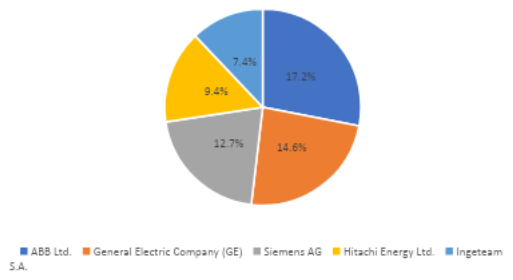
ABB Ltd., General Electric Company (GE), Siemens AG, Hitachi Energy Ltd., and Ingeteam S.A. are the key players in the STATCOM UPS Market
ABB Ltd.
ABB leads the STATCOM UPS (Static Synchronous Compensator Uninterruptible Power Supply) Market with a commanding 17.2% market share, underpinned by its long-standing expertise in power electronics, grid stability, and advanced reactive power solutions. The company’s STATCOM UPS systems are highly sought after in industries such as utilities, railways, renewable energy, and manufacturing, where voltage regulation, power factor correction, and grid reliability are critical.
General Electric Company (GE)
GE holds a substantial 14.6% share in the STATCOM UPS Market, offering high-performance systems designed to ensure grid stability and uninterrupted power quality in critical applications. Leveraging its deep-rooted capabilities in electrical engineering and grid solutions, GE provides STATCOM UPS units tailored for utility-scale energy systems, industrial automation, and mission-critical facilities. These systems are engineered to deliver fast dynamic reactive power support, voltage stabilization, and enhanced fault ride-through capabilities.
Siemens AG
Siemens captures a significant 12.7% market share in the STATCOM UPS segment, with solutions built around its robust SIPLINK and SVC PLUS platforms, designed for high-efficiency reactive power compensation and voltage support. Siemens’ systems are utilized across industrial grids, renewable energy plants, data centers, and transportation networks, providing stable power supply and improving system voltage during fluctuations or disturbances.
Hitachi Energy Ltd.
Hitachi Energy holds a 9.4% share in the STATCOM UPS Market, leveraging its hybrid approach that integrates power electronics and energy storage to enhance grid performance and stability. The company offers compact, high-speed STATCOM UPS solutions that cater to electric utilities, industrial operations, and high-voltage direct current (HVDC) systems, addressing the increasing need for real-time grid balancing, voltage compensation, and disturbance mitigation.
Ingeteam S.A.
Ingeteam SA accounts for 7.4% of the global STATCOM UPS Market, recognized for its specialized solutions in renewable energy systems, industrial facilities, and power quality management. The company’s STATCOM UPS offerings are built for versatility, efficiency, and compact design, making them ideal for installations where space constraints and fast dynamic response are essential. Ingeteam’s strength lies in its ability to customize solutions based on specific grid and load requirements, supported by advanced control electronics and firmware that optimize voltage stability.
Potential Threats to Top Five Players in the STATCOM UPS Market
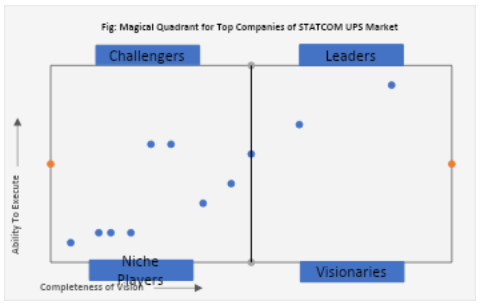
CMR identified several emerging players Hyosung Heavy Industries Corporation, NR Electric Co., Ltd., Mitsubishi Electric Corporation, Nidec Corporation, and Jema Energy S.A. that are positioning themselves as significant threats to the leading firms in the STATCOM UPS market. These companies are gaining momentum through innovation, technological capability, and expansion strategies, signaling a shift in the competitive landscape. Based in South Korea, Hyosung Heavy Industries Corporation offers advanced STATCOM solutions designed to enhance grid stability and reactive power compensation. With a strong emphasis on R&D and the integration of smart technologies, Hyosung is actively expanding its footprint in emerging markets across Asia and the Middle East. Their focus on modular, scalable STATCOM units positions them well to meet growing demand in both utility-scale and industrial applications. NR Electric Co., Ltd., headquartered in China, is gaining attention for its comprehensive range of power electronics and grid automation solutions, including STATCOM UPS systems. The company leverages its deep expertise in power system control and protection to deliver cost-effective, high-performance STATCOM products. NR Electric’s increasing presence in Southeast Asia, Africa, and South America is a direct challenge to incumbent players, especially in regions undergoing rapid grid modernization.
Mitsubishi Electric Corporation, a global leader in electrical and electronic equipment, has strategically diversified its energy systems portfolio to include advanced STATCOM UPS technologies. With a focus on energy efficiency, compact design, and system reliability, Mitsubishi Electric is targeting key markets in North America and Europe. Their reputation for quality and strong global service network enhances their competitiveness and positions them as a serious threat to established providers. Nidec Corporation, known for its motion control and energy solutions, has recently entered the STATCOM space with innovative products that combine voltage regulation and uninterruptible power supply functionalities. Their unique approach to integrating STATCOM within broader energy storage and power quality solutions makes them attractive to commercial and industrial customers seeking multifunctional systems. Spanish-based Jema Energy S.A. specializes in power conversion systems and is making inroads into the STATCOM UPS segment with compact, high-efficiency units tailored for renewable energy applications and smart grid systems. Their emphasis on customization, energy optimization, and sustainable designs allows them to serve niche markets and partner with local utilities and EPC contractors across Europe and Latin America. These emerging players are combining technological innovation, regional expansion, and cost-effective offerings to challenge traditional STATCOM UPS providers and disrupt the market dynamics.
Conclusion
Sustainable Innovation and Digital Optimization to Drive Growth in the STATCOM UPS Market
The global STATCOM UPS market is projected to grow significantly from USD 715.9 million in 2024 to USD 2,429.2 million by 2032, reflecting a strong CAGR of 16.50%. This surge is largely fueled by the growing need for voltage regulation, grid resilience, and backup support amid increasing renewable energy integration, electrification of industries, and digital transformation of energy infrastructure. As utilities and industries seek reliable power quality solutions, STATCOM UPS systems are becoming essential tools in maintaining grid stability and operational continuity. Leading companies such as ABB Ltd., Siemens AG, Schneider Electric SE, General Electric Company, and Eaton Corporation are shaping the market through continuous technological advancement, robust global networks, and a customer-centric approach. Their investments in intelligent STATCOM systems capable of real-time grid monitoring, energy optimization, and remote diagnostics underline their commitment to innovation and performance.
However, rising players such as Hyosung Heavy Industries, NR Electric, and Mitsubishi Electric are challenging this dominance by introducing disruptive technologies and expanding aggressively into underserved regions. These companies are leveraging scalable, digitally integrated STATCOM UPS solutions and sustainable practices to gain a competitive edge. For new entrants, success will depend on their ability to provide cost-effective, compact, and high-performance STATCOM UPS systems tailored for evolving grid demands. Targeting growth corridors in Asia-Pacific, Latin America, and Africa, focusing on digital control, and delivering environmentally friendly solutions will be key differentiators. As the STATCOM UPS market continues to evolve, collaboration between governments, energy developers, and innovative players will be crucial to achieving the broader goals of energy efficiency, grid modernization, and sustainability. With the right mix of innovation, market targeting, and strategic execution, both incumbents and newcomers can thrive in this rapidly expanding industry.
 X
X
Article Details
-
Author Sneha Mali
-
Published 22 May 2025
-
Last Updated 16 Jun 2025
-
Reading Time~3 minutes
Related Reports
Get a Custom Report
Interested in a similar analysis for your market? Our experts can deliver a customized report.
Contact Our ExpertsMore Articles
Explore all published articles across 30+ industry verticals.
View All Articles