
Article
Introduction to the Aircraft Battery Market
The global Aircraft Battery market is witnessing substantial momentum, driven by the ongoing electrification of aviation systems, advancements in battery technologies, and increasing adoption of electric and hybrid-electric aircraft. According to Cognitive Market Research, the market is valued at USD 412.9 million in 2024 and is projected to reach USD 1,194.5 million by 2032, expanding at a strong CAGR of 14.20%. Aircraft batteries are critical components for powering onboard systems, emergency backup, and propulsion in electric aviation platforms. The increasing shift toward more electric aircraft (MEA) architectures and the rising demand for lightweight, high-density energy storage solutions are fueling this market’s expansion across both commercial and defense sectors. As aircraft manufacturers look to reduce fuel dependency, carbon emissions, and maintenance costs, the integration of advanced battery systems is becoming increasingly essential. Lithium-based chemistries, especially lithium-ion and lithium-sulfur, are gaining prominence due to their superior energy-to-weight ratio, long lifecycle, and fast-charging capabilities. In the commercial aviation segment, the push for sustainable aviation and regional electric aircraft is creating new demand, while in military aviation, battery-powered systems offer enhanced operational flexibility and silent flight capabilities. North America and Europe are leading the development of electrified aircraft platforms, while Asia-Pacific countries are stepping up efforts to modernize their aviation infrastructure and support green aviation initiatives.
Top Companies Operating in the Aircraft Battery Industry Worldwide
- EnerSys
- Saft
- Concorde Batteries
- Teledyne Battery Products
- EaglePicher Technologies
- GS Yuasa Corporation
- Marathonnorco Aerospace
- Mid-Continent Instruments and Avionics
- True Blue Power
- Lithium Werks
Criteria for Comparing Companies in the Aircraft Battery Market
According to Cognitive Market Research, companies in the Aircraft Battery market are evaluated based on innovation in chemistry, safety compliance, energy density, lifecycle performance, and adaptability across diverse aircraft platforms. A major benchmark for comparison lies in battery efficiency and safety key parameters in aviation applications where performance reliability under extreme conditions is critical. Companies offering batteries that meet stringent aviation standards (such as DO-311A, DO-160, and FAA regulations) and provide proven resilience to temperature fluctuations, pressure variations, and vibration are gaining a competitive edge. Energy-to-weight ratio is a defining factor, as aircraft designers seek lightweight solutions without compromising power output. Players that excel in developing compact, lightweight battery modules with modular design options are better suited for evolving MEA and electric vertical take-off and landing (eVTOL) platforms. Integration capability with battery management systems (BMS), predictive diagnostics, and smart charging interfaces is also becoming vital in modern aircraft designs. Battery solutions that support redundancy, automatic fault detection, and minimal maintenance requirements are favored across commercial aviation, business jets, drones, and next-gen urban air mobility (UAM) vehicles.
Additionally, companies with robust R&D pipelines, vertically integrated manufacturing, and strong partnerships with aerospace OEMs and defense contractors stand out in this rapidly advancing market. Collaborations with aviation innovators such as Airbus, Boeing, Joby Aviation, or Embraer as well as certifications from aviation authorities, play a significant role in gaining market traction. Leading players such as EaglePicher Technologies, Saft (a subsidiary of TotalEnergies), Concorde Battery Corporation, GS Yuasa, and Teledyne Technologies are heavily investing in next-generation chemistries and hybrid energy systems to address the rising demand for longer flight endurance, reduced emissions, and enhanced operational safety.
Top Manufacturing Companies of Aircraft Battery:
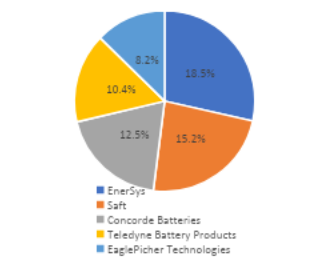
EnerSys, Saft, Concorde Batteries, Teledyne Battery Products, and EaglePicher Technologies are the key players in the Aircraft Battery Market
EnerSys
EnerSys leads the global Aircraft Battery Market with a notable 18.5% market share, driven by its extensive portfolio of advanced battery systems used in both commercial and military aircraft. The company’s offerings include nickel-cadmium (Ni-Cd) and valve-regulated lead-acid (VRLA) batteries, which are valued for their high reliability, energy density, and robust design under extreme operating conditions. In recent years, EnerSys has continued to strengthen its aerospace presence through technological enhancements and strategic supply contracts with major aircraft OEMs and defense agencies.
Saft
Saft, a subsidiary of TotalEnergies, follows with a significant 15.2% market share, securing its position as a key player in aviation and defense battery systems. Known for its high-performance lithium-ion and Ni-Cd batteries, Saft provides critical power solutions for main aircraft power, emergency systems, and auxiliary power units (APUs). Its batteries are widely adopted in commercial airliners, business jets, and rotary-wing aircraft, underscoring the brand’s credibility and technical depth.
Concorde Batteries commands a respectable 12.5% share of the aircraft battery market, recognized for its premium sealed lead-acid batteries used widely across general aviation, military, and commercial applications. The company has earned a reputation for manufacturing durable, low-maintenance batteries that meet stringent FAA and military specifications, making it a trusted supplier for operators requiring high reliability and quick replacement in mission-critical environments.
Teledyne Battery Products
Teledyne Battery Products holds a 10.4% market share, known for its Aero Battery line, which includes Ni-Cd and lead-acid batteries designed specifically for aerospace and defense platforms. As part of Teledyne Technologies, the division benefits from strong technological synergies and a commitment to precision engineering across its battery systems. These solutions are used in commercial transport, business jets, and UAVs, with customers valuing their performance in high-vibration, high-altitude environments.
EaglePicher Technologies
EaglePicher Technologies secures an 8.2% market share, recognized for its specialized battery solutions for aerospace and defense, including both primary and rechargeable systems. The company’s products are utilized in a range of platforms, from fighter jets and helicopters to space launch systems, highlighting its engineering expertise in mission-critical energy storage. EaglePicher is especially known for its custom-designed batteries that meet unique performance requirements in high-altitude and high-G-force conditions.
Potential Threats to Top Five Players in the Aircraft Battery Market
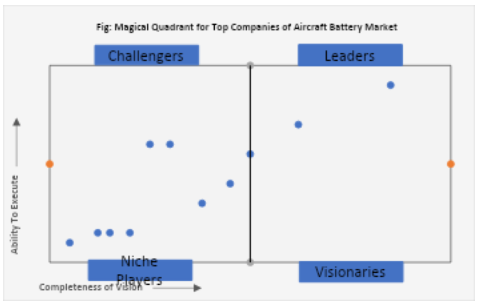
CMR identified a group of emerging companies in the aircraft battery market are GS Yuasa Corporation, Marathonnorco Aerospace, Mid-Continent Instruments and Avionics, True Blue Power, and Lithium Werks that are increasingly positioning themselves as competitive threats to traditional industry leaders. GS Yuasa Corporation, a Japan-based battery manufacturer, has expanded its presence in the aviation sector by offering high-performance lithium-ion batteries that cater to both commercial and military aircraft. The company’s extensive experience in energy storage technologies, combined with its strong focus on R&D, places it in direct competition with established aviation battery suppliers. With rising demand for lightweight, energy-dense battery systems to power electric and hybrid-electric aircraft, GS Yuasa’s technological capabilities are attracting global interest.
Marathonnorco Aerospace, headquartered in the United States, has carved out a reputation for delivering reliable and rugged batteries for defense and aerospace applications. The company’s specialization in both nickel-cadmium and sealed lead-acid battery systems, along with a growing emphasis on lithium-ion technologies, gives it a diverse product portfolio well-suited to modern aviation needs. Its longstanding relationships with major aerospace OEMs enhance its ability to win contracts and challenge larger incumbents. Meanwhile, Mid-Continent Instruments and Avionics, known for its innovative avionics and power solutions, has made significant inroads in battery development. Their True Blue Power division produces FAA-certified lithium-ion batteries known for high energy density, long life, and low maintenance requirements, capturing attention from both traditional aircraft manufacturers and emerging eVTOL developers. Additionally, Lithium Werks, with its expertise in lithium iron phosphate (LiFePO4) chemistry, offers a safer, thermally stable alternative for aerospace power systems. Their batteries are being increasingly considered for UAVs, UAM vehicles, and other next-gen aviation platforms where safety and cycle life are paramount. These companies are leveraging advancements in chemistry, safety systems, and certification compliance to disrupt the aircraft battery landscape. Through targeted innovations, strategic collaborations, and expanding international footprints, these emerging players are reshaping competitive dynamics and posing substantial threats to long-standing market leaders.
Conclusion
Investments in next-generation chemistries, compliance engineering, and strategic collaborations are criticElectric Aircraft Battery al to long-term growth in the Aircraft Battery Market
The global aircraft battery market is experiencing a pivotal transformation, driven by the aviation sector’s pursuit of decarbonization, electrification, and operational efficiency. As aircraft manufacturers explore cleaner propulsion systems and more energy-efficient avionics, demand for advanced batteries that offer high energy density, lightweight construction, and strong safety credentials continues to rise. Established players such as GS Yuasa Corporation, Marathonnorco Aerospace, and True Blue Power have built reputations on proven technologies and robust support infrastructure. However, the future of this market will be shaped by the ability to adapt quickly to emerging trends, particularly those centered around solid-state and lithium-sulfur chemistries. To stay ahead in this competitive and regulation-heavy market, both incumbents and new entrants must channel investments into next-generation materials science, fail-safe design engineering, and scalable manufacturing capabilities. Collaborations with aerospace OEMs, electric aircraft startups, and research institutions will be key to accelerating innovation while ensuring regulatory compliance. Furthermore, expanding global footprints through localized production and service partnerships can strengthen supply chain resilience and meet the increasing demand for electric aviation platforms. With the momentum building around sustainable air mobility, those companies that prioritize innovation, certifications, and customer-aligned solutions will be well-positioned to lead the next chapter of growth in the aircraft battery industry.

 X
X
Article Details
-
Author Anushka Gore
-
Published 21 May 2025
-
Last Updated 26 Jun 2025
-
Reading Time~3 minutes
Related Reports
Get a Custom Report
Interested in a similar analysis for your market? Our experts can deliver a customized report.
Contact Our ExpertsMore Articles
Explore all published articles across 30+ industry verticals.
View All Articles