Article
Strategic Analysis: Emerging Players and Disruptors in the Global Polymers Market
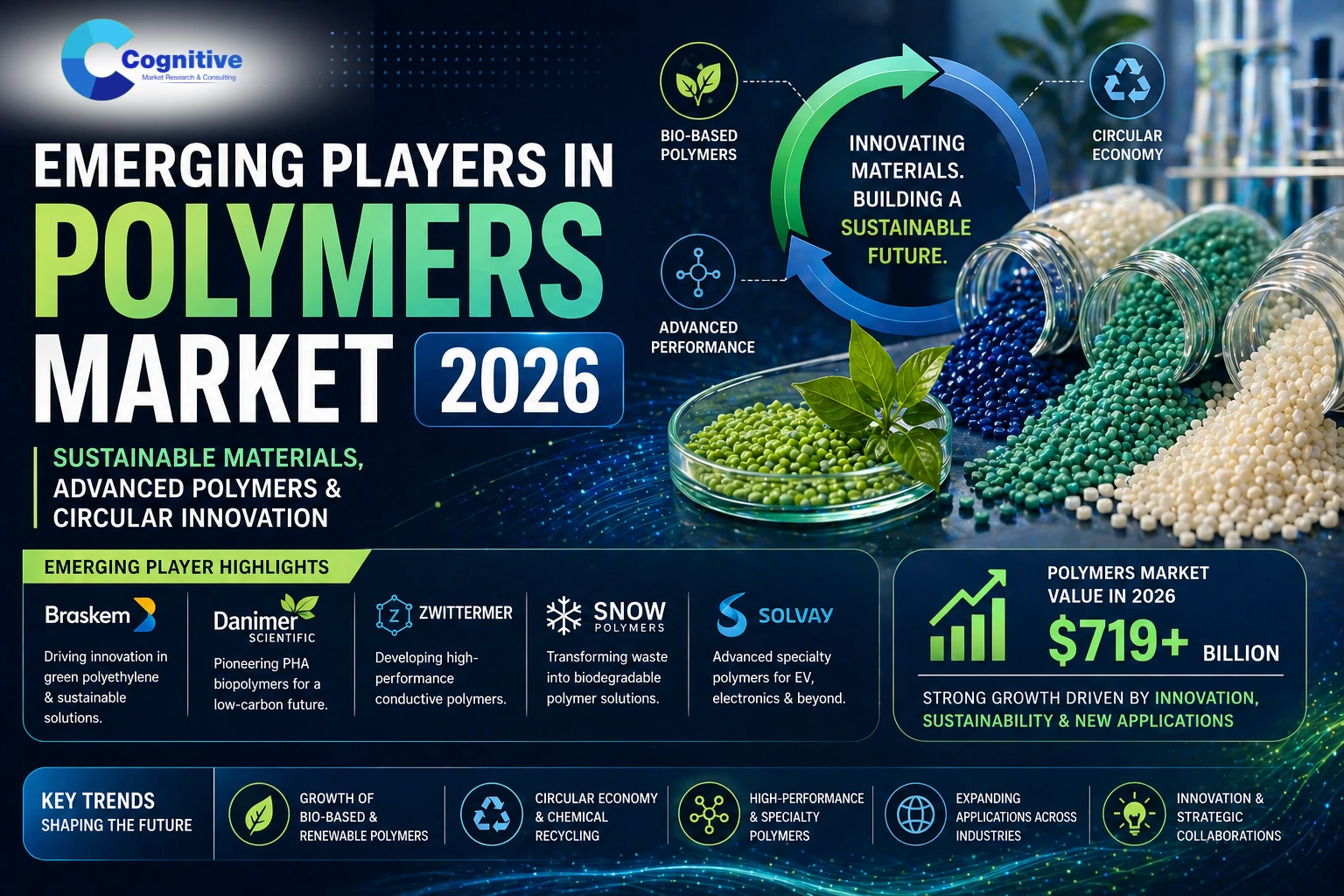
The global polymers market in 2026 is no longer defined solely by the volume of polyethylene (PE) or polypropylene (PP) produced. The narrative has shifted toward circularity and specialty performance. Valued at approximately USD 719.93 billion in 2026, the market is undergoing a structural recomposition.
While the Big Oil legacy players still dominate the volume, a new tier of emerging players is capturing the high-margin, high-growth segments. These disruptors are winning contracts by solving the three major headaches for 2026 manufacturers: stringent ESG regulations (like the EU's 95 g/km emission standards), the need for high-performance thermal management in EV batteries, and the transition toward chemical recycling.
1. The Bio-Polymer and Renewable Feedstock Pioneers
In 2026, bio-based has moved from a marketing buzzword to a procurement requirement. The emerging players in this space are those who have successfully moved beyond pilot plants into industrial-scale production.
1.1 Braskem S.A. and the I’m green Evolution
While Braskem is an established giant, their 2026 position is that of an emerging leader in the bio-based ecosystem. They have aggressively expanded their bio-ethylene capacity, catering specifically to European and North American OEMs who are under pressure to de-fossilize their supply chains. Their I’m green polyethylene is now a benchmark for manufacturers looking for a drop-in replacement that doesn't require re-tooling.
1.2 Danimer Scientific and PHA Scalability
Danimer has emerged as the 2026 specialist in Polyhydroxyalkanoates (PHA). Unlike PLA, which often requires industrial composting, Danimer’s PHA solutions are marine-biodegradable. For B2B clients in the packaging and consumer goods sectors, Danimer represents a safety net against increasingly aggressive global plastic waste legislation. Their 2026 strategy focuses on Nodax PHA blends that provide the heat resistance previously lacking in biopolymers.
1.3 Avantium and the PEF Breakthrough
Based in the Netherlands, Avantium has become the 2026 player to watch in the high-performance barrier packaging segment. Their 100% plant-based Polyethylene Furanoate (PEF) is outperforming traditional PET in CO2 and oxygen barrier properties. For manufacturers of beverage and electronic components, Avantium offers a way to reduce wall thickness (saving material) while improving shelf-life and sustainability metrics.
Section 2: Speciality Players in EV and Thermal Management
The electrification of the global fleet has created a vacuum for polymers that can handle high-voltage environments and extreme thermal cycling. The emerging winners in 2026 are those who have mastered E-Specialties.
2.1 Solvay S.A.: The PEEK and PEI Authority
Solvay has repositioned itself in 2026 as the primary architect of the EV powertrain's plastic components. Their focus on Polyether Ether Ketone (PEEK) and Polyetherimide (PEI) allows manufacturers to replace heavy metal housings in electric motors. In 2026, Solvay’s Amodel PPA is the industry standard for high-voltage battery connectors, offering a blend of dielectric strength and flame retardancy that traditional nylon simply cannot match.
2.2 Arkema S.A. and Bio-PA11
Arkema is winning the 2026 battle for the sustainable EV. Their Rilsan PA11 derived from castor oil is being used by premium EV manufacturers for cooling lines and battery busbar insulation. By 2026, Arkema has successfully marketed this as the only high-performance bio-nylon that meets the rigorous safety standards of the automotive industry, effectively carving out a monopoly in the Green-Tech high-performance niche.
2.3 Celanese Corporation and Modular Thermoplastics
Celanese has emerged in 2026 as a master of the System-Level supply. Instead of just selling POM (Polyoxymethylene), they are selling integrated structural modules. Their 2026 R&D is focused on Overmolding technologies where they combine high-strength polymers with sensors directly in the manufacturing process, catering to the growing Software-Defined Vehicle market.
Section 3: The Chemical Recycling and Circularity Disruptors
By 2026, mechanical recycling is no longer enough to meet OEM requirements for virgin-quality recycled content. This has allowed a new class of Chemical Recycling Specialists to become essential B2B partners.
3.1 Mura Technology and Hydro-PRT
In partnership with Dow, Mura Technology has become a critical player in 2026. Their Hydro-PRT (Hydrothermal Plastic Recycling Technology) can process multi-layer flexible films the unrecyclables of 2020. For manufacturers, Mura is the key to unlocking Food-Grade Recycled Content, allowing brands to hit their 2030 sustainability goals ahead of schedule.
3.2 Agilyx and Polystyrene Circularity
Agilyx has successfully dominated the circularity of Polystyrene (PS) in 2026. By breaking PS back down into its original styrene monomer, they provide manufacturers with a material that is indistinguishable from fossil-fuel-based PS. This has revitalized the PS market, which many thought would be legislated out of existence by 2025.
3.3 Carbios and Enzymatic Recycling
The French firm Carbios has disrupted the textile and PET markets in 2026 with their enzymatic depolymerization technology. They have moved from lab-scale to high-volume B2B supply, allowing manufacturers to create Infinite PET. For the 2026 textile industry, Carbios is the primary reason that Fiber-to-Fiber recycling has finally become economically viable.
Section 4: Regional Emerging Powerhouses (APAC & India)
The geographical center of polymer innovation has shifted toward the East in 2026, with Indian and Chinese firms moving from volume producers to tech innovators.
4.1 Reliance Industries Limited (India)
Reliance is no longer just a regional player. In 2026, they have emerged as a global leader in Integrated Circularity. Their massive investment in pyrolysis and chemical recycling at the Jamnagar site has made them one of the world's largest suppliers of Circular Polymers. For global manufacturers, Reliance offers a one-stop-shop for both high-volume feedstock and specialized sustainable grades.
4.2 LG Chem (South Korea)
LG Chem has used 2026 to cement its position as the polymer partner for the electronics industry. Their Bio-balanced ABS and PC (Polycarbonate) are the go-to materials for the 2026 consumer electronics market. They have successfully leveraged their battery division to create a unique Battery-Polymer Synergy, where they develop specialized casing materials specifically for their own cells, then sell that expertise to other OEMs.
Section 5: The Rise of Smart and Functional Polymers
2026 marks the entry of polymers that do things. These are no longer passive materials but active components of the product design.
5.1 Evonik and 3D Printing Specialty Grades
Evonik has become the 2026 leader in Additive Manufacturing Polymers. Their VESTOSINT and INFINAM powders are now used for end-use industrial parts, not just prototypes. For manufacturers, Evonik represents the move toward On-Demand Polymer Parts, reducing the need for massive inventory and long supply chains.
5.2 Milliken & Company and the Efficiency Additive
Milliken is the 2026 player that makes everyone else’s polymers better. Their Millad ClearX 9000 clarifiers and Hyperform HPN nucleating agents are essential for manufacturers who need to speed up cycle times and reduce energy consumption. In a year where energy costs are a top-three concern for every factory manager, Milliken’s ability to reduce processing temperatures by 10-15% has made them an indispensable B2B partner.
Section 6: Strategic Recommendations for B2B Stakeholders
6.1 Move Toward Material Agility
In 2026, your production lines must be capable of handling varying grades of recycled content. The emerging players mentioned above provide Circular-Ready materials, but manufacturers must invest in advanced sensors and AI-driven processing controls to handle the slight variations in these new-age feedstocks.
6.2 Prioritize Life Cycle Assessment (LCA) Transparency
The emerging winners of 2026 all share one trait: they provide data. If a polymer supplier cannot provide a certified, blockchain-tracked LCA for every batch, they will not be considered for OEM contracts. Manufacturers should prioritize partnerships with players who offer Digital Material Passports.
6.3 Focus on End-of-Life Design
Stop selecting polymers based only on their performance during the vehicle's life. 2026 regulations require that you design for what happens after the vehicle is scrapped. Partnering with companies like Agilyx or Mura ensures that your products are built to be reborn, securing your brand's regulatory compliance.
Section 7: Conclusion
The polymer market of 2026 is a bifurcated world. On one side, we have the commodity squeeze, where traditional producers are fighting over shrinking margins. On the other, we have the Specialty Surge, where players like Solvay, Avantium, and Mura are defining the future of manufacturing.
For our clients at Cognitive Market Research, the message is clear: the most dangerous thing you can do in 2026 is stay loyal to a standard polymer. The winners of this decade will be the manufacturers who align themselves with these emerging disruptors players who understand that a polymer's value is now measured in carbon saved and functionality gained.

 X
X
Article Details
-
Author Akash Das
-
Published 20 Apr 2026
-
Last Updated 29 Apr 2026
-
Reading Time~3 minutes
Get a Custom Report
Interested in a similar analysis for your market? Our experts can deliver a customized report.
Contact Our ExpertsMore Articles
Explore all published articles across 30+ industry verticals.
View All Articles