Article
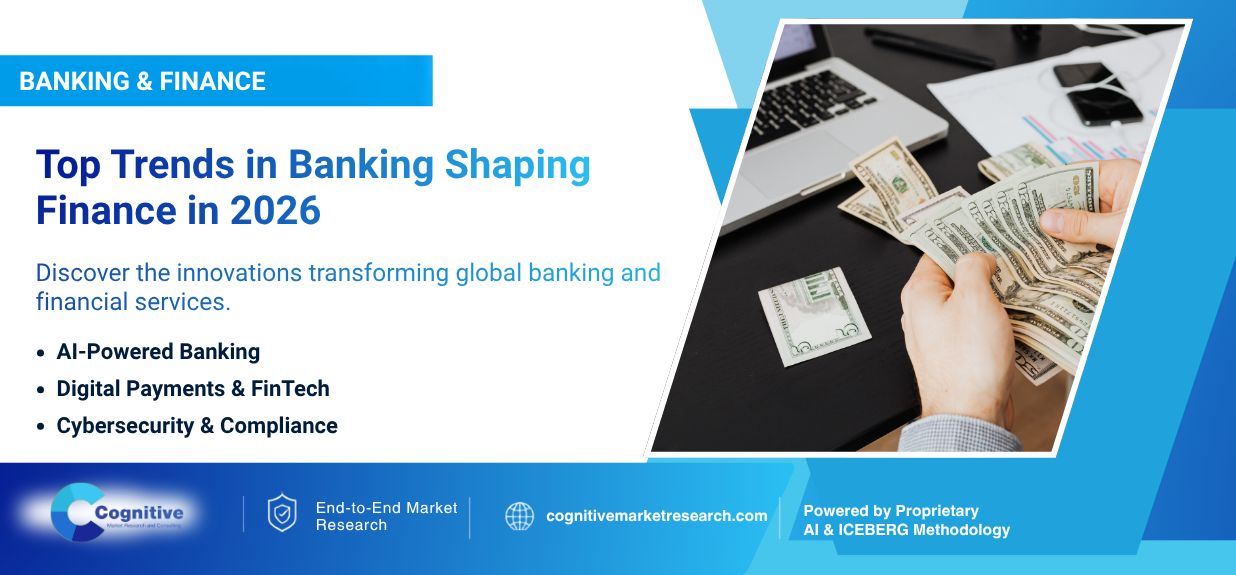
Top 5 Trends in Banking Shaping the Future of Financial Ecosystems: What Leaders and Professionals Must Know
Introduction: Why the Financial Landscape is Rapidly Evolving
The international financial architecture is undergoing an extraordinary era of technological disruption and structural realignment. Modern banking institutions, fintech collaborators, and regulatory bodies are navigating a complex landscape where legacy system modernizations converge with data-driven artificial intelligence systems. For students entering the workforce, corporate decision-makers, and seasoned banking professionals, understanding these shifts is no longer optional it is a core survival requirement.
Moving past surface-level corporate summaries requires objective, data-driven transparency to understand how modern capital allocation and customer expectations are shifting. Recent primary studies and market intelligence frameworks compiled by Cognitive Market Research and Consulting highlight that the global banking market has scaled significantly, touching monumental valuations as non-discretionary corporate investments flow into core system upgrades and automated financial channels.
What Are the Top 5 Trends in Banking Transforming Global Markets?
Our comprehensive analysis of contemporary financial data reveals a rapidly maturing banking ecosystem defined by five foundational pillars. Financial organizations are moving from experimental digital applications to deeply embedded technological frameworks that prioritize speed, hyper-personalization, and secure cloud integration.
1. Generative AI and Automated Decision Intelligence
Artificial intelligence has evolved past basic customer service chatbots into sophisticated cognitive engines capable of real-time credit risk modeling, automated fraud detection, and tailored wealth management advice.
Leading financial institutions leverage advanced machine learning models to analyze unstructured data streams, dramatically reducing operational friction while protecting capital assets against sophisticated cyber threats.
2. Banking-as-a-Service (BaaS) and Embedded Finance
Non-financial corporations ranging from e-commerce giants to software-as-a-service (SaaS) platforms are seamlessly integrating financial products directly into their user interfaces via robust API connections.
This shift allows retail customers and small-to-medium enterprises (SMEs) to access lending, payment processing, and digital wallets without interacting with a traditional bank branch.
3. Open Banking Mandates and Cross-Border Interoperability
Regulatory frameworks across North America, Europe, and Asia-Pacific continue to mandate secure data-sharing protocols. Open banking frameworks empower consumers to securely share their financial data with authorized third-party providers.
This creates a highly competitive marketplace characterized by innovative budgeting tools, instant account switching, and streamlined cross-border settlements that reduce transaction friction.
4. Tokenization and Digital Assets Integration
The rise of stablecoins, central bank digital currencies (CBDCs), and tokenized real-world assets (RWAs) is redefining monetary sovereignty and asset transfer speeds.
Traditional financial institutions are moving from cautious observers to active orchestrators, embedding tokenized deposits into cross-border trade finance pipelines.
Example: Corporate treasuries use tokenized commercial paper to execute instant, 24/7 multi-currency settlements globally.
5. Hyper-Personalization and Relationship-Driven Digital Experiences
Digital banking is shifting away from purely transactional efficiency toward holistic, advisory-first digital ecosystems.
Banks utilize real-time behavioral analytics to anticipate client liquidity needs, transforming mobile banking apps into proactive financial advisors.
Macroeconomic Expansion and Regional Market Dynamics
When evaluating the primary growth drivers behind modern trends in banking, macro-indicators display remarkable resilience across diverse geographical corridors. Global banking and financial services valuations continue to surge, driven by expanding middle-class populations, rapid smartphone adoption, and digital payment frameworks.
- North America: Commands a dominant share of absolute market value, anchored by ultra-dense capital markets and early institutional adoption of generative AI financial workflows.
- Asia-Pacific: Represents the fastest-growing geographical region, propelled by rapid urbanization, massive smartphone penetration, and government-backed financial inclusion initiatives in economies like India and China.
- Europe: Focuses heavily on strict regulatory compliance, open banking mandates, green bond issuance, and sustainable corporate loan financing.
This steady market progress is continuously supported by falling data storage costs, zero-trust cloud security architectures, and a growing consumer preference for friction-free, mobile-first banking experiences.
Risk Mitigation, Compliance, and Enterprise Resilience
As digital touchpoints multiply, risk management remains a paramount priority for banking executives. Cyber threats, complex multi-party BaaS architectures, and volatile cross-border regulatory requirements demand continuous capital outlays.
Institutions deploying advanced digital inventory twins, automated compliance checking tools, and decentralized ledger verification systems successfully minimize regulatory friction. By fortifying operational resilience, banks protect their equity against market volatility while maintaining the high levels of consumer trust required for long-term enterprise value creation.
How Cognitive Market Research Helps Enterprises Navigate Banking Trends
Navigating the complexities of modern financial markets requires granular, verified intelligence rather than generalized assumptions. Cognitive Market Research and Consulting bridges the intent-action gap through specialized analytical frameworks:
- Multi-Vector Data Triangulation: Cross-referencing regional consumer sentiment, regulatory updates, and macroeconomic forecasts to de-risk capital deployment.
- Behavioral Analytics & Custom Surveys: Uncovering the psychological and operational drivers behind digital adoption among retail and commercial bank customers.
- Strategic Growth Roadmaps: Equipping financial institutions, technology vendors, and fintech startups with actionable insights on emerging revenue pools and competitive positioning.
Tailored Problem Solving: If your institution is struggling with customer churn in digital channels or trying to optimize open banking API monetization, Cognitive Market Research provides customized market intelligence reports that pinpoint exact growth vectors, regulatory hurdles, and competitor vulnerabilities.
Conclusion: The Strategic Outlook for Financial Institutions
True leadership in the contemporary banking sector depends on how effectively an institution adapts its technological architecture to match evolving consumer demands and regulatory standards. Whether prioritizing AI-driven fraud prevention, expanding embedded finance partnerships, or scaling green lending portfolios, banks that embrace digital agility will secure a commanding competitive advantage.

 X
X
Article Details
-
Author Sumedha Gosavi
-
Published 28 Jul 2026
-
Last Updated 29 Jul 2026
-
Reading Time~3 minutes
Related Reports
Get a Custom Report
Interested in a similar analysis for your market? Our experts can deliver a customized report.
Contact Our ExpertsMore Articles
Explore all published articles across 30+ industry verticals.
View All Articles