Article
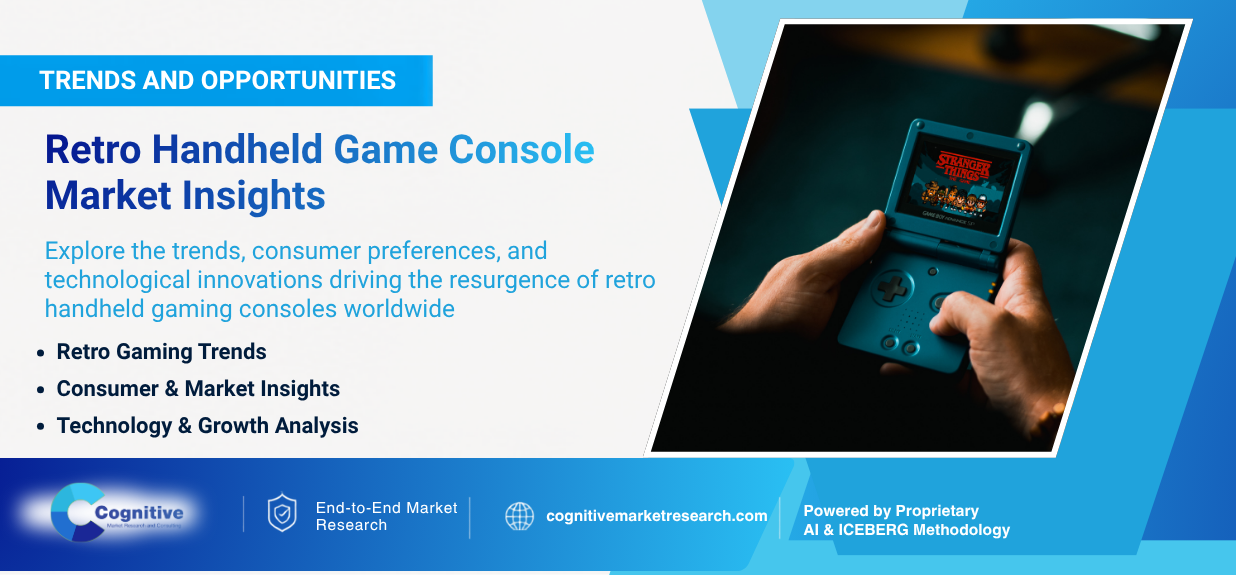
Reviving the Past, Powering the Present: The Booming Retro and Handheld Game Console Market
Nostalgia is a powerful economic catalyst. In an era dominated by hyper-realistic graphics, cloud streaming, and complex live-service ecosystems, millions of gamers are looking backward. They are trading massive 4K home rigs for pocket-sized plastic devices pre-loaded with 8-bit, 16-bit, and 32-bit classics.
Simultaneously, the demand for high-performance handheld game consolesmmranging from modern emulation handhelds to dedicated gaming PCs has exploded into a multi-billion-dollar juggernaut. For manufacturers, distributors, software developers, and investors, navigating this vibrant intersection of retro nostalgia and modern portable engineering requires more than guesswork. It demands rigorous, decision-grade market intelligence.
-
The Renaissance of Retro: Why Nostalgia is Big Business
The modern consumer is perpetually connected, bombarded by notifications, and fatigued by subscription-based live-service games that demand endless time commitments. In response, a massive counter-movement has taken root: the rush toward retro gaming.
The retro game console market valued at over $4 billion globally is expanding at a compound annual growth rate (CAGR) that significantly outpaces traditional home console sectors. Adults born in the 1970s, 1980s, and 1990s are driving a massive wave of demand for devices that replicate the tactile joy of their childhoods. For these consumers, a handheld game console is not just a toy; it is an accessible, friction-free tool for relaxation and mental decompression away from work computers and smartphones.
-
Anatomy of the Handheld Boom: Technology Meets Portability
The modern handheld market has evolved far beyond the bulky arcade cabinets or primitive monochrome screens of the past. Today’s portable gaming ecosystem is characterized by breathtaking engineering convergence.
Using advanced open-source Linux systems, Android-based emulation, and high-definition IPS touchscreens, manufacturers are packing thousands of classic 16-bit and 32-bit titles into devices no larger than a smartphone. Features like anti-slip cross keys, ergonomic vertical and horizontal form factors, and modular custom software libraries ensure that hardware manufacturers can iterate rapidly to match changing consumer tastes—whether a buyer wants a classic Game Boy aesthetic or a high-performance modern gaming handheld.
-
B2B Market Dynamics: Manufacturing and Sourcing Realities
For B2B buyers, importers, and original equipment manufacturers (OEMs), the handheld and retro console sector presents incredible profit margins, but also distinct operational hurdles. Component sourcing such as securing reliable lithium-ion batteries, premium display panels, and precision controllers requires strict quality control. Furthermore, navigating software licensing, firmware optimization, and regional distribution networks demands deep supply chain visibility. Companies entering this space cannot afford to rely on surface-level assumptions or generalized public reports.
-
Mitigating Enterprise Risk: Why Off-the-Shelf Data Isn't Enough
When leadership teams evaluate a capital expenditure or a major product launch in the consumer electronics and gaming space, generalized market reports often leave dangerous blind spots.
Advisory institutions frequently highlight critical risk vectors such as Irreversible Capital Commitments, Operating History Deficits, and Shadow Competitor Dynamics. Committing thousands or millions of dollars to manufacturing or importing a new line of handheld consoles without granular, verified data can lead to margin erosion and costly product recalls. This is where customized, decision-grade intelligence becomes non-negotiable.
Why Choose Cognitive Market Research for Your Gaming Industry Strategy?
At Cognitive Market Research and Consulting, we transform complex market noise into actionable strategic clarity. Our dedicated research frameworks combine deep consumer sentiment analysis, competitive benchmarking, and supply chain auditing. We do not just hand you raw numbers; we interpret what shifting consumer desires mean for your product roadmap, pricing strategy, and brand positioning. By partnering with Cognitive Market Research, executive leadership teams equip themselves with the precise intelligence required to de-risk high-stakes decisions and capture dominant market share.
 X
X
Article Details
-
Author Anushka Gore
-
Published 20 Jul 2026
-
Last Updated 21 Jul 2026
-
Reading Time~3 minutes
Related Reports
Get a Custom Report
Interested in a similar analysis for your market? Our experts can deliver a customized report.
Contact Our ExpertsMore Articles
Explore all published articles across 30+ industry verticals.
View All Articles