Article
Non-Invasive Devices: Understanding Their Reliability, Applications and Market Potential
Healthcare is increasingly moving toward technologies that can deliver useful clinical information while minimizing discomfort, procedural risk, and recovery time. Non-invasive devices have become an important part of this transformation, supporting diagnosis, monitoring, measurement, and patient management without requiring instruments to penetrate the body.
For patients, the appeal is straightforward: greater comfort and reduced procedural burden. For healthcare providers, these technologies can support efficient monitoring and potentially improve the patient experience. For manufacturers, the growing interest in non-invasive devices creates opportunities to develop technologies that combine accuracy, usability, connectivity, and safety.
Meaning of Non-Invasive Devices
Non-invasive devices are medical or healthcare technologies designed to assess, monitor, diagnose, or support patients without physically entering the body or breaking the skin.
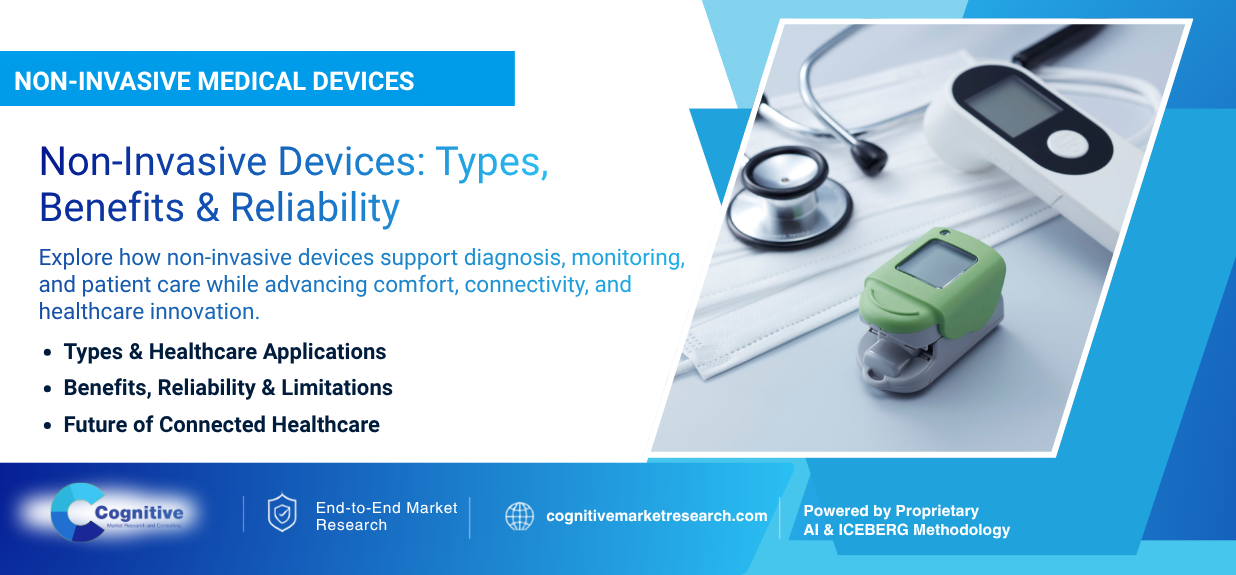
Examples include blood pressure monitors, pulse oximeters, wearable health trackers, external ultrasound systems, thermometers, electrocardiography equipment, and certain optical monitoring technologies. Depending on their intended use, these devices can measure physiological parameters such as heart rate, oxygen saturation, temperature, blood pressure, electrical activity, or other biological signals.
The fundamental principle behind non-invasive devices is to obtain meaningful information externally. Technologies such as optical sensors, ultrasound, electrical signal detection, imaging, and other sensing methods allow manufacturers to develop solutions for different healthcare applications.
How Do Non-Invasive Devices Work?
The technology behind non-invasive devices varies significantly according to the parameter being measured.
Optical devices may use light to detect changes associated with blood flow or tissue characteristics. Electrical sensors can capture physiological signals from the body's surface. Ultrasound systems use sound waves to generate information about internal structures without surgical access.
Wearable devices represent another important category. Sensors positioned on the skin can continuously or periodically collect physiological information and transmit it to connected applications or healthcare platforms.
The increasing integration of sensors, wireless connectivity, artificial intelligence, and data analytics is also expanding the capabilities of non-invasive medical devices. Manufacturers are therefore moving beyond simple measurement toward continuous monitoring and connected healthcare ecosystems.
Are Non-Invasive Devices Reliable?
One of the most important questions surrounding non-invasive devices is reliability.
The answer depends on the specific device, intended application, technology, design, validation, and conditions in which it is used. A non-invasive device should not automatically be considered less reliable simply because it does not enter the body. However, accuracy can be affected by factors such as sensor placement, movement, environmental conditions, patient characteristics, calibration, and device design.
For manufacturers, reliability must therefore be addressed during product development rather than treated as a marketing feature. Appropriate testing, validation, quality management, usability assessment, and regulatory compliance are essential for technologies intended for healthcare applications.
For users, it is equally important to understand the intended purpose of a device. A consumer wellness wearable, for example, may serve a different purpose from a clinically validated diagnostic device.
Non-Invasive Devices Uses
The applications of non-invasive devices extend across multiple areas of healthcare. Patient monitoring is one of the most significant applications, where external sensors can help healthcare professionals observe physiological parameters. Diagnostic applications are also important. External imaging and sensing technologies can provide clinicians with information that supports clinical assessment without requiring an invasive procedure. Home healthcare is another growing area. Connected non-invasive devices can enable patients to monitor selected health parameters outside traditional clinical environments. This supports the broader development of remote patient monitoring and decentralized healthcare models. technology is further expanding the potential application base. Devices capable of collecting physiological information over longer periods can contribute to preventive health, wellness monitoring, and selected clinical workflows.
Non-Invasive Devices Importance for Manufacturers
For medical device manufacturers, developing non-invasive devices involves more than creating a technically functional product. Manufacturers must balance accuracy, patient safety, usability, production costs, connectivity, regulatory requirements, and market demand. User expectations are also changing. Patients increasingly value convenient healthcare technologies that are comfortable and easy to operate. Healthcare organizations, meanwhile, may prioritize reliability, interoperability, data security, workflow integration, and total cost of ownership. This creates opportunities for manufacturers that can identify unmet needs and translate them into commercially viable products. Market research can help manufacturers evaluate customer requirements, competitive positioning, technology adoption, pricing considerations, application opportunities, and regional demand before making significant investments.
Benefits and Limitations of Non-Invasive Devices
The major advantage of non-invasive devices is their ability to collect health-related information without requiring penetration of the body. This can improve user comfort and make repeated or continuous monitoring more practical. Other potential advantages include easier patient acceptance, suitability for home-based monitoring, reduced procedural burden, and opportunities for connected healthcare applications.
However, non-invasive devices also have limitations. Certain measurements may be more difficult to obtain externally than through invasive techniques. Accuracy can vary depending on technology and operating conditions, while some devices require careful calibration and correct positioning. Therefore, the appropriate technology depends on the clinical or user requirement rather than simply choosing the least invasive option.
The Future of Non-Invasive Devices
The future of non-invasive devices is closely connected with advancements in sensor technology, artificial intelligence, miniaturization, wearable electronics, remote monitoring, and connected healthcare. Manufacturers are increasingly exploring technologies capable of collecting more information while becoming smaller, easier to use, and more connected. AI-based analytics may further help transform raw sensor information into useful insights, although the clinical value of such systems depends on appropriate validation and application. From a market perspective, manufacturers that understand both technological capabilities and user needs will be better positioned to identify sustainable opportunities in the evolving healthcare landscape.
Conclusion
Non-invasive devices are becoming increasingly important because they provide ways to monitor, measure, and support healthcare without requiring direct entry into the body. Their reliability depends on the technology, intended use, validation, operating conditions, and quality of the device rather than simply on whether the device is invasive or non-invasive.
For users, understanding the capabilities and limitations of each technology is essential. For manufacturers, the opportunity lies in developing solutions that combine accuracy, safety, usability, connectivity, and commercially relevant applications.
Cognitive Market Research & Consulting can help organizations evaluate market dynamics, customer requirements, competitive landscapes, technology trends, and growth opportunities associated with emerging healthcare technologies and non-invasive devices.

 X
X
Article Details
-
Author Supriya Yadav
-
Published 04 Sep 2026
-
Last Updated 08 Sep 2026
-
Reading Time~3 minutes
Related Reports
Get a Custom Report
Interested in a similar analysis for your market? Our experts can deliver a customized report.
Contact Our ExpertsMore Articles
Explore all published articles across 30+ industry verticals.
View All Articles