We value your privacy
We use cookies to improve your experience and analyze traffic. By continuing, you consent to our use of cookies under GDPR, CCPA and other applicable laws. Privacy Policy
Cookie preferences
Choose which categories of cookies you allow. Strictly necessary cookies are always on.
Strictly necessary
Required for core site functionality, security and your session. Always active.
Analytics
Help us understand how visitors use the site (e.g. Google Analytics) so we can improve it.
Marketing
Used to measure campaigns and show you relevant ads on other sites (e.g. LinkedIn, Google Ads).
Pet Food Packaging Market Analysis size 2021 was recorded $10428.5 Million whereas by the end of 2026 it will reach $13772.37 Million. According to the author, by 2033 Pet Food Packaging market size will become $20328.5 Million. Pet Food Packaging market will be growing at a CAGR of 5.697% during 2026 to 2033. Download a free sample with data verified by Chidanand Bilagi
Pet Food Packaging Market Analysis from 2022 to 2034 Containing Market Size, Share along with its CAGR, Forecast and Trends
Top Countries — Revenue
Million
Market Dynamics of Pet Food Packaging Market Analysis
Growth Drivers
Growth in Global Pet Ownership and Spending
Premiumization of Pet Food
Demand for Convenience and Portion Control
Restraints
The High Cost of Sustainable Materials
Stringent Food Safety and Barrier Requirements
Intense Cost Pressure from Pet Food Manufacturers
Trends
The Push for Recyclable and Sustainable Solutions
Shift to High-Value Flexible Packaging Formats
Growth of E-commerce and Direct-to-Consumer (D2C) Channels
Access the full forecast model.
Country-level data · Company profiles · Editable dataset · Analyst consultation included.
Pet Food Packaging Market Analysis — Presence
Geographical Analysis
Click countries to explore
Loading map…
Regional and Country Analysis
Global Pet Food Packaging Market Analysis 2026
Country-level values are locked in this preview.
Request a free sample
to unlock the full breakdown.
Region / Country
2021 (A)
2025 (A)
2033 (P)
CAGR
Global
$ 10428.5 Million
$ 13027.1 Million
$ 20328.5 Million
5.72%
North America
$ 2934.57 Million
$ 3738.78 Million
$ 5950.16 Million
5.98%
United States
$ 2183.61 Million
$ 2837.74 Million
$ 4604.23 Million
6.236%
Canada
$ 280.25 Million
$ 362.29 Million
$ 585.5 Million
6.184%
Mexico
$ 470.71 Million
$ 538.76 Million
$ 760.43 Million
4.402%
Europe
$ 2005.39 Million
$ 2567.65 Million
$ 4104.33 Million
6.038%
United Kingdom
$ 151.61 Million
$ 197.97 Million
$ 322.6 Million
6.294%
France
$ 256.69 Million
$ 322.5 Million
$ 505.65 Million
5.783%
Germany
$ 190.91 Million
$ 242.13 Million
$ 382.93 Million
5.897%
Italy
$ 128.15 Million
$ 167.41 Million
$ 272.94 Million
6.3%
Russia
$ 239.44 Million
$ 314.28 Million
$ 514.68 Million
6.36%
Spain
$ 120.12 Million
$ 152.26 Million
$ 240.92 Million
5.904%
Sweden
$ 101.67 Million
$ 126.84 Million
$ 197.42 Million
5.686%
Denmark
$ 40.91 Million
$ 51.35 Million
$ 80.03 Million
5.703%
Switzerland
$ 106.29 Million
$ 134.55 Million
$ 213.02 Million
5.911%
Luxembourg
$ 21.46 Million
$ 27.99 Million
$ 45.56 Million
6.28%
Rest of Europe
$ 648.14 Million
$ 830.38 Million
$ 1328.57 Million
6.051%
Asia Pacific
$ 2204.57 Million
$ 2739.6 Million
$ 4254.76 Million
5.657%
China
$ 481.92 Million
$ 586.82 Million
$ 893.07 Million
5.39%
Japan
$ 485.89 Million
$ 621.89 Million
$ 993.91 Million
6.036%
South Korea
$ 92.81 Million
$ 112.32 Million
$ 170.19 Million
5.331%
India
$ 258.6 Million
$ 319.71 Million
$ 493.98 Million
5.589%
Australia
$ 88.18 Million
$ 107.94 Million
$ 165.09 Million
5.455%
Singapore
$ 117.5 Million
$ 146.84 Million
$ 228.91 Million
5.706%
Taiwan
$ 89.29 Million
$ 115.34 Million
$ 183.81 Million
5.998%
South East Asia
$ 132.5 Million
$ 163.83 Million
$ 253.16 Million
5.591%
Rest of APAC
xxxx
xxxx
xxxx
xxxx
South America
$ 766.49 Million
$ 934.05 Million
$ 1418.93 Million
5.366%
Brazil
$ 279.54 Million
$ 337.19 Million
$ 507.13 Million
5.234%
Argentina
$ 122.26 Million
$ 149.63 Million
$ 228.45 Million
5.431%
Colombia
$ 82.93 Million
$ 99.01 Million
$ 147.43 Million
5.102%
Peru
$ 31.96 Million
$ 37.74 Million
$ 55.62 Million
4.969%
Chile
$ 16.71 Million
$ 19.71 Million
$ 29.09 Million
4.986%
Rest of South America
$ 233.09 Million
$ 290.77 Million
$ 451.22 Million
5.647%
Middle East
$ 649.69 Million
$ 792.05 Million
$ 1203.45 Million
5.368%
Saudi Arabia
$ 191.98 Million
$ 227 Million
$ 334.32 Million
4.958%
Turkey
$ 98.95 Million
$ 122.37 Million
$ 188.7 Million
5.563%
UAE
$ 62.05 Million
$ 75.25 Million
$ 113.73 Million
5.299%
Egypt
$ 28.07 Million
$ 33.19 Million
$ 48.86 Million
4.954%
Qatar
$ 27.55 Million
$ 34.53 Million
$ 54.04 Million
5.756%
Rest of Middle East
$ 241.1 Million
$ 299.71 Million
$ 463.81 Million
5.61%
Africa
$ 1867.74 Million
$ 2255 Million
$ 3396.9 Million
5.255%
East Africa
xxxx
xxxx
xxxx
xxxx
West Africa
xxxx
xxxx
xxxx
xxxx
North Africa
xxxx
xxxx
xxxx
xxxx
South Africa
$ 537.53 Million
$ 651.47 Million
$ 985.1 Million
5.305%
The global pet food packaging market is on a robust growth path, driven by a confluence of factors including rising pet ownership, increased spending on pet care, and the demand for innovative packaging solutions. The market is characterized by a dynamic interplay of evolving consumer preferences, technological advancements, and a growing regulatory focus on sustainability and food safety. As pet owners become more discerning, packaging plays a crucial role in brand differentiation, product integrity, and communicating value, making it a pivotal component of the overall pet food industry.
Global Pet Food Packaging Market Drivers
Increasing Pet Humanization and Premiumization: As pet owners increasingly view their pets as family members, they are willing to spend more on high-quality, premium pet food. This trend directly translates to a demand for advanced packaging that preserves freshness, offers convenience, and has a premium look and feel, thereby driving market growth.
Surge in E-commerce and Direct-to-Consumer (DTC) Channels: The proliferation of online retail has created a need for packaging that is durable enough to withstand shipping, lightweight to manage costs, and visually engaging for a digital shelf. This shift in sales channels is a significant driver for innovation in packaging design and materials.
Growing Demand for Convenience and Portion Control: Modern lifestyles have fueled the demand for convenient packaging solutions like single-serve pouches, resealable bags, and easy-to-open containers. These formats cater to consumer needs for ease of use, portion control, and maintaining product freshness over time, boosting the adoption of flexible packaging formats.
Global Pet Food Packaging Market Trends
Emphasis on Sustainable and Eco-Friendly Packaging: There is a strong and growing trend towards sustainability, with consumers and regulators pushing for recyclable, compostable, and renewable materials. Manufacturers are increasingly adopting mono-material structures, post-consumer recycled (PCR) content, and bio-based plastics to reduce their environmental footprint.
Rise of Flexible Packaging Formats: Flexible packaging, such as stand-up pouches and quad-seal bags, is gaining market share over rigid formats like metal cans and paper bags. This is due to its lower weight, design versatility, improved barrier properties, and convenience features like zippers and sliders.
Adoption of Smart and Interactive Packaging: The integration of technologies like QR codes, NFC tags, and augmented reality is an emerging trend. This allows brands to engage with consumers, provide detailed product information, verify authenticity, and enhance brand loyalty through an interactive experience.
Global Pet Food Packaging Market Restraints
Stringent Food Safety and Labeling Regulations: The pet food packaging industry is subject to strict regulations concerning food-contact materials, product safety, and accurate labeling. Compliance with these evolving standards can be complex and costly for manufacturers, acting as a market restraint.
Volatility in Raw Material Prices: The prices of key raw materials used in packaging, such as plastic polymers and aluminum, are subject to market volatility. Fluctuations in these costs can impact manufacturer profit margins and lead to price instability for the end products.
Challenges in Recycling Mixed-Material Packaging: While multi-layer flexible packaging offers excellent barrier properties, it is often difficult to recycle due to the combination of different materials. This poses a significant challenge for companies striving to meet their sustainability goals and consumer expectations for recyclability.
Market Size: $ 2934.57 Million (2021) -> $ 3738.78 Million (2025) -> $ 5950.16 Million (2033)
CAGR (2021-2033): 5.98%
Market Characteristics
Country-Specific Insight: North America is the largest regional market, holding a 28.7% global share in 2025. The United States dominates the region, accounting for 21.78% of the global market in 2025. Canada contributes 2.78% to the global market, while Mexico, with its growing pet population, holds a 4.14% global market share.
Key Drivers
High rates of pet ownership and significant spending on premium pet care products.
Strong consumer demand for convenience-driven packaging with features like resealability.
A well-established e-commerce infrastructure supporting the growth of online pet food sales.
Key Trends
Rapid adoption of stand-up pouches and other flexible packaging formats.
Growing preference for clean-label packaging with transparent and minimalist designs.
Increased focus on packaging made from post-consumer recycled (PCR) content.
Key Restraints
Strict regulations from the FDA and other governing bodies on packaging materials and claims.
Intense competition among major brands, leading to pressure on pricing and innovation.
Consumer resistance to packaging formats perceived as non-recyclable.
Technology Focus
The region's technology focus is on high-barrier flexible films to extend shelf life, advanced resealable zipper technologies for consumer convenience, and the integration of digital printing for customized and short-run packaging designs. There is also a strong push towards developing mono-material solutions that are easier to recycle.
Market Size: $ 2005.39 Million (2021) -> $ 2567.65 Million (2025) -> $ 4104.33 Million (2033)
CAGR (2021-2033): 6.038%
Market Characteristics
Country-Specific Insight: Europe commands a 19.7% share of the global market in 2025. Key contributors include France (2.48% global share), Russia (2.41% global share), Germany (1.86% global share), and the United Kingdom (1.52% global share). Italy and Spain contribute 1.28% and 1.17% respectively to the global market size.
Key Drivers
Strong legislative push and consumer demand for sustainable and circular economy-compliant packaging.
High disposable income and the deep-rooted trend of pet humanization across the continent.
A large and sophisticated retail landscape, including specialty pet stores that demand premium packaging.
Key Trends
Widespread shift from multi-material laminates to recyclable mono-material PE or PP structures.
Growing popularity of paper-based flexible packaging and cartons with barrier coatings.
Increased use of smaller, single-serve formats, especially in the wet pet food category.
Key Restraints
Complex and varied recycling infrastructures across different countries, complicating packaging design.
Stringent EU regulations, such as the Packaging and Packaging Waste Regulation (PPWR), imposing strict targets.
Economic pressures in some parts of the region impacting consumer spending on premium products.
Technology Focus
Technological efforts are concentrated on developing advanced chemical and mechanical recycling processes, creating high-barrier paper-based packaging solutions, and implementing digital watermarks (like the HolyGrail 2.0 initiative) to improve sorting and recycling accuracy.
Market Size: $ 2204.57 Million (2021) -> $ 2739.6 Million (2025) -> $ 4254.76 Million (2033)
CAGR (2021-2033): 5.657%
Market Characteristics
Country-Specific Insight: The Asia Pacific region represents 21.0% of the global market in 2025 and is expanding rapidly. Japan is a major player with a 4.77% global market share, closely followed by China at 4.50%. India is another key market, contributing 2.45% to the global total, with significant growth potential.
Key Drivers
Rapidly rising disposable incomes and a growing middle class leading to increased pet adoption.
Urbanization and smaller living spaces driving demand for smaller, more convenient package sizes.
Increasing awareness of pet health and nutrition, boosting sales of commercially prepared pet food.
Key Trends
Strong growth in e-commerce, making it a primary channel for pet food sales in countries like China.
Adoption of Western trends, including premiumization and demand for visually appealing packaging.
A nascent but growing interest in sustainable packaging solutions among urban consumers.
Key Restraints
Price sensitivity in many developing markets, favoring basic, low-cost packaging.
Underdeveloped waste management and recycling infrastructure in several countries.
Diverse and fragmented market with varying local regulations and consumer preferences.
Technology Focus
The focus is on cost-effective yet visually attractive packaging technologies, such as rotogravure printing on flexible films. There's also a growing adoption of retort pouches for wet food and the use of QR codes on packaging for product information and marketing in digitally-savvy markets.
Market Size: $ 766.491 Million (2021) -> $ 934.045 Million (2025) -> $ 1418.93 Million (2033)
CAGR (2021-2033): 5.366%
Market Characteristics
Country-Specific Insight: South America accounts for 7.2% of the global pet food packaging market in 2025. Brazil is the undisputed leader in the region, holding a 2.59% share of the global market on its own. The market is characterized by a strong affinity for pets and a growing formal pet food sector.
Key Drivers
A large pet population and a culture where pets are considered integral family members.
Economic development and a shift from homemade pet food to commercially produced options.
Growth of large-format retail chains and supermarkets that stock a wide variety of pet foods.
Key Trends
Dominance of large-sized bags (10kg+) of dry pet food, demanding durable packaging materials.
Increasing adoption of flexible packaging over traditional multiwall paper sacks.
Emerging trend of premium and therapeutic pet food lines, requiring more sophisticated packaging.
Key Restraints
Economic instability and currency fluctuations impacting consumer purchasing power.
Logistical and infrastructure challenges in reaching more remote areas.
Lower consumer awareness and demand for sustainable packaging options compared to developed regions.
Technology Focus
Technology in this region is geared towards producing durable, high-strength woven polypropylene (PP) bags and multi-layer film bags for large volumes of dry food. There is also a focus on improving printing quality for better brand differentiation on crowded store shelves.
Market Size: $ 649.693 Million (2021) -> $ 792.049 Million (2025) -> $ 1203.45 Million (2033)
CAGR (2021-2033): 5.368%
Market Characteristics
Country-Specific Insight: The Middle East accounts for 6.1% of the global market in 2025. The market is driven by affluent consumers in Gulf Cooperation Council (GCC) countries. Saudi Arabia leads the region, holding 1.74% of the global market share, while the UAE contributes a notable 0.58%.
Key Drivers
High disposable incomes and a large expatriate population driving demand for premium imported pet food.
A growing trend of pet ownership, particularly smaller dogs and cats, in urban areas.
Development of high-end pet stores and veterinary clinics that stock specialized products.
Key Trends
Strong demand for high-quality, aesthetically pleasing packaging that reflects a premium product.
Popularity of metal cans and flexible pouches for wet pet food.
Increasing availability of a wide range of international brands through modern retail channels.
Key Restraints
Harsh climatic conditions (high heat and humidity) requiring packaging with superior barrier properties.
Cultural and regulatory nuances related to pet ownership in some areas.
Heavy reliance on imported finished goods and packaging materials.
Technology Focus
The technology focus is on high-barrier packaging materials, including aluminum foils and metallized films, to protect products from extreme temperatures and humidity. There is also a demand for high-quality printing and finishing techniques to appeal to affluent consumers.
Market Size: $ 1867.74 Million (2021) -> $ 2255 Million (2025) -> $ 3396.9 Million (2033)
CAGR (2021-2033): 5.255%
Market Characteristics
Country-Specific Insight: Holding 17.3% of the global market in 2025, Africa presents a unique landscape. The market is led by key economies like Nigeria, which accounts for a substantial 6.55% of the global market, and South Africa, which holds a 5.00% global share, indicating a concentrated but growing demand.
Key Drivers
A growing urban population and an expanding middle class beginning to adopt pet ownership.
Increased foreign investment and the entry of international pet food brands.
Improving retail infrastructure in major urban centers.
Key Trends
Demand for highly cost-effective and functional packaging solutions.
Prevalence of large-format bags for dry pet food, catering to price-conscious consumers.
A slow but steady increase in the availability of smaller, more modern packaging formats in supermarkets.
Key Restraints
Limited purchasing power and extreme price sensitivity across large parts of the continent.
Fragmented supply chains and significant logistical hurdles.
Lack of widespread recycling infrastructure and low consumer demand for sustainable features.
Technology Focus
The primary technology focus is on low-cost, durable packaging like woven PP sacks and basic flexible bags. The emphasis is on functionality and affordability over advanced features or premium aesthetics, meeting the fundamental need to protect the product at an accessible price point.
A = Actual · E = Estimated · P = Projected · 🔒 Locked values require full access. Click headers to sort.
Material Type breakdown · Illustrative 2025 shares shown free · Full-period forecast in paid report.
Paper & paperboard Pet Food Packaging Market Analysis
XX
Paper & paperboard Market Size 2025
XX %
CAGR
Locked · Full data in paid report
plastic Pet Food Packaging Market Analysis
XX
plastic Market Size 2025
XX %
CAGR
Locked · Full data in paid report
Metal Pet Food Packaging Market Analysis
XX
Metal Market Size 2025
XX %
CAGR
Locked · Full data in paid report
Others Pet Food Packaging Market Analysis
XX
Others Market Size 2025
XX %
CAGR
Locked · Full data in paid report
Market size by (Illustrative, 2025)
Share distribution (2025)
Disclaimer: The charts and graphs are for illustrative purposes only and do not represent actual market values. To access accurate quantitative data, please request a paid report or request free sample.
To learn more about market share and segmentation, request the free sample pages.
Competitor Analysis
Gain a decisive edge in the challenging chemical and materials market. As companies navigate strict regulations and volatile supply chains, they are turning to technology to innovate and improve efficiency. Our competitive analysis provides the intelligence you need to understand this dynamic environment. This study reveals your competitor's revenue models, core strategies, and recent developments all framed within a comprehensive S.W.O.T. analysis so you can make informed decisions and capitalize on market opportunities.
Click any bar or cell to request the full company profile
Top Companies (In no particular order)
2022 (A)
2023 (A)
2024 (A)
2025 (A)
Amcor Limited
•••
•••
•••
•••
Bemis
•••
•••
•••
•••
Constantia Flexibles
•••
•••
•••
•••
Ardagh group
•••
•••
•••
•••
Coveris
•••
•••
•••
•••
Sonoco Products Co
•••
•••
•••
•••
Mondi Group
•••
•••
•••
•••
HUHTAMAKI
•••
•••
•••
•••
Printpack
•••
•••
•••
•••
Winpak
•••
•••
•••
•••
ProAmpac
•••
•••
•••
•••
Berry Plastics Corporation
•••
•••
•••
•••
Bryce Corporation
•••
•••
•••
•••
Aptar Group
•••
•••
•••
•••
We Provide Regional Breakdown of this Companies and Company specific to any Country, Region, Product/ service as well. We cover market share analysis for publicly listed companies as well as privately held companies, subject to data availability.
The global pet food packaging market is poised for significant growth, projected to expand from $10,428.5 million in 2021 to $20,328.5 million by 2033, demonstrating a steady CAGR of 5.72%. This expansion is primarily fueled by the increasing trend of pet humanization, where owners seek premium, high-quality products for their pets, mirroring human consumer trends. Consequently, packaging has evolved to reflect this premiumization, with a strong emphasis on convenience features like resealability and single-serve portions. Sustainability is another critical driver, pushing manufacturers towards recyclable, compostable, and eco-friendly materials. North America currently leads the market, but the Asia Pacific region is expected to witness the fastest growth, driven by rising disposable incomes and increasing pet adoption rates. The market's trajectory will be shaped by ongoing innovations in materials, design, and smart packaging technologies to meet the evolving demands of pet owners worldwide.
Key strategic insights from our comprehensive analysis reveal:
The profound impact of the pet humanization trend is driving demand for premium and specialized packaging solutions that emphasize product safety, freshness, and convenience.
Sustainability is no longer a niche concern but a mainstream market driver. A significant shift towards recyclable, mono-material, and biodegradable packaging is evident, influencing consumer purchasing decisions and corporate strategies.
E-commerce is reshaping the distribution landscape, necessitating packaging that is not only visually appealing but also durable, lightweight, and optimized for shipping to reduce transit costs and environmental impact.
Strategic Recommendations for Manufacturers
This section explores the key market dynamics for Pet Food Packaging Market Analysis within the chemical industry. Our analysis details the primary drivers, restraints, opportunities, and the technological roadmap shaping the sector. We examine how factors like raw material availability, economic conditions, and stringent environmental and safety regulations impact the production, pricing, and distribution of chemicals. This intelligence helps businesses understand current market conditions and technological advancements, enabling informed strategic planning in a complex regulatory environment.
Analyst Conclusion
As per Cognitive's Research Analyst, Pet Food Packaging are specialized containers and materials used for the storage, protection, and distribution of pet food products. They play an essential role in preserving product integrity and freshness, extending shelf life, and providing convenience features for pet owners.
Looking at the Historical Growth The global market expanded from $10428.5 million in 2021 to an estimated $13772.37 million in 2026 due to the increasing trend of pet humanization and rising pet ownership rates globally. Regionally, North America grew from $2934.57 million in 2021 to $3962.34 million in 2026, while Asia Pacific progressed from $2204.57 million to $2894.66 million over the same period.
Currently in 2026, North America holds a commanding 28.77% of the global market, driven by high pet ownership rates, substantial spending on premium pet care products, and a well-established e-commerce infrastructure. Additionally Europe is set to be the fastest-growing region, exhibiting the highest CAGR of 6.038%, fueled by a strong legislative push for environmentally responsible packaging, high disposable incomes, and widespread pet humanization trends.
The market is witnessing a definitive shift towards sustainable and eco-friendly packaging solutions, driven by tightening environmental regulations and growing consumer preference for recyclable materials. Ongoing innovation in materials and smart packaging technologies is also leading, focusing on enhanced product protection, ease of use for consumers, and improved recyclability.
In the future, The global Pet Food Packaging market will reach to $20328.5 million by 2033, expanding at a compound annual growth rate of 5.72% from 2021, primarily driven by the continued focus on pet well-being and increased spending on pet care. Ongoing innovation in materials science and the strong trend towards ecologically sound packaging solutions will also contribute significantly.
Senior Research Associate at Cognitive Market Research
Chidanand Bilagi is a Senior Research Associate at Cognitive Market Research and Consulting, specializing in the chemical and materials industry. With a strong focus on global chemical markets, advanced materials, specialty chemicals, sustainable materials, and emerging industrial innovations, he delivers in-depth market intelligence and strategic insights to support informed decision-making.
His expertise includes analyzing industry trends, competitive landscapes, supply chain dynamics, regulatory developments, raw material pricing patterns, and technological advancements shaping the future of the chemical and materials sector. Through rigorous research and data-driven analysis, Chidanand contributes to the development of comprehensive market reports, helping businesses, investors, and industry stakeholders identify opportunities and address challenges in an evolving global market landscape.
Pet Food Packaging Market Analysis market size and growth rate is provided in the report covering 2021-2025 historical and 2025-2033 forecast data.
Major factors including drivers, restraints, opportunities and challenges are analyzed with detailed insights.
Top manufacturers Amcor Limited, Bemis, Constantia Flexibles, Ardagh group, Coveris, Sonoco Products Co, Mondi Group, HUHTAMAKI, Printpack, Winpak, ProAmpac, Berry Plastics Corporation, Bryce Corporation, Aptar Group and others are profiled in the report.
Segments include Material Type, Food Type and additional sub-segments.
Regional analysis covers all major markets. The report identifies the dominant region and provides country-level data.
Sample pages can be obtained on demand from the website. 24/7 chat support and direct call services are available.
★ Reviews
Rate this report
Pet Food Packaging Market Analysis — Table of Contents
Disclaimer:
This is just a redacted sample pages of the actual deliverable report and only for representative purposes
Charts/Graphs/Numbers/data are only for Representative purposes and do not depict actual statistics.
The table of Contents differs according to the user License selection. Current Displayed TOC is for the Corporate User License Report Edition. TOC Customization options: Add or Remove section/s Or chapter/s from the report.
Specific Tables, Graphs, Sections, and Chapters can be ordered at a discounted price.
If applicable; On Request Volume Data will also be provided (at an Additional Cost).
13.14.2 AI-Driven Transformation of Industry Value Chain
13.14.3 Evolution of Business Models & Revenue Streams
13.14.4 AI-Driven Product, Service & Innovation Transformation
13.14.5 Customer Behavior, AI Adoption & Future Market Evolution
Chapter 14. TOP 10 Country Analysis
14.1 Country 1
14.2 Country 2
14.3 Country 3
14.4 Country 4
14.5 Country 5
14.6 Country 6
14.7 Country 7
14.8 Country 8
14.9 Country 9
14.10 Country 10
Chapter 15. Research Findings
15.1 Key Takeaways
15.2 Analyst Point of View
15.3 Assumptions and Acronyms
Chapter 16. Research Methodology and Sources
16.1 Primary Data Collection
16.1.1 Steps for Primary Data Collection
16.1.1.1 Identification of KOL
16.1.2 Backward Integration
16.1.3 Forward Integration
16.1.4 How Primary Research Help Us
16.1.5 Modes of Primary Research
16.2 Secondary Research
16.2.1 How Secondary Research Help Us
16.2.2 Sources of Secondary Research
16.3 Data Validation
16.3.1 Data Triangulation
16.4 Data Representation
Athenaeum AI Dashboard
Research Framework · 70:30 Primary:Secondary
Our Proprietary Methodology
Cognitive Market Research and Consulting "The Full Truth" methodology — a rigorous triangulation process that combines primary research, secondary validation, and expert calibration. Implemented by Chidanand Bilagi and team for the Pet Food Packaging Market Analysis Market analysis.
01
Primary Intelligence Gathering
Direct interviews with 50+ industry stakeholders including manufacturers, distributors, end-users, and regulatory bodies across all six regions.
02
Secondary Data Triangulation
Cross-referencing against trade databases, customs records, financial filings, patent databases, and verified industry publications.
03
Expert Validation Protocol
Each data point undergoes validation by minimum two independent domain experts with 15+ years of industry experience.
04
Athenaeum AI Processing
Our proprietary AI platform aggregates, normalizes, and identifies patterns across 10,000+ data points to surface non-obvious insights.
05
Editorial & QA Review
Final review by senior analysts ensures accuracy, coherence, and actionability of all insights and recommendations.
To maintain the integrity of our proprietary methodology and protect our elite expert network, specific source disclosures are reserved for full-access partners. Our research framework is anchored by a 70:30 primary-to-secondary ratio, ensuring your strategy is driven by real-time market intelligence rather than recycled, publicly available, or AI-generated data. Every deliverable includes an exhaustive source directory and grants direct analyst access.
Latest News about Pet Food Packaging Market
25 Apr 2024economictimes.indiatimes.com
French pet food maker Royal Canin opens new plant in Maharashtra with ?100 crore investment
The French pet food manufacturer Royal Canin announced that, after investing ?100 crore, it has opened the second-largest fully functional packaging plant in Asia in Bhiwandi, Maharashtra. The first Royal Canin facility in India, the new packaging center will be equipped with automatic packing equipment and related utilities to convert bulk products into retail packets that meet the needs of Indian pet owners. The idea of future exports from the facility was not ruled out by the firm. The first Royal Canin facility in India, the new packaging center will be equipped with automatic packing equipment and related utilities to convert bulk products into retail packets that meet the needs of Indian pet owners. The idea of future exports from the facility was not ruled out by the firm.
The Three Pillars of End-to-End Market Research Services
We don't just hand over data. We partner with your team across three integrated service lines — each designed to give you decision-grade intelligence on the Pet Food Packaging Market Analysis market.
Service 01
Market Survey
B2BB2C
Structured primary research across both B2B and B2C channels. We design and execute custom surveys targeting manufacturers, distributors, procurement heads, and end-consumers in the pet food packaging market analysis ecosystem — validated by our global panel of 10,000+ industrial respondents.
What's Included
Buyer intent & sentiment analysis
Purchase cycle mapping
Price sensitivity research
Channel preference profiling
Competitive perception study
Most Requested
Service 02
Customized Market Data & Reports
CustomReady Report
Choose from our ready-to-access 8th Edition report or commission a fully customized dataset tailored to your exact strategic questions. Cross-splits, custom geographies, proprietary segmentation — we build the intelligence asset your board actually needs.
What's Included
Ready syndicate report
Custom data scope & segmentation
Excel quantitative models
Board-ready PPT with key findings
Secure cloud portal access
Service 03
Strategic Consultation
With SurveyWith Report
Every survey and every report comes with dedicated analyst consultation. Our senior research team walks your leadership through findings, answers strategic questions in real-time, and helps translate data into your next board presentation or investment thesis.
Tell us the specific segments, regions, or companies you need — and we will tailor the deliverable to your requirements.
Why Trust Us
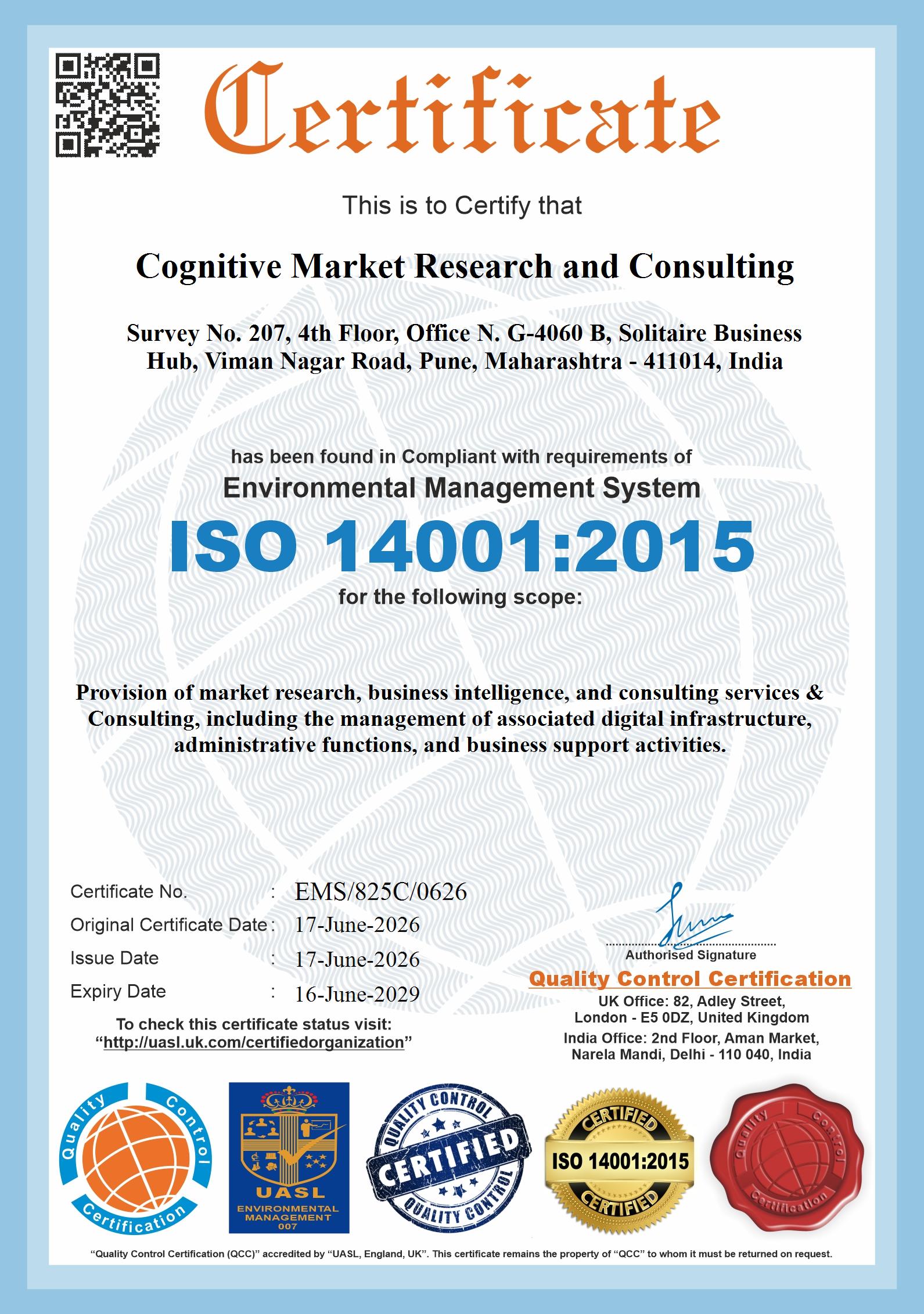
What these certifications mean to usA market figure is only as reliable as the system that produced it. That is why our accreditations cover the whole chain, not just the research step. ESOMAR and MRSI membership binds us to the professional codes that govern how respondents are recruited and how findings may be represented. ISO 20252 governs the research process itself; ISO 9001 and our quality control certification govern how consistently we repeat it. ISO 27001 and ISO 27701, alongside our GDPR, CCPA and DPDP compliance, govern what happens to your brief and your data once it reaches us; because a confidential scope is often more sensitive than the deliverable. ISO 14001, our D-U-N-S registration, Chamber of Commerce membership and DMCA protection speak to how the company itself is run and how its work is safeguarded.Our Clutch and Trustpilot profiles are deliberately listed next to them. They are the only signals on this page we do not issue ourselves, and they are the ones we would check first if we were you.
The global pet food packaging market will continue its upward trajectory, with a projected CAGR of 5.72%, driven by the enduring trend of pet humanization and increased spending on pet care.
North America and Europe remain the largest markets, but the highest growth rates are anticipated in the Asia-Pacific region, presenting significant expansion opportunities for manufacturers.
Sustainability has become a cornerstone of market strategy; the push for recyclable, mono-material, and paper-based solutions is a dominant trend that will shape future innovation and material choices.
Flexible packaging, particularly stand-up pouches, continues to gain market share from rigid formats due to its convenience, design flexibility, and lower material usage, aligning with both consumer and sustainability demands.