We value your privacy
We use cookies to improve your experience and analyze traffic. By continuing, you consent to our use of cookies under GDPR, CCPA and other applicable laws. Privacy Policy
Cookie preferences
Choose which categories of cookies you allow. Strictly necessary cookies are always on.
Strictly necessary
Required for core site functionality, security and your session. Always active.
Analytics
Help us understand how visitors use the site (e.g. Google Analytics) so we can improve it.
Marketing
Used to measure campaigns and show you relevant ads on other sites (e.g. LinkedIn, Google Ads).
ⓘ 8th Edition 2026Revenue: BillionVolume/Consumption: Units
Electric Vehicle Market Analysis 2026
Electric Vehicle Market Analysis size 2021 was recorded $489940 Million whereas by the end of 2026 it will reach $963510 Million. According to the author, by 2033 Electric Vehicle market size will become $2487750 Million. Electric Vehicle market will be growing at a CAGR of 14.37% during 2026 to 2033. Download a free sample with data verified by Sneha Singh
Electric Vehicle Market Analysis from 2022 to 2034 Containing Market Size, Share along with its CAGR, Forecast and Trends
Top Countries — Revenue
Billion
Market Dynamics of Electric Vehicle Market Analysis
Growth Drivers
Government Policies & Emission Regulations
Global governments are enforcing stringent emission standards and providing strong policy support to drive EV adoption.
For example, the EU plans to ban sales of new internal combustion engine (ICE) vehicles by 2035, and India's FAME II scheme is offering incentives for electric 2-wheelers, 3-wheelers, and buses.
Market Opportunity: Growth in EV Charging Infrastructure & Energy Storage Integration
The expansion of charging infrastructure is unlocking EV market potential in underserved regions.
For instance, China has over 2.7 million public chargers (as of 2024), the largest in the world, and aims to double it by 2025. Integration of EVs with renewable-powered charging stations and V2G (vehicle-to-grid) systems is gaining traction. This infrastructure-led growth is a huge opportunity for energy companies, startups, and utilities investing in grid-tied EV ecosystems.
Restraints
High Upfront Costs
Inadequate Charging Infrastructure
Battery Lifecycle and Recycling Issues
Trends
Electrification of Commercial Fleets & Shared Mobility
Major logistics and ride-hailing companies are transitioning to electric fleets to cut operational costs and meet ESG goals. Urban last-mile delivery services are increasingly shifting to electric 2-wheelers and 3-wheelers in Southeast Asia and Europe. Amazon aims to deploy 100,000 Rivian electric delivery vans by 2030, and Uber has committed to go fully electric in key cities by 2030.
Access the full forecast model.
Country-level data · Company profiles · Editable dataset · Analyst consultation included.
Electric Vehicle Market Analysis — Presence
Geographical Analysis
Click countries to explore
Loading map…
Regional and Country Analysis
Global Electric Vehicle Market Analysis 2026
Country-level values are locked in this preview.
Request a free sample
to unlock the full breakdown.
Region / Country
2021 (A)
2025 (A)
2033 (P)
CAGR
Global
$ 489.94 Billion
$ 842.1 Billion
$ 2487.75 Billion
14.5%
North America
$ 89.17 Billion
$ 154.1 Billion
$ 460.24 Billion
14.656%
United States
$ 60.1 Billion
$ 102.17 Billion
$ 294.55 Billion
14.151%
Canada
$ 17.21 Billion
$ 30.51 Billion
$ 95.73 Billion
15.364%
Mexico
$ 11.86 Billion
$ 21.42 Billion
$ 69.96 Billion
15.944%
Europe
$ 118.08 Billion
$ 198.74 Billion
$ 562.23 Billion
13.882%
United Kingdom
$ 19.01 Billion
$ 31.2 Billion
$ 83.21 Billion
13.045%
France
$ 14.29 Billion
$ 22.86 Billion
$ 57.91 Billion
12.324%
Germany
$ 29.05 Billion
$ 48.09 Billion
$ 132.13 Billion
13.465%
Italy
$ 9.56 Billion
$ 15.5 Billion
$ 39.92 Billion
12.551%
Russia
$ 6.49 Billion
$ 10.14 Billion
$ 25.3 Billion
12.114%
Spain
$ 8.62 Billion
$ 14.91 Billion
$ 43.85 Billion
14.442%
Sweden
$ 5.43 Billion
$ 8.94 Billion
$ 23.61 Billion
12.904%
Denmark
$ 6.14 Billion
$ 10.73 Billion
$ 33.17 Billion
15.15%
Switzerland
$ 3.78 Billion
$ 6.56 Billion
$ 19.12 Billion
14.308%
Luxembourg
$ 1.89 Billion
$ 2.98 Billion
$ 6.75 Billion
10.749%
Rest of Europe
$ 13.82 Billion
$ 26.83 Billion
$ 97.27 Billion
17.468%
Asia Pacific
$ 203.33 Billion
$ 357.89 Billion
$ 1107.05 Billion
15.16%
China
$ 82.96 Billion
$ 147.81 Billion
$ 466.07 Billion
15.437%
Japan
$ 27.25 Billion
$ 46.17 Billion
$ 132.85 Billion
14.124%
South Korea
$ 15.05 Billion
$ 25.41 Billion
$ 71.96 Billion
13.896%
India
$ 33.35 Billion
$ 59.77 Billion
$ 192.63 Billion
15.753%
Australia
$ 8.95 Billion
$ 14.85 Billion
$ 40.96 Billion
13.52%
Singapore
$ 4.68 Billion
$ 7.52 Billion
$ 21.03 Billion
13.728%
Taiwan
$ 8.54 Billion
$ 14.32 Billion
$ 42.07 Billion
14.424%
South East Asia
$ 16.67 Billion
$ 30.42 Billion
$ 100.74 Billion
16.146%
Rest of APAC
$ 5.9 Billion
$ 11.63 Billion
$ 38.75 Billion
16.232%
South America
$ 37.24 Billion
$ 59.79 Billion
$ 156.73 Billion
12.802%
Brazil
$ 16.27 Billion
$ 25.71 Billion
$ 65.04 Billion
12.302%
Argentina
$ 6.22 Billion
$ 10.05 Billion
$ 26.64 Billion
12.969%
Colombia
$ 5.14 Billion
$ 8.67 Billion
$ 25.08 Billion
14.198%
Peru
$ 2.5 Billion
$ 4.19 Billion
$ 11.76 Billion
13.779%
Chile
$ 3.46 Billion
$ 5.56 Billion
$ 14.42 Billion
12.649%
Rest of South America
$ 3.65 Billion
$ 5.62 Billion
$ 13.79 Billion
11.876%
Middle East
$ 27.44 Billion
$ 45.47 Billion
$ 126.88 Billion
13.685%
Saudi Arabia
$ 11.36 Billion
$ 18.55 Billion
$ 49.99 Billion
13.19%
Turkey
$ 5.16 Billion
$ 8.73 Billion
$ 25.38 Billion
14.266%
UAE
$ 3.73 Billion
$ 6.18 Billion
$ 17.13 Billion
13.58%
Egypt
$ 3.46 Billion
$ 5.59 Billion
$ 14.72 Billion
12.855%
Qatar
$ 1.59 Billion
$ 2.82 Billion
$ 9.01 Billion
15.627%
Rest of Middle East
$ 2.14 Billion
$ 3.59 Billion
$ 10.66 Billion
14.56%
Africa
$ 14.7 Billion
$ 26.11 Billion
$ 74.63 Billion
14.032%
East Africa
xxxx
xxxx
xxxx
xxxx
West Africa
xxxx
xxxx
xxxx
xxxx
North Africa
xxxx
xxxx
xxxx
xxxx
South Africa
$ 6.25 Billion
$ 11.23 Billion
$ 32.84 Billion
14.36%
The global electric vehicle market is in a phase of dynamic and accelerated growth, marking a pivotal shift in the automotive industry away from fossil fuels. This transition is underpinned by a global consensus on reducing carbon emissions and is propelled by continuous innovation. The market dynamics are characterized by intense competition, with established automakers electrifying their fleets and new, EV-focused players capturing significant market share. While growth is strong, the market's trajectory is heavily influenced by regional policies, economic conditions, and the pace of infrastructure development, creating a complex and evolving global landscape.
Global Electric Vehicle Market Drivers
Government Policies and Financial Incentives: Governments worldwide are implementing policies such as tax credits, subsidies, and grants for purchasing EVs. Additionally, regulations mandating zero-emission vehicles and phasing out ICE vehicles are compelling both consumers and manufacturers to shift towards electric mobility.
Growing Environmental Concerns: Increasing public awareness and concern about air pollution and climate change are major catalysts. Consumers are increasingly choosing EVs as a cleaner, more sustainable transportation alternative, a trend reinforced by corporate sustainability goals and international climate agreements.
Advancements in Battery Technology and Cost Reduction: Continuous improvements in lithium-ion battery technology have led to higher energy density, longer driving ranges, and faster charging times. Simultaneously, economies of scale in battery production are driving down costs, making EVs more affordable and competitive with traditional vehicles.
Global Electric Vehicle Market Trends
Expansion of Charging Infrastructure: A significant trend is the rapid expansion of public and private charging networks. Investments are pouring into the development of high-speed DC fast chargers along highways and more accessible Level 2 chargers in urban and residential areas to alleviate range anxiety.
Diversification of EV Models: Manufacturers are expanding their EV portfolios beyond niche models to include a wide range of vehicle types, such as SUVs, pickup trucks, and commercial vans. This diversification is crucial for appealing to a broader consumer base and meeting various market needs.
Integration of Smart and Autonomous Technologies: EVs are increasingly becoming platforms for advanced technology, including sophisticated infotainment systems, over-the-air updates, and advanced driver-assistance systems (ADAS). The push towards fully autonomous driving capabilities is a prominent trend, with EVs often serving as the flagship models for these innovations.
Global Electric Vehicle Market Restraints
High Initial Purchase Price: Despite falling battery costs, the upfront cost of an EV often remains higher than that of a comparable ICE vehicle. This price disparity is a significant barrier for many potential buyers, particularly in price-sensitive and emerging markets.
Inadequate Charging Infrastructure and Range Anxiety: While expanding, the charging infrastructure in many regions is still insufficient to support mass adoption. This "range anxiety"—the fear of a battery running out before reaching a charging station—remains a major psychological barrier for consumers.
Battery Raw Material Supply Chain and Lifecycle Concerns: The supply chain for critical battery minerals like lithium, cobalt, and nickel is concentrated in a few geographic regions, creating risks of price volatility and geopolitical disruptions. Furthermore, concerns about the environmental impact of mining and the challenge of battery recycling and disposal present long-term restraints.
Country-Specific Insight: North America will hold an 18.3% share of the global EV market in 2025. The United States is the dominant force, projected to account for 12.13% of the global market by 2025. Canada and Mexico are also experiencing strong growth, holding approximately 3.62% and 2.54% of the global market share in 2025, respectively.
Key Drivers
Strong federal and state-level incentives, particularly the Inflation Reduction Act (IRA) in the U.S., which provides significant tax credits for EV purchases.
High consumer interest in technology and performance, with a growing demand for electric SUVs and pickup trucks.
Major investments by domestic automakers (GM, Ford, Tesla) to onshore production and build out supply chains.
Key Trends
Rapid build-out of DC fast-charging corridors along major highways to facilitate long-distance travel.
The "electrification" of iconic American vehicle segments, especially pickup trucks, is a major market trend.
Increasing partnerships between automakers and utility companies for smart charging and vehicle-to-grid (V2G) programs.
Key Restraints
Vast geographical distances and less-dense charging infrastructure in rural and central regions create significant range anxiety.
Political polarization can lead to uncertainty in long-term environmental policy and incentive structures.
Grid capacity and modernization challenges in accommodating a massive increase in electricity demand from EVs.
Technology Focus
The region's technology focus is on high-performance batteries for long-range vehicles, the development of robust ADAS and autonomous driving features, and software-defined vehicle platforms. There is a strong emphasis on large-format vehicles like SUVs and pickup trucks, requiring powerful drivetrain and battery systems.
Country-Specific Insight: Europe is a leading region, projected to capture 23.6% of the global market in 2025. Germany leads the continent, holding 5.71% of the global market share in 2025, followed by the United Kingdom with 3.71% and France with 2.71%. Countries like Denmark and Spain are also showing impressive growth.
Key Drivers
Extremely stringent EU-wide CO2 emission standards for new cars, imposing heavy fines on non-compliant automakers.
Generous government subsidies and tax exemptions in countries like Germany, France, and Norway.
Strong public environmental awareness and a well-developed public transport system that complements EV usage.
Key Trends
Focus on building a dense, interoperable public charging network across the continent.
Rising popularity of compact and mid-size EVs well-suited for European cities.
Corporate fleets are rapidly transitioning to EVs to meet sustainability targets and benefit from tax advantages.
Key Restraints
High electricity prices in several European countries can impact the total cost of ownership advantage.
Complexities in harmonizing charging payment and access systems across different countries and providers.
Dependence on imported batteries and raw materials, primarily from Asia.
Technology Focus
European technology efforts are geared towards high-efficiency powertrains to comply with strict regulations, development of a comprehensive charging standard (CCS), and circular economy initiatives, including battery recycling and second-life applications, driven by EU directives.
Country-Specific Insight: The APAC region is the global leader, projected to account for a massive 42.5% of the global market in 2025. China is the undisputed market driver, expected to hold 17.55% of the global market alone. India (7.10%) and Japan (5.48%) are other major contributors with significant growth trajectories.
Key Drivers
Aggressive government mandates and subsidies in China, making it the world's largest EV market.
Dominance in the global battery manufacturing and supply chain, leading to cost advantages.
Rapid urbanization and severe air pollution in major cities are pushing governments and consumers towards cleaner mobility solutions.
Key Trends
Proliferation of a wide range of EV models, from low-cost micro-EVs to premium sedans and SUVs.
Innovation in battery-swapping technology as an alternative to conventional charging, especially in China and India.
Strong growth in the electric two- and three-wheeler segments, which dominate mobility in many Southeast Asian countries.
Key Restraints
Inconsistent charging infrastructure and grid stability outside of major metropolitan areas.
Affordability remains a major barrier in developing nations within the region.
Intense competition and price wars among a large number of domestic manufacturers can impact profitability.
Technology Focus
The APAC region's technology focus is on cost-effective battery chemistries like Lithium Iron Phosphate (LFP), manufacturing process innovation to drive down costs, and the development of battery swapping infrastructure. There is also a strong focus on software for connected car services tailored to local consumer preferences.
Country-Specific Insight: South America represents an emerging market, holding approximately 7.1% of the global EV market share in 2025. Brazil is the largest market in the region, accounting for an estimated 3.05% of the global total in 2025, with countries like Colombia and Argentina also beginning to build momentum.
Key Drivers
Abundant renewable energy resources, particularly hydropower, which can provide clean electricity for charging.
Growing government interest in reducing dependence on imported oil and curbing urban pollution.
Introduction of electric buses for public transportation in major cities like Santiago and Bogotá.
Key Trends
Focus on electrification of public transport and commercial fleets as an initial adoption strategy.
Entry of Chinese EV brands offering more affordable models compared to European and American counterparts.
Growing local assembly and manufacturing initiatives to reduce import tariffs and costs.
Key Restraints
High import taxes on vehicles and a lack of strong, widespread government incentives for consumers.
Limited public charging infrastructure and low consumer awareness.
Economic volatility and currency fluctuations impact vehicle affordability and market stability.
Technology Focus
Technology adoption in this region is focused on robust and cost-effective EVs suitable for varied road conditions. There is a particular interest in leveraging the region's ethanol production capabilities for hybrid-electric vehicles as a transitional technology, alongside the gradual introduction of pure BEVs.
Country-Specific Insight: The Middle East is a growing market driven by economic diversification, accounting for an estimated 5.4% of the global EV market in 2025. Saudi Arabia (2.20% global share) and the UAE are leading this transition, investing heavily in infrastructure as part of their long-term national vision plans.
Key Drivers
Strong government-led economic diversification initiatives (e.g., Saudi Vision 2030, UAE Net Zero 2050).
High disposable income and a penchant for luxury and high-technology vehicles.
Investments in smart city projects (like NEOM) that have EV infrastructure at their core.
Key Trends
Rapid adoption of premium and luxury EV models from leading global brands.
Government and state-owned entities are leading the way by electrifying their vehicle fleets.
Development of domestic EV manufacturing capabilities, such as the Ceer brand in Saudi Arabia.
Key Restraints
Extreme heat and climate conditions can negatively affect battery performance and longevity.
Historically low gasoline prices reduce the economic incentive for consumers to switch to EVs.
A deeply ingrained car culture centered around powerful, large-engine ICE vehicles.
Technology Focus
The technology focus in the Middle East is on advanced battery cooling systems to cope with high ambient temperatures, luxury in-cabin technology and connectivity, and the development of high-power charging networks to cater to premium, long-range EVs.
Country-Specific Insight: Africa is a nascent but high-potential market, representing about 3.1% of the global EV share in 2025. South Africa is the regional leader, holding an estimated 1.33% of the global market in 2025, with growing interest in countries like Nigeria and Kenya, particularly in the two-wheeler and public transit segments.
Key Drivers
Abundant solar energy potential offers a pathway for decentralized, clean charging solutions.
Growing startup ecosystem focused on electric mobility, particularly for two-wheelers and last-mile delivery.
Governmental goals to combat severe urban air pollution and reduce fuel import costs.
Key Trends
Adoption of electric motorcycles ("e-bodas") for ride-hailing and delivery services is a key entry point.
Pilot programs for electric buses in major metropolitan areas are gaining traction.
Development of local assembly plants for EVs to create jobs and lower costs.
Key Restraints
Prohibitively high cost of new EVs for the vast majority of the population.
Extremely limited charging infrastructure and unreliable electricity grids.
Lack of comprehensive government policies and financial incentives to stimulate demand.
Technology Focus
The primary technology focus is on durable, low-cost electric two- and three-wheelers with swappable batteries. For four-wheeled vehicles, the focus is on rugged designs suitable for challenging road conditions. Off-grid, solar-powered charging stations are a key area of innovation for the region.
A = Actual · E = Estimated · P = Projected · 🔒 Locked values require full access. Click headers to sort.
The EV sector is rapidly transforming technologically in almost every area of battery chemistry, motor drive efficiency, charging systems, and connectivity. For example, solid-state batteries have been developed that promise higher energy density, faster charging, and better safety; companies such as Toyota and QuantumScape are actively prototyping this technology with aspirations to mass produce solid-state batteries by 2027. Silicon anode batteries (proprietary to firms such as Sila Nanotechnologies and Mercedes-Benz) are also being developed, and they promise at least a 20% increase in range over traditional lithium-ion packs.
Ultra-fast charging networks, such as IONITY in Europe, have now produced charging stations, such as Tesla Superchargers, that can charge an EV to 80% of its full capacity in approximately twenty minutes. Even more exciting is the rise of wireless EV charging systems for public and private use; companies such as WiTricity and HEVO are piloting inductive charging-based systems. There have also been advancements in thermal management systems, and artificial intelligence (AI) based battery management systems (BMS) that ensure battery life, energy efficiency, and safety; this is especially beneficial for high-performance EVs, such as the Lucid Air and Tesla Model S Plaid.V2G innovative technology allows EVs to put energy back into the grid. Nissan's Leaf and Ford's F-150 Lightning are early instances of V2G-powered cars, helping manage peak demand and increase grid resource stability.
Investment and Funding
Year
News
March 2025
Pulsetrain, Battery tech startup, announced that it has raised USD$6.7 million in a seed funding round, with proceeds aimed at advancing its technology to significantly improve EV battery performance
November 2023
California-based Element Energy has raised US$111 million in equity and debt financing for its proprietary battery management system (BMS) for first and second-life battery storage.
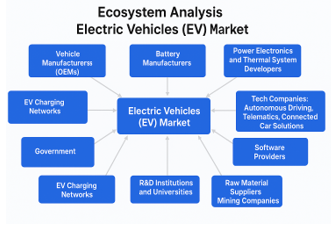
Ecosystem Analysis
The Electric Vehicles (EV) Market has a multi-faceted, dynamic ecosystem that encompasses multiple industries and stakeholders. At the center of the ecosystem are vehicle OEMs like Tesla, BYD, Hyundai, and Volkswagen that design and assemble the electric cars, bikes, buses and trucks; surrounded by battery manufacturers like CATL, LG Energy Solution and Panasonic that provide the lithium ion or solid-state power sources. In addition to this are battery management system (BMS) companies, developers of power electronics and thermal systems to assist with safety and efficiency. On the infrastructure side, companies like ChargePoint, ABB, and Ionity are building their EV charging networks, and energy utilities and grid operators are integrating vehicle-to-grid (V2G) capacity with the electric power grid to stabilize the electric power demand caused by EV charging.
Upstream in the value chain are the raw material suppliers (for lithium, cobalt, nickel, and graphite) and mining companies that will be impacted by geopolitical state shifts to the cost and availability of critical minerals. Governments act as a powerful enabler through regulation, subsidies, and emission mandates; along with research and development (R&D) institutions and universities that drive innovation around materials and mobility systems. Interestingly, tech companies like Google, Apple, and Nvidia are all in development of autonomous driving, telematics, and connected car solutions that make EVs more intelligent and responsive.
This interdependent ecosystem also includes software providers, fleet operators, aftermarket service networks, and financial institutions offering EV leasing or insurance. Together, this ecosystem ensures that EVs are not just cars, but integral components of a smarter, greener, and digitally connected mobility future.
List of Manufacturers:
List of Distributors:
List of Raw Material Suppliers
Patent Analysis:
Patent analysis in this sector reveals key trends in innovation, competitive positioning, and technology focus areas.
SR NO
Patent Name
Patent No.
Description
Filed Date
Expiry Date
1.
Electric Car
CN111376742A
The application filed by Toyota Motor Corp. The electric vehicle includes a power converter that converts the electric power of the main battery into the driving electric power of the electric motor for running.
2019-12-26
Pending
2.
Electric automobile and high-voltage electric integrated system
CN218085085U
The application filed by Weilai Automobile Technology Anhui Co Ltd. The utility model relates to an electric automobile technical field specifically provides an electric automobile and high-voltage electrical integrated system.
2022-08-30
2032-08-30
Recent Developments:
Year
News
On 24 January 2025
• Tesla has released the new Model Y in the US and Canada. The US pricing for the Model Y Launch Series, which begins at USD 59,990 before options, began deliveries in March 2025
July 2022
• Tesla has released the new Model Y in the US and Canada. The US pricing for the Model Y Launch Series, which begins at USD 59,990 before options, began deliveries in March 2025
Trade Analysis
The global trade environment for electric vehicles is rapidly changing due to shifting supply chains, critical mineral dependencies, and protectionist measures. The global competition is growing among major EV producing nations (China, Germany, South Korea, the U.S., etc.) in part because of the new trade issues (tariffs, localization requirements) that are also affecting global trade. China is still the number one exporter of electric vehicles (EVs) in the world, especially to Europe, where cheap EVs from BYD and SAIC are competing in the marketplace.
The EU is now exploring possible anti-subsidy tariffs on Chinese EVs in order to safeguard its domestic EV manufacturers. The trade issue between the U.S. and China, along with the Inflation Reduction Act (IRA) creating more rigid sourcing structures of battery materials, has compelled further nearshoring and shifting of minerals for battery materials to allied countries like Canada, Mexico, and Australia. South Korea and Japan still remain primary exporters of advanced EV components like battery cells, inverters, and semiconductors. Meanwhile, nations with lithium, cobalt, and nickel deposits (Chile, Indonesia, Democratic Republic of Congo) are now vital in helping countries obtain upstream battery supply to build EVs. As nations trade policy evolves into a strategic and security-based environment, all automakers are now also investing more into domestic factories and diversifying the sourcing of minerals to lessen geopolitical risks and reliance on specific countries.
Conferences and Events:
Sr. No
Event Name
Location
Description
1.
EVS – Electric Vehicle Symposium & Exhibition
Globally
One of the largest global platforms for electric mobility, covering EV tech, battery systems, and future mobility.
2.
Battery Electric Vehicle (BEV) Congress
U.S.
Battery advancements, grid integration, charging infrastructure, and EV architecture.
3.
MOVE: Mobility Re-Imagined
London, UK & Asia editions
Startups, OEMs, and government agencies discuss scale-up strategies and policy frameworks.
4.
Auto Expo – The Motor Show
India
Platform where Tata Motors, MG, and others launch new EV models for Asian markets.
5.
International Conference on Electric Vehicle and Battery Technology
U.S., Canada, and EU countries.
Useful for tracking patent discussions, battery chemistry evolution, and EV safety testing standards.
Inorganic Strategies
Year
News
February 2023
BYD, the leading manufacturer of new energy vehicles, has appointed two additional dealer partners to support the entry of its passenger cars into Europe. Motor Distributors Ltd (MDL) becomes a National Dealer Partner for the Republic of Ireland, and RSA, an existing Dealer Partner for BYD in Norway, extends its coverage to Finland and Iceland.
March 2023
The city of Moscow has signed a contract for 1,000 electric buses from KAMAZ. There were planned to purchase another 200 electric buses from GAZ Group.
Regulatory Landscape:
The regulatory environment for electric vehicles is evolving rapidly, driven by global climate goals, air quality standards, and energy transition efforts.
Emission Reduction & Phase-Out Mandates: The EU’s Fit for 55 package mandates a 100% reduction in CO? emissions from new cars by 2035, effectively banning the sale of new petrol and diesel vehicles.
EV Purchase Incentives & Subsidies: India (FAME II): The Faster Adoption and Manufacturing of Electric Vehicles scheme offers direct subsidies for EVs and charging infrastructure.
Battery & Safety Regulations: UN ECE R100/R136: Sets global standards for battery safety, thermal management, and electrical protection.
EU Battery Regulation (2023): Introduces strict traceability, carbon footprint labeling, and recycling obligations for batteries used in EVs.
Vehicle-to-Grid (V2G) and Smart Charging Policies: Countries like Germany, Japan, and the Netherlands are piloting V2G integration, supported by flexible grid codes and incentives.
Analyst Recommendation:
Evolving electric vehicle landscape, it is evident that the global EV market is transitioning from early adoption to mainstream penetration, spurred by policy reforms, technological advancements, and consumer awareness. To remain competitive in this environment, stakeholders must adopt a holistic approach that spans beyond vehicle production and embraces localized supply chains, battery innovation, charging infrastructure, and regulatory compliance. Given the increasing scrutiny around sourcing, environmental impact, and product lifecycle, it is recommended that companies adopt a vertically integrated model and invest in both digital and sustainable solutions. The market also presents strong opportunities in the mid-priced EV segment, battery recycling, and fleet electrification, especially in emerging economies where regulatory frameworks are beginning to align with global trends.
Key Recommendations:
Localize Supply Chains to Mitigate Trade Risks
Establish regional manufacturing hubs for batteries and components to meet tariff and incentive requirements
Invest in Battery Lifecycle Innovation
Prioritize R&D in solid-state and sodium-ion battery technologies to enhance range, safety, and cost.
Expand Charging Infrastructure Collaborations
Partner with utility companies and municipalities to develop ultra-fast and accessible EV charging networks.
Capitalize on Fleet Electrification & B2B Segments
Focus on commercial fleets, last-mile delivery, and urban transit systems where electrification demand is rising.
Leverage Government Incentives and Public-Private Partnerships
Align product portfolios with national and regional subsidy programs.
Vehicle Type breakdown · Illustrative 2025 shares shown free · Full-period forecast in paid report.
Two Wheeler Electric Vehicle Market Analysis
XX
Two Wheeler Market Size 2025
XX %
CAGR
Locked · Full data in paid report
Passenger Vehicle Electric Vehicle Market Analysis
XX
Passenger Vehicle Market Size 2025
XX %
CAGR
Locked · Full data in paid report
Commercial Vehicle Electric Vehicle Market Analysis
XX
Commercial Vehicle Market Size 2025
XX %
CAGR
Locked · Full data in paid report
Market size by (Illustrative, 2025)
Share distribution (2025)
Disclaimer: The charts and graphs are for illustrative purposes only and do not represent actual market values. To access accurate quantitative data, please request a paid report or request free sample.
To learn more about market share and segmentation, request the free sample pages.
Competitor Analysis
Leading Companies:
BYD
Tesla
Hyundai Motor Group
General Motors
Volkswagen
Renault
Emerging Players
Rivian Automotive
Lucid Motors
XPeng Motors
VinFast
Leading players in the EV market are characterized by their global manufacturing scale, advanced R&D in battery and autonomous technologies, and strong distribution networks. These companies have well-established brand equity, enabling them to dominate in both mature and emerging markets. Their ability to align with evolving regulations and invest in sustainable practices gives them a long-term competitive edge.
Emerging players are reshaping the EV landscape by targeting niche segments, offering affordable and innovative models, and leveraging digital-first strategies. They often operate with leaner, more flexible business models and are backed by strategic investments or government incentives. Their agility allows them to respond quickly to market demands and explore untapped growth opportunities.
Click any bar or cell to request the full company profile
Top Companies (In no particular order)
2022 (A)
2023 (A)
2024 (A)
2025 (A)
BYD
•••
•••
•••
•••
Tesla
•••
•••
•••
•••
Hyundai Motor Group
•••
•••
•••
•••
General Motors
•••
•••
•••
•••
Volkswagen
•••
•••
•••
•••
Renault
•••
•••
•••
•••
We Provide Regional Breakdown of this Companies and Company specific to any Country, Region, Product/ service as well. We cover market share analysis for publicly listed companies as well as privately held companies, subject to data availability.
The global Electric Vehicle (EV) market is undergoing a monumental transformation, driven by a confluence of stringent environmental regulations, significant government incentives, and rapid technological advancements in battery technology and charging infrastructure. The market is projected to experience robust growth, expanding from approximately $489.94 billion in 2021 to an estimated $2,487.75 billion by 2033, reflecting an impressive Compound Annual Growth Rate (CAGR) of 14.5%. This expansion is not uniform, with the Asia-Pacific region, led by China, dominating market share and growth. As consumer awareness regarding climate change rises and the total cost of ownership for EVs becomes more competitive with internal combustion engine (ICE) vehicles, the transition to electric mobility is accelerating globally. Key challenges, including the high initial cost, range anxiety, and the need for a more extensive charging network, remain, but are being actively addressed by both public and private sector initiatives, paving the way for a mainstream EV adoption.
Key strategic insights from our comprehensive analysis reveal:
The Asia-Pacific region stands as the powerhouse of the global EV market, commanding the largest market share, driven primarily by massive government support, manufacturing capabilities, and consumer demand in China.
Government policies, including direct subsidies, tax credits, and stringent emission standards, are the single most significant driver of EV adoption rates across all major regions, creating a direct correlation between regulatory support and market growth.
Technological innovation in battery systems—focusing on increased energy density, faster charging speeds, and lower costs—along with the strategic build-out of public charging infrastructure, are the primary enablers for overcoming key market restraints like range anxiety and high purchase prices.
Strategic Recommendations for Manufacturers
To capitalize on the burgeoning EV market, manufacturers should prioritize a multi-pronged strategy. Firstly, accelerate investment in battery research and development, focusing on next-generation technologies like solid-state batteries to enhance range, reduce costs, and minimize reliance on contentious raw materials. Secondly, diversify product portfolios to include more affordable, mass-market models to penetrate emerging economies and appeal to a wider demographic. Thirdly, forge strategic partnerships with utility companies, real estate developers, and governments to co-develop and expand charging infrastructure, creating a seamless ecosystem for EV owners. Finally, enhancing software and connectivity features will be key differentiators, offering value through over-the-air updates, subscription services, and superior user experiences.
The automobile and transportation industry is in the midst of a major shift, driven by advancements in sustainable and intelligent mobility. Key drivers for the Electric Vehicle Market Analysis market include the move to electrification (EVs, hybrids), breakthroughs in autonomous driving, and the rise of connected vehicles powered by IoT and AI. These technologies are enhancing everything from personal transport to fleet management and last-mile delivery. However, the industry faces challenges, primarily from strict emissions regulations and evolving compliance standards, as well as growing cybersecurity and data privacy concerns. Despite these obstacles, significant opportunities exist for companies that can innovate and adapt. By capitalizing on the trends toward sustainable technology and intelligent mobility solutions, businesses in the Electric Vehicle Market Analysis market can secure a strong competitive position for future growth.
Trump’s Tariff Analysis
During the Trump administration, tariffs were imposed on a wide range of Chinese imports, including electric vehicle components like batteries, motors, and electronics, raising costs for U.S.-based EV manufacturers. For example, Tesla was forced to renegotiate supply chains and applied for tariff exemptions on key components like computer chips and chargers. The 25% tariff on Chinese-made battery cells significantly impacted price competitiveness and production timelines. As a response, several companies, including Tesla and GM, increased investment in domestic manufacturing to reduce reliance on imports. While the tariffs created short-term cost pressures and supply chain disruptions, they also accelerated efforts toward localization, onshoring, and vertical integration in the U.S. EV industry.
Analyst Conclusion
As per Cognitive's Research Analyst, Electric Vehicle are integral to the monumental transformation within the automotive industry, driving a pivotal shift away from fossil fuels. They play an essential role in offering cleaner transportation solutions and improving energy efficiency.
Looking at the Historical Growth The global market expanded from $489.94 Billion in 2021 to an estimated $963.51 Billion in 2026 due to a global consensus on reducing fossil fuel reliance and continuous technological innovation. Regionally, Asia Pacific grew from $203.325 Billion in 2021 to $412.19 Billion in 2026, while Europe progressed from $118.075 Billion to $226.31 Billion over the same period.
Currently in 2026, Asia Pacific holds a commanding 42.78% of the global market, driven by aggressive government support in China, its dominant position in battery manufacturing, and increasing urban demand. This region is also set to remain the fastest-growing market, exhibiting the highest CAGR of 15.16%, fueled by the expansion of diverse EV models, innovative battery-swapping solutions, and robust growth in two- and three-wheeler segments.
The market is witnessing a definitive shift towards the integration of smart and autonomous technologies, driven by the evolution of EVs into platforms for advanced technology, including sophisticated infotainment and driver-assistance systems. Ongoing innovation in battery technology is also leading, focusing on increased energy density, faster charging speeds, and lower costs.
In the future, The global Electric Vehicle market will reach to $2,487.75 Billion by 2033, expanding at a compound annual growth rate of 14.5% from 2021, primarily driven by rising consumer awareness for cleaner transport and improved total cost of ownership compared to ICE vehicles. Ongoing innovation in charging infrastructure and the strong trend towards sustainable mobility will also contribute significantly.
Sneha Singh is a Research Analyst at Cognitive Market Research & Consulting with a strong focus on the Automotive & Transportation and Transport & Logistics sectors. She supports organizations with strategic market insights and industry intelligence, helping businesses understand market dynamics, evaluate emerging opportunities, and make informed decisions in an increasingly evolving transportation landscape.
Sneha brings extensive experience in market assessment, competitive benchmarking, supply chain analysis, customer and stakeholder research, regulatory evaluation, and industry trend monitoring. Her work involves a combination of primary and secondary research methodologies, including expert interviews, stakeholder surveys, and comprehensive analysis of industry data, enabling clients to gain a holistic understanding of market developments and growth potential.
At Cognitive Market Research & Consulting, she contributes to market research reports, custom consulting projects, and survey-based studies across a broad range of segments, including passenger vehicles, commercial vehicles, electric mobility, automotive components, freight transportation, warehousing, logistics services, and supply chain technologies. Her research helps organizations evaluate market potential, understand competitive landscapes, assess investment opportunities, and develop effective business strategies.
Known for her analytical approach and attention to detail, Sneha transforms complex market information into actionable insights that support strategic planning and long-term growth. Her commitment to research excellence enables clients to navigate industry challenges, capitalize on emerging trends, and build sustainable competitive advantages in global transportation and logistics markets.
Electric Vehicle Market Analysis market size and growth rate is provided in the report covering 2021-2025 historical and 2025-2033 forecast data.
Major factors including drivers, restraints, opportunities and challenges are analyzed with detailed insights.
Top manufacturers BYD, Tesla, Hyundai Motor Group, General Motors, Volkswagen, Renault and others are profiled in the report.
Segments include Vehicle Type, Propulsion and additional sub-segments.
Regional analysis covers all major markets. The report identifies the dominant region and provides country-level data.
Sample pages can be obtained on demand from the website. 24/7 chat support and direct call services are available.
★ Reviews
Rate this report
Electric Vehicle Market Analysis — Table of Contents
Disclaimer:
This is just a redacted sample pages of the actual deliverable report and only for representative purposes
Charts/Graphs/Numbers/data are only for Representative purposes and do not depict actual statistics.
The table of Contents differs according to the user License selection. Current Displayed TOC is for the Corporate User License Report Edition. TOC Customization options: Add or Remove section/s Or chapter/s from the report.
Specific Tables, Graphs, Sections, and Chapters can be ordered at a discounted price.
If applicable; On Request Volume Data will also be provided (at an Additional Cost).
Report Scope
Vehicle Type
Two Wheeler, Passenger Vehicle, Commercial Vehicle
Propulsion
Battery Electric Vehicle (BEV), Hybrid Electric Vehicle ( HEV)
Vehicle Class
Low Priced, Mid-priced, Luxury
Top Speed
<125 MPH, >125 MPH
Vehicle Drive Type
Front-Wheel Drive, Rear Wheel Drive, All Wheel Drive
EV Charging Point Type
Normal Charging, Super Charging, Inductive Charging
Vehicle Connectivity
V2B, Vehicle to Grid, Vehicle to Vehicle
Component
Battery Pack & High Voltage Component, Motor, Brake, Wheel & Suspension, Body & Chassis, Others
End Use
Private Use, Commercial Use, Industrial Use
List of Competitors
BYD, Tesla, Hyundai Motor Group, General Motors, Volkswagen, Renault
Chapter 1. Competitor Analysis (Subject to Data Availability (Private Players))
1.1 Top Competitors Analysis
1.1.1 Global Electric Vehicle Market Analysis by Key Players
1.1.2 Segment Market Analysis by Key Players
1.1.3 Top Players Ranking 2024
1.1.4 New Product Launch Analysis
1.1.5 Industry Mergers and Acquisition Analysis
1.2 Company Profile (Data Subject to Availability) Sample Format
1.2.1 BYD
1.2.1.1 Company Basic Information, Manufacturing Base, Sales Area, and Competitors
1.2.1.2 Business Overview
1.2.1.3 Financials (Subject to data availability)
1.2.1.4 R&D Investment (Subject to data availability)
1.2.1.5 Product Types Specification
1.2.1.6 Business Strategy
1.2.1.7 Recent Developments
1.2.1.8 Management Change
1.2.1.9 S.W.O.T Analysis
1.2.2 Tesla
1.2.2.1 Company Basic Information, Manufacturing Base, Sales Area, and Competitors
1.2.2.2 Business Overview
1.2.2.3 Financials (Subject to data availability)
1.2.2.4 R&D Investment (Subject to data availability)
1.2.2.5 Product Types Specification
1.2.2.6 Business Strategy
1.2.2.7 Recent Developments
1.2.2.8 Management Change
1.2.2.9 S.W.O.T Analysis
1.2.3 Hyundai Motor Group
1.2.3.1 Company Basic Information, Manufacturing Base, Sales Area, and Competitors
1.2.3.2 Business Overview
1.2.3.3 Financials (Subject to data availability)
1.2.3.4 R&D Investment (Subject to data availability)
1.2.3.5 Product Types Specification
1.2.3.6 Business Strategy
1.2.3.7 Recent Developments
1.2.3.8 Management Change
1.2.3.9 S.W.O.T Analysis
1.2.4 General Motors
1.2.4.1 Company Basic Information, Manufacturing Base, Sales Area, and Competitors
1.2.4.2 Business Overview
1.2.4.3 Financials (Subject to data availability)
1.2.4.4 R&D Investment (Subject to data availability)
1.2.4.5 Product Types Specification
1.2.4.6 Business Strategy
1.2.4.7 Recent Developments
1.2.4.8 Management Change
1.2.4.9 S.W.O.T Analysis
1.2.5 Volkswagen
1.2.5.1 Company Basic Information, Manufacturing Base, Sales Area, and Competitors
1.2.5.2 Business Overview
1.2.5.3 Financials (Subject to data availability)
1.2.5.4 R&D Investment (Subject to data availability)
1.2.5.5 Product Types Specification
1.2.5.6 Business Strategy
1.2.5.7 Recent Developments
1.2.5.8 Management Change
1.2.5.9 S.W.O.T Analysis
1.2.6 Renault
1.2.6.1 Company Basic Information, Manufacturing Base, Sales Area, and Competitors
1.2.6.2 Business Overview
1.2.6.3 Financials (Subject to data availability)
1.2.6.4 R&D Investment (Subject to data availability)
1.2.6.5 Product Types Specification
1.2.6.6 Business Strategy
1.2.6.7 Recent Developments
1.2.6.8 Management Change
1.2.6.9 S.W.O.T Analysis
Chapter 2. Global Electric Vehicle Market Analysis
2.1 Global Electric Vehicle Market Analysis
2.2 Global Electric Vehicle Market Analysis by Region
2.3 Global Electric Vehicle Market Analysis by Vehicle Type
2.4 Global Electric Vehicle Market Analysis by Propulsion
2.5 Global Electric Vehicle Market Analysis by Vehicle Class
2.6 Global Electric Vehicle Market Analysis by Top Speed
2.7 Global Electric Vehicle Market Analysis by Vehicle Drive Type
2.8 Global Electric Vehicle Market Analysis by EV Charging Point Type
2.9 Global Electric Vehicle Market Analysis by Vehicle Connectivity
2.10 Global Electric Vehicle Market Analysis by Component
2.11 Global Electric Vehicle Market Analysis by End Use
2.12 Global Electric Vehicle Market Analysis by Key Players
Chapter 3. North America Electric Vehicle Market Analysis
3.1 North America Electric Vehicle Market Analysis
3.2 North America Electric Vehicle Market Analysis by Country
3.3 North America Electric Vehicle Market Analysis by Vehicle Type
3.4 North America Electric Vehicle Market Analysis by Propulsion
3.5 North America Electric Vehicle Market Analysis by Vehicle Class
3.6 North America Electric Vehicle Market Analysis by Top Speed
3.7 North America Electric Vehicle Market Analysis by Vehicle Drive Type
3.8 North America Electric Vehicle Market Analysis by EV Charging Point Type
3.9 North America Electric Vehicle Market Analysis by Vehicle Connectivity
3.10 North America Electric Vehicle Market Analysis by Component
3.11 North America Electric Vehicle Market Analysis by End Use
3.12 North America Electric Vehicle Market Analysis by Key Players
Chapter 4. Europe Electric Vehicle Market Analysis
4.1 Europe Electric Vehicle Market Analysis
4.2 Europe Electric Vehicle Market Analysis by Country
4.3 Europe Electric Vehicle Market Analysis by Vehicle Type
4.4 Europe Electric Vehicle Market Analysis by Propulsion
4.5 Europe Electric Vehicle Market Analysis by Vehicle Class
4.6 Europe Electric Vehicle Market Analysis by Top Speed
4.7 Europe Electric Vehicle Market Analysis by Vehicle Drive Type
4.8 Europe Electric Vehicle Market Analysis by EV Charging Point Type
4.9 Europe Electric Vehicle Market Analysis by Vehicle Connectivity
4.10 Europe Electric Vehicle Market Analysis by Component
4.11 Europe Electric Vehicle Market Analysis by End Use
4.12 Europe Electric Vehicle Market Analysis by Key Players
Chapter 5. Asia Pacific Electric Vehicle Market Analysis
5.1 Asia Pacific Electric Vehicle Market Analysis
5.2 Asia Pacific Electric Vehicle Market Analysis by Country
5.3 Asia Pacific Electric Vehicle Market Analysis by Vehicle Type
5.4 Asia Pacific Electric Vehicle Market Analysis by Propulsion
5.5 Asia Pacific Electric Vehicle Market Analysis by Vehicle Class
5.6 Asia Pacific Electric Vehicle Market Analysis by Top Speed
5.7 Asia Pacific Electric Vehicle Market Analysis by Vehicle Drive Type
5.8 Asia Pacific Electric Vehicle Market Analysis by EV Charging Point Type
5.9 Asia Pacific Electric Vehicle Market Analysis by Vehicle Connectivity
5.10 Asia Pacific Electric Vehicle Market Analysis by Component
5.11 Asia Pacific Electric Vehicle Market Analysis by End Use
5.12 Asia Pacific Electric Vehicle Market Analysis by Key Players
Chapter 6. South America Electric Vehicle Market Analysis
6.1 South America Electric Vehicle Market Analysis
6.2 South America Electric Vehicle Market Analysis by Country
6.3 South America Electric Vehicle Market Analysis by Vehicle Type
6.4 South America Electric Vehicle Market Analysis by Propulsion
6.5 South America Electric Vehicle Market Analysis by Vehicle Class
6.6 South America Electric Vehicle Market Analysis by Top Speed
6.7 South America Electric Vehicle Market Analysis by Vehicle Drive Type
6.8 South America Electric Vehicle Market Analysis by EV Charging Point Type
6.9 South America Electric Vehicle Market Analysis by Vehicle Connectivity
6.10 South America Electric Vehicle Market Analysis by Component
6.11 South America Electric Vehicle Market Analysis by End Use
6.12 South America Electric Vehicle Market Analysis by Key Players
Chapter 7. Middle East Electric Vehicle Market Analysis
7.1 Middle East Electric Vehicle Market Analysis
7.2 Middle East Electric Vehicle Market Analysis by Country
7.3 Middle East Electric Vehicle Market Analysis by Vehicle Type
7.4 Middle East Electric Vehicle Market Analysis by Propulsion
7.5 Middle East Electric Vehicle Market Analysis by Vehicle Class
7.6 Middle East Electric Vehicle Market Analysis by Top Speed
7.7 Middle East Electric Vehicle Market Analysis by Vehicle Drive Type
7.8 Middle East Electric Vehicle Market Analysis by EV Charging Point Type
7.9 Middle East Electric Vehicle Market Analysis by Vehicle Connectivity
7.10 Middle East Electric Vehicle Market Analysis by Component
7.11 Middle East Electric Vehicle Market Analysis by End Use
7.12 Middle East Electric Vehicle Market Analysis by Key Players
Chapter 8. Africa Electric Vehicle Market Analysis
8.1 Africa Electric Vehicle Market Analysis
8.2 Africa Electric Vehicle Market Analysis by Country
8.3 Africa Electric Vehicle Market Analysis by Vehicle Type
8.4 Africa Electric Vehicle Market Analysis by Propulsion
8.5 Africa Electric Vehicle Market Analysis by Vehicle Class
8.6 Africa Electric Vehicle Market Analysis by Top Speed
8.7 Africa Electric Vehicle Market Analysis by Vehicle Drive Type
8.8 Africa Electric Vehicle Market Analysis by EV Charging Point Type
8.9 Africa Electric Vehicle Market Analysis by Vehicle Connectivity
8.10 Africa Electric Vehicle Market Analysis by Component
8.11 Africa Electric Vehicle Market Analysis by End Use
8.12 Africa Electric Vehicle Market Analysis by Key Players
Chapter 9. Vehicle Type Analysis
9.1 Two Wheeler
9.1.1 Global Two Wheeler Market
9.1.2 Global Two Wheeler Market by Region
9.2 Passenger Vehicle
9.2.1 Global Passenger Vehicle Market
9.2.2 Global Passenger Vehicle Market by Region
9.3 Commercial Vehicle
9.3.1 Global Commercial Vehicle Market
9.3.2 Global Commercial Vehicle Market by Region
Chapter 10. Propulsion Analysis
10.1 Battery Electric Vehicle (BEV)
10.1.1 Global Battery Electric Vehicle (BEV) Market
10.1.2 Global Battery Electric Vehicle (BEV) Market by Region
10.2 Hybrid Electric Vehicle ( HEV)
10.2.1 Global Hybrid Electric Vehicle ( HEV) Market
10.2.2 Global Hybrid Electric Vehicle ( HEV) Market by Region
Chapter 11. Vehicle Class Analysis
11.1 Low Priced
11.1.1 Global Low Priced Market
11.1.2 Global Low Priced Market by Region
11.2 Mid-priced
11.2.1 Global Mid-priced Market
11.2.2 Global Mid-priced Market by Region
11.3 Luxury
11.3.1 Global Luxury Market
11.3.2 Global Luxury Market by Region
Chapter 12. Top Speed Analysis
12.1 <125 MPH
12.1.1 Global <125 MPH Market
12.1.2 Global <125 MPH Market by Region
12.2 >125 MPH
12.2.1 Global >125 MPH Market
12.2.2 Global >125 MPH Market by Region
Chapter 13. Vehicle Drive Type Analysis
13.1 Front-Wheel Drive
13.1.1 Global Front-Wheel Drive Market
13.1.2 Global Front-Wheel Drive Market by Region
13.2 Rear Wheel Drive
13.2.1 Global Rear Wheel Drive Market
13.2.2 Global Rear Wheel Drive Market by Region
13.3 All Wheel Drive
13.3.1 Global All Wheel Drive Market
13.3.2 Global All Wheel Drive Market by Region
Chapter 14. EV Charging Point Type Analysis
14.1 Normal Charging
14.1.1 Global Normal Charging Market
14.1.2 Global Normal Charging Market by Region
14.2 Super Charging
14.2.1 Global Super Charging Market
14.2.2 Global Super Charging Market by Region
14.3 Inductive Charging
14.3.1 Global Inductive Charging Market
14.3.2 Global Inductive Charging Market by Region
Chapter 15. Vehicle Connectivity Analysis
15.1 V2B
15.1.1 Global V2B Market
15.1.2 Global V2B Market by Region
15.2 Vehicle to Grid
15.2.1 Global Vehicle to Grid Market
15.2.2 Global Vehicle to Grid Market by Region
15.3 Vehicle to Vehicle
15.3.1 Global Vehicle to Vehicle Market
15.3.2 Global Vehicle to Vehicle Market by Region
Chapter 16. Component Analysis
16.1 Battery Pack & High Voltage Component
16.1.1 Global Battery Pack & High Voltage Component Market
16.1.2 Global Battery Pack & High Voltage Component Market by Region
16.2 Motor
16.2.1 Global Motor Market
16.2.2 Global Motor Market by Region
16.3 Brake
16.3.1 Global Brake Market
16.3.2 Global Brake Market by Region
16.4 Wheel & Suspension
16.4.1 Global Wheel & Suspension Market
16.4.2 Global Wheel & Suspension Market by Region
16.5 Body & Chassis
16.5.1 Global Body & Chassis Market
16.5.2 Global Body & Chassis Market by Region
16.6 Others
16.6.1 Global Others Market
16.6.2 Global Others Market by Region
Chapter 17. End Use Analysis
17.1 Private Use
17.1.1 Global Private Use Market
17.1.2 Global Private Use Market by Region
17.2 Commercial Use
17.2.1 Global Commercial Use Market
17.2.2 Global Commercial Use Market by Region
17.3 Industrial Use
17.3.1 Global Industrial Use Market
17.3.2 Global Industrial Use Market by Region
Chapter 18. Qualitative Analysis (Subject to Data Availability)
18.1 Market Drivers
18.2 Market Restraints
18.3 Market Trends
18.4 Market Opportunity
18.5 Technological Road Map (Subject to Data Availability)
18.6 Product Life Cycle (Subject to Data Availability)
18.7 Customer and Buyer Behavior Analysis
18.7.1 Digital Engagement, Customer Experience & Relationship Analysis
18.14.2 AI-Driven Transformation of Industry Value Chain
18.14.3 Evolution of Business Models & Revenue Streams
18.14.4 AI-Driven Product, Service & Innovation Transformation
18.14.5 Customer Behavior, AI Adoption & Future Market Evolution
Chapter 19. TOP 10 Country Analysis
19.1 Country 1
19.2 Country 2
19.3 Country 3
19.4 Country 4
19.5 Country 5
19.6 Country 6
19.7 Country 7
19.8 Country 8
19.9 Country 9
19.10 Country 10
Chapter 20. Research Findings
20.1 Key Takeaways
20.2 Analyst Point of View
20.3 Assumptions and Acronyms
Chapter 21. Research Methodology and Sources
21.1 Primary Data Collection
21.1.1 Steps for Primary Data Collection
21.1.1.1 Identification of KOL
21.1.2 Backward Integration
21.1.3 Forward Integration
21.1.4 How Primary Research Help Us
21.1.5 Modes of Primary Research
21.2 Secondary Research
21.2.1 How Secondary Research Help Us
21.2.2 Sources of Secondary Research
21.3 Data Validation
21.3.1 Data Triangulation
21.4 Data Representation
Athenaeum AI Dashboard
Research Framework · 70:30 Primary:Secondary
Our Proprietary Methodology
Cognitive Market Research and Consulting "The Full Truth" methodology — a rigorous triangulation process that combines primary research, secondary validation, and expert calibration. Implemented by Sneha Singh and team for the Electric Vehicle Market Analysis Market analysis.
01
Primary Intelligence Gathering
Direct interviews with 50+ industry stakeholders including manufacturers, distributors, end-users, and regulatory bodies across all six regions.
02
Secondary Data Triangulation
Cross-referencing against trade databases, customs records, financial filings, patent databases, and verified industry publications.
03
Expert Validation Protocol
Each data point undergoes validation by minimum two independent domain experts with 15+ years of industry experience.
04
Athenaeum AI Processing
Our proprietary AI platform aggregates, normalizes, and identifies patterns across 10,000+ data points to surface non-obvious insights.
05
Editorial & QA Review
Final review by senior analysts ensures accuracy, coherence, and actionability of all insights and recommendations.
To maintain the integrity of our proprietary methodology and protect our elite expert network, specific source disclosures are reserved for full-access partners. Our research framework is anchored by a 70:30 primary-to-secondary ratio, ensuring your strategy is driven by real-time market intelligence rather than recycled, publicly available, or AI-generated data. Every deliverable includes an exhaustive source directory and grants direct analyst access.
Latest News about Electric Vehicle Market
27 Nov 2024economictimes.indiatimes.com
Mahindra unveils BE 6e and XEV 9e, ushering in the 'born electric' era
The much-awaited Born Electric line, which includes the BE 6e and XEV 9e electric SUVs, was launched by Mahindra & Mahindra (M&M) This new portfolio, which was introduced on the "INGLO" platform, represents a revolutionary development in Mahindra's approach to electric mobility. The "INGLO" platform, a flat-floor skateboard design intended to increase passenger space by doing away with the center tube, is utilized by both SUVs. High-density battery technology is integrated into the platform to optimize efficiency and range.
With 59 kWh and 79 kWh battery packs, respectively, the BE 6e and XEV 9e can produce up to 282 horsepower. Each charge should provide a range of 450–500 kilometers. Range anxiety is reduced by the fast charging capabilities of both SUVs, which can reach 20–80% battery capacity in just 20 minutes.
Morocco Becomes EU’s Top Auto Export Hub, Surpassing China and Japan
Morocco surpassed China and Japan to become the largest vehicle export hub in the European Union. Due to a boom in automobile production and components, Morocco's trade with Europe is expected to increase further. Thanks to its advantageous geographic location and encouraging government subsidies, Morocco has established itself as a crucial manufacturing hub, particularly for European automakers Stellantis and Renault.
With exports accounting for almost 80% of domestic output, Morocco's Tanger Med Port, one of the biggest automotive ports in the world, handled over 578,500 automobiles in 2023. "Morocco is perfect for exporting automobiles because of its close proximity to Europe and effective logistics," stated Taieb Douhlal, Operational Director at Austics Group. By 2025, the government wants to double yearly car production to one million units.
Although Morocco is the top exporter of automobiles, Tunisia and Algeria are also making progress in their industries. Approximately 80% of Tunisia's automobile production is exported to Europe. However, as Mitsubishi Corporation recently relocated its operations from Tunisia to Casablanca, Morocco, competition for investment is changing the face of North Africa.
In 2025, Egypt intends to restart Lada vehicle manufacture at a new facility in Tarbul, with an anticipated yearly production of 50,000–70,000 automobiles as part of its automotive sector overhaul.
Evology Charging and CSL Group extend partnership with the implementation of rSIM technology
Electric vehicle (EV) charging operations are being revolutionized, and new benchmarks for dependability and efficiency are being set by Evology Charging and CSL Group through the use of rSIM technology. Continuing to set the standard for sustainable and creative solutions, Evology Charging is a driving force in the UK's EV infrastructure market. Aiming to satisfy the growing demand, Evology is committed to building an easily accessible charging infrastructure. By 2030, forecasts indicate that there will be an additional 9 million electric vehicles on British roads.
Over the years, Evology's collaboration with CSL has been crucial to improving their EV charging operations. But now that CSL's cutting-edge rSIM technology has been integrated, Evology has improved efficiency and dependability throughout its network. By implementing rSIM, EV chargers may now have continuous, reliable connectivity that sets new benchmarks for uptime and operational effectiveness. Important issues with EV charging infrastructure are addressed by the partnership between CSL and Evology Charging. Conventional systems frequently have cybersecurity and resilience issues, which cause downtime and user annoyance. By guaranteeing smooth connectivity across several locales, CSL's multi-network roaming SIMs alleviate these problems and improve operational reliability as well as customer happiness.
The collaboration between CSL and Evology Charging, enabled by rSIM technology, is poised to transform connection norms within the EV charging sector. Along with increasing Evology's competitive advantage, rSIM has cleared the path for a more environmentally friendly and interconnected mobility infrastructure in the future. This collaboration highlights how important connection solutions will be in determining how electric vehicle charging will develop in the future.
NAVEE Teams Up with Target to Debut S40 and V40i Electric Scooters
NAVEE is thrilled to announce that it has partnered with renowned North American retailer Target to bring the much anticipated NAVEE S40 and V40i electric scooters to its shops, marking an important milestone in the company's worldwide expansion journey. With this partnership, NAVEE not only enters the North American retail market but also demonstrates its quick expansion and growing impact within the electric mobility industry.
The NAVEE S40, which recently took home the coveted 2024 Red Dot and iF Design Awards, is set to revolutionize urban commuting. In keeping with its goal to "Navigate the infinite possibilities for the future of mobility," NAVEE is dedicated to offering premium, environmentally responsible transportation options that satisfy the demands of contemporary city people. Inspired by the Tesla Cybertruck, the NAVEE S40 combines cutting-edge technology with potent performance. It is perfect for off-roading as well as urban use because to its 700W motor, 25-mile range, and ShockMasterTM dual swingarm suspension. This elegant, functional, and award-winning scooter is ideal for everyday commuting.
The new V40i's emphasis on use and convenience balances out the S40. It is lighter and easier to use, and it is aimed at women and people who would rather have a less complicated solution. Target's diversified customer base may benefit from the exceptional maneuverability and 25-mile range of the V40i, which makes it a great urban commuting choice. Its small design further enhances its appeal.
Evergrandes New Energy Vehicle Unit Surges on a Possible Buyer
Hong Kong-listed shares of the EV unit of the troubled property developer China Evergrande Group surged by as much as 113% on Monday. This marked the first trading day after the company requested a suspension in advance of an announcement. In a late Sunday stock exchange filing, the EV unit revealed that liquidators of its parent company had identified a potential buyer interested in acquiring a 29% stake, with an option to purchase an additional 29.5% stake later. The buyer's identity was not disclosed. Kenny Ng, a securities strategist at Everbright Securities International in Hong Kong, noted that investors were optimistic about the prospect of new ownership. According to the filing, the potential buyer might also offer a line of credit to support the ongoing operations of Evergrande New Energy Vehicle Group.
Hyundai Motor doubles down on EVs as it ramps up investment in Korea
The Hyundai Motor Group intends to increase the manufacturing of electric vehicles and new mobility business in South Korea by investing 68 trillion won ($51 billion) over three years. The 35.5 trillion won investment would go toward building new facilities for electric vehicle (EV) production lines and research and development. This coincides with competitor manufacturers cutting back on their intentions to increase EV production in favor of hybrid vehicles or increasing shareholder dividends and share buybacks. General Motors (GM) prioritized EVs over short-term earnings in 2021 and expected to invest over $35 billion in EV initiatives through 2025. But last year, the US carmaker cut its estimated EV output and postponed the construction of an electric truck factory. On Friday, the New York Auto Show opens, and the industry must make a difficult choice. Although the Japanese carmaker has prioritized growing sales of gas-electric hybrids, Toyota is expanding the number of EVs in its lineup. Regarding the introduction of plug-in hybrid cars, Hyundai will stick to its goals while remaining adaptable. Hyundai anticipates starting EV production in Georgia in October to be eligible for $7,500 in tax credits under the Inflation Reduction Act. The investment plan calls for the renovation of a Kia facility to make compact electric cars (EVs), the commencement of production of "PBV" vehicles in 2025 at a second factory, and the mass production of "ultra-large" Genesis luxury EVs by Hyundai at its Ulsan factory in the first quarter of 2026.
Xiaomi takes aim at Tesla in Chinese auto market with $29,870 electric car
The third-largest smartphone vendor in China, Xiaomi, will make its debut in the automotive industry on Thursday when it introduces its electric vehicle (EV). The car will be compared to Porsche's Taycan and Panamera sports car versions and priced under 500,000 RMB ($69,170.64). Lei Jun, the founder and CEO of Xiaomi, achieved his goal of investing $10 billion in the automotive industry with the launch. On the likelihood that Xiaomi's auto initiative will be successful, analysts are split. Some think it's a logical progression for Xiaomi, providing a smoother online experience and gathering additional information. Lei, however, has stated that the SU7 will be "a bit expensive," deviating from the company's reputation as an inexpensive brand. The launch of the SU7 coincides with China's. The SU7 is going on sale at a time when a faltering domestic economy and a pricing war are plaguing China's car industry. Xiaomi is third in terms of cash and cash equivalents, indicating that it has more resources than other EV companies. Xiaomi has an advantage over traditional automakers in smart cockpits, a characteristic that Chinese consumers enjoy, according to analysts, thanks to its experience with smartphones.
The global electric vehicle industry in 2026 is being reshaped by emerging companies driving innovation in battery technology, smart mobility, and sustainable transportation. This article highlights key EV startups and fast-growing manufacturers that are redefining vehicle design, performance, and market competition worldwide.
The Three Pillars of End-to-End Market Research Services
We don't just hand over data. We partner with your team across three integrated service lines — each designed to give you decision-grade intelligence on the Electric Vehicle Market Analysis market.
Service 01
Market Survey
B2BB2C
Structured primary research across both B2B and B2C channels. We design and execute custom surveys targeting manufacturers, distributors, procurement heads, and end-consumers in the electric vehicle market analysis ecosystem — validated by our global panel of 10,000+ industrial respondents.
What's Included
Buyer intent & sentiment analysis
Purchase cycle mapping
Price sensitivity research
Channel preference profiling
Competitive perception study
Most Requested
Service 02
Customized Market Data & Reports
CustomReady Report
Choose from our ready-to-access 8th Edition report or commission a fully customized dataset tailored to your exact strategic questions. Cross-splits, custom geographies, proprietary segmentation — we build the intelligence asset your board actually needs.
What's Included
Ready syndicate report (250+ pages)
Custom data scope & segmentation
Excel quantitative models
Board-ready PPT with key findings
Secure cloud portal access
Service 03
Strategic Consultation
With SurveyWith Report
Every survey and every report comes with dedicated analyst consultation. Our senior research team walks your leadership through findings, answers strategic questions in real-time, and helps translate data into your next board presentation or investment thesis.
Tell us the specific segments, regions, or companies you need — and we will tailor the deliverable to your requirements.
Why Trust Us
What these certifications mean to usA market figure is only as reliable as the system that produced it. That is why our accreditations cover the whole chain, not just the research step. ESOMAR and MRSI membership binds us to the professional codes that govern how respondents are recruited and how findings may be represented. ISO 20252 governs the research process itself; ISO 9001 and our quality control certification govern how consistently we repeat it. ISO 27001 and ISO 27701, alongside our GDPR, CCPA and DPDP compliance, govern what happens to your brief and your data once it reaches us; because a confidential scope is often more sensitive than the deliverable. ISO 14001, our D-U-N-S registration, Chamber of Commerce membership and DMCA protection speak to how the company itself is run and how its work is safeguarded.Our Clutch and Trustpilot profiles are deliberately listed next to them. They are the only signals on this page we do not issue ourselves, and they are the ones we would check first if we were you.
We worked on a project with Cognitive Market Research and the quality of the research met our expectations. We appreciate the help and prompt response from…
The global electric vehicle market is on a trajectory to grow fivefold, from $489.94 Billion in 2021 to over $2.48 Trillion in 2033, demonstrating a powerful and sustained shift towards e-mobility.
The Asia-Pacific region, commanding 42.5% of the market by 2025, is the undisputed epicenter of the EV industry, driven by China's dominant manufacturing ecosystem and supportive policies, with India emerging as a key growth market.
Government intervention through financial incentives, emission regulations, and infrastructure investment is the most critical factor accelerating EV adoption, with the strongest markets directly correlating with the most supportive regulatory environments.
While the outlook is overwhelmingly positive, sustained growth hinges on overcoming universal challenges: reducing the high upfront cost of EVs, expanding charging infrastructure beyond urban centers, and securing a stable, ethical supply chain for battery raw materials.