We value your privacy
We use cookies to improve your experience and analyze traffic. By continuing, you consent to our use of cookies under GDPR, CCPA and other applicable laws. Privacy Policy
Cookie preferences
Choose which categories of cookies you allow. Strictly necessary cookies are always on.
Strictly necessary
Required for core site functionality, security and your session. Always active.
Analytics
Help us understand how visitors use the site (e.g. Google Analytics) so we can improve it.
Marketing
Used to measure campaigns and show you relevant ads on other sites (e.g. LinkedIn, Google Ads).
Cement Market Analysis size 2021 was recorded $376255 Million whereas by the end of 2026 it will reach $477882.20 Million. According to the author, by 2033 Cement market size will become $668017 Million. Cement market will be growing at a CAGR of 4.9% during 2026 to 2033. Download a free sample with data verified by Chidanand Bilagi
Cement Market Analysis from 2022 to 2034 Containing Market Size, Share along with its CAGR, Forecast and Trends
Top Countries — Revenue
Billion
Market Dynamics of Cement Market Analysis
Growth Drivers
Rapid urbanization and infrastructure development worldwide
Increasing government investments in smart cities and housing projects
Rising demand for sustainable and green construction materials
Restraints
High carbon emissions associated with cement production
Fluctuating raw material prices impacting production costs
Trends
Increasing adoption of green cement to reduce environmental impact
Growing use of alternative fuels and raw materials in cement production
Access the full forecast model.
Country-level data · Company profiles · Editable dataset · Analyst consultation included.
Cement Market Analysis — Presence
Geographical Analysis
Click countries to explore
Loading map…
Regional and Country Analysis
Global Cement Market Analysis 2026
Country-level values are locked in this preview.
Request a free sample
to unlock the full breakdown.
Region / Country
2021 (A)
2025 (A)
2033 (P)
CAGR
Global
$ 376.26 Billion
$ 455.6 Billion
$ 668.02 Billion
4.9%
North America
$ 109.57 Billion
$ 129.03 Billion
$ 184.37 Billion
4.563%
United States
$ 86.73 Billion
$ 101.62 Billion
$ 144.29 Billion
4.48%
Canada
$ 14.73 Billion
$ 17.6 Billion
$ 25.89 Billion
4.941%
Mexico
$ 8.11 Billion
$ 9.81 Billion
$ 14.2 Billion
4.734%
Europe
$ 78.64 Billion
$ 92.49 Billion
$ 133.6 Billion
4.705%
United Kingdom
$ 9.04 Billion
$ 10.78 Billion
$ 15.9 Billion
4.983%
France
$ 9.36 Billion
$ 10.73 Billion
$ 15.03 Billion
4.305%
Germany
$ 12.9 Billion
$ 15.63 Billion
$ 23.38 Billion
5.163%
Italy
$ 5.19 Billion
$ 5.73 Billion
$ 7.75 Billion
3.836%
Russia
$ 9.52 Billion
$ 10.82 Billion
$ 15.1 Billion
4.251%
Spain
$ 5.35 Billion
$ 6.01 Billion
$ 8.55 Billion
4.502%
Sweden
$ 3.93 Billion
$ 4.44 Billion
$ 6.01 Billion
3.864%
Denmark
$ 3.62 Billion
$ 4.16 Billion
$ 5.88 Billion
4.411%
Switzerland
$ 3.38 Billion
$ 3.79 Billion
$ 5.21 Billion
4.052%
Luxembourg
$ 2.44 Billion
$ 2.68 Billion
$ 3.74 Billion
4.247%
Rest of Europe
$ 13.92 Billion
$ 17.71 Billion
$ 27.06 Billion
5.439%
Asia Pacific
$ 136.96 Billion
$ 166.75 Billion
$ 256.52 Billion
5.531%
China
$ 55.19 Billion
$ 67.7 Billion
$ 107.23 Billion
5.916%
Japan
$ 14.46 Billion
$ 16.94 Billion
$ 25.04 Billion
5.003%
South Korea
$ 7.12 Billion
$ 7.84 Billion
$ 10.77 Billion
4.058%
India
$ 23.83 Billion
$ 30.02 Billion
$ 47.97 Billion
6.036%
Australia
$ 3.6 Billion
$ 4.05 Billion
$ 5.72 Billion
4.404%
Singapore
$ 4.25 Billion
$ 4.84 Billion
$ 6.93 Billion
4.593%
Taiwan
$ 4.52 Billion
$ 5.17 Billion
$ 7.44 Billion
4.655%
South East Asia
$ 20.91 Billion
$ 25.8 Billion
$ 37.55 Billion
4.806%
Rest of APAC
$ 3.07 Billion
$ 4.4 Billion
$ 7.88 Billion
7.541%
South America
$ 22.2 Billion
$ 32.35 Billion
$ 48.1 Billion
5.084%
Brazil
$ 7.44 Billion
$ 10.93 Billion
$ 16.4 Billion
5.2%
Argentina
$ 3 Billion
$ 4.27 Billion
$ 6.06 Billion
4.474%
Colombia
$ 1.6 Billion
$ 2.36 Billion
$ 3.56 Billion
5.262%
Peru
$ 1.09 Billion
$ 1.52 Billion
$ 2.19 Billion
4.658%
Chile
$ 1.07 Billion
$ 1.49 Billion
$ 2.16 Billion
4.795%
Rest of South America
$ 8.01 Billion
$ 11.78 Billion
$ 17.72 Billion
5.245%
Middle East
$ 17.91 Billion
$ 21.69 Billion
$ 28.46 Billion
3.455%
Saudi Arabia
$ 6.86 Billion
$ 8.41 Billion
$ 11.01 Billion
3.415%
Turkey
$ 4.23 Billion
$ 5.03 Billion
$ 6.52 Billion
3.287%
UAE
$ 2.11 Billion
$ 2.57 Billion
$ 3.47 Billion
3.821%
Egypt
$ 2.02 Billion
$ 2.49 Billion
$ 3.33 Billion
3.678%
Qatar
$ 1.64 Billion
$ 2.05 Billion
$ 2.72 Billion
3.591%
Rest of Middle East
$ 1.06 Billion
$ 1.13 Billion
$ 1.42 Billion
2.897%
Africa
$ 10.99 Billion
$ 13.3 Billion
$ 16.97 Billion
3.088%
East Africa
xxxx
xxxx
xxxx
xxxx
West Africa
xxxx
xxxx
xxxx
xxxx
North Africa
xxxx
xxxx
xxxx
xxxx
South Africa
$ 4.78 Billion
$ 5.73 Billion
$ 7.23 Billion
2.937%
The global cement market is a cornerstone of the worldwide construction and infrastructure industry. Its health is a direct indicator of economic development and activity. The market is characterized by a steady demand fueled by the fundamental need for housing, commercial spaces, and public infrastructure. While traditionally a conservative industry, it is currently undergoing a significant transformation driven by the dual pressures of meeting rising demand and addressing its substantial environmental footprint. This dynamic is fostering innovation in production processes, material science, and business models across the globe.
Global Cement Market Drivers
Rapid Urbanization and Industrialization: The continuous migration of populations to urban centers, particularly in developing economies, necessitates the construction of new housing, commercial buildings, and transportation networks, creating a sustained demand for cement.
Government-Led Infrastructure Projects: Governments worldwide are launching large-scale infrastructure projects, including roads, bridges, dams, and public transport systems, to stimulate economic growth and improve public services, directly boosting cement consumption.
Growing Housing Sector Demand: A rising global population coupled with increasing disposable incomes leads to a higher demand for residential construction, from affordable housing projects to luxury developments, which are all heavily reliant on cement.
Global Cement Market Trends
Shift Towards Green and Sustainable Cement: There is a strong industry-wide trend towards producing environmentally friendly cement. This includes using alternative fuels, increasing the use of supplementary cementitious materials (SCMs) like fly ash and slag, and developing novel low-CO2 binders.
Digitalization and Automation of Cement Plants: Manufacturers are increasingly adopting Industry 4.0 technologies such as IoT sensors, AI-driven process control, and robotics to optimize production, reduce energy consumption, improve safety, and enable predictive maintenance.
Development of Specialty and High-Performance Cements: There is a growing demand for specialized cement products with enhanced properties, such as high-early strength, improved durability, and resistance to chemical attacks, for use in challenging environments and advanced architectural designs.
Global Cement Market Restraints
High Carbon Emissions and Environmental Regulations: The cement industry is a major source of CO2 emissions, leading to increasingly stringent environmental regulations and carbon taxes that add significant operational costs and reputational risks for manufacturers.
Volatility in Energy and Raw Material Prices: Cement production is highly energy-intensive and reliant on raw materials like limestone and clay. Fluctuations in the prices of coal, petcoke, electricity, and key raw materials can significantly impact profitability.
High Capital Investment and Long Gestation Periods: Establishing new cement plants requires substantial capital investment and long lead times for construction and commissioning, which can be a significant barrier to entry and expansion, especially in economically uncertain times.
Country-Specific Insight: Holding approximately 28.3% of the global market in 2025, North America is a significant market driven by infrastructure upgrades. The United States dominates the region, projected to hold about 22.3% of the global market share in 2025. Canada and Mexico follow, with expected global shares of approximately 3.9% and 2.2% respectively, supported by steady construction and industrial activities.
Regional Dynamics:
Key Drivers
Government initiatives like the Bipartisan Infrastructure Law in the U.S. for upgrading aging infrastructure.
A robust residential construction sector, particularly in suburban areas.
Reshoring of manufacturing activities driving demand for new industrial facilities.
Key Trends
Increasing adoption of low-carbon cements and concrete to meet green building standards (LEED).
Growing use of supplementary cementitious materials (SCMs) like fly ash and slag.
Consolidation of market players and vertical integration strategies.
Key Restraints
Stringent environmental regulations, particularly concerning air quality and emissions.
Logistical challenges and high transportation costs over large distances.
Shortages of skilled labor in the construction industry.
Technology Focus
The focus is on carbon capture, utilization, and storage (CCUS) technologies at major plants, alongside the digital integration of supply chains for just-in-time delivery and efficiency gains.
Country-Specific Insight: Europe is projected to account for about 20.3% of the global market in 2025, with a strong focus on decarbonization. Key countries like Germany (projected 3.4% global share), Russia (2.4%), the United Kingdom (2.4%), and France (2.4%) lead the market, driven by renovation projects and stringent environmental goals under the EU Green Deal.
Regional Dynamics:
Key Drivers
The European Green Deal, pushing for climate-neutral buildings and circular economy models.
Strong government support for renovation waves to improve energy efficiency in buildings.
Investment in renewable energy infrastructure, such as wind turbine foundations.
Key Trends
Rapid development and market penetration of low-clinker and novel cements.
Implementation of carbon pricing through the EU Emissions Trading System (ETS).
Emphasis on circularity, including the recycling of concrete demolition waste.
Key Restraints
The high cost of carbon abatement technologies and ETS compliance.
An aging workforce and challenges in attracting new talent.
Economic uncertainties and fluctuating construction demand in some member states.
Technology Focus
The primary technological drive is towards decarbonization, including pioneering industrial-scale CCUS projects, increasing alternative fuel usage, and developing breakthrough technologies like electrification of heat.
Country-Specific Insight: As the global powerhouse, APAC is expected to command roughly 36.6% of the global market in 2025. China remains the dominant force, with an estimated 14.9% global share, while India is the fastest-growing major market, projected to hold a 6.6% global share. Japan also contributes significantly, with an expected share of around 3.7%.
Regional Dynamics:
Key Drivers
Massive urbanization and the development of megacities across the region.
Ambitious national infrastructure plans, such as China's Belt and Road Initiative and India's National Infrastructure Pipeline.
A burgeoning middle class driving demand for residential and commercial real estate.
Key Trends
Rapid adoption of blended cements to extend material supply and reduce carbon footprint.
Construction of large, modern, and highly efficient integrated cement plants.
Increasing government focus on quality standards and environmental performance.
Key Restraints
Overcapacity in some markets, leading to intense price competition.
Logistical bottlenecks and underdeveloped infrastructure in certain areas.
Growing environmental scrutiny and pollution control measures, particularly in China and India.
Technology Focus
Technology adoption centers on building new-generation, energy-efficient plants with advanced process control. There is also a growing interest in waste heat recovery systems and digital platforms to manage large-scale operations.
Country-Specific Insight: Expected to represent about 7.1% of the global market in 2025, South America's growth is tied to economic stability and infrastructure development. Brazil is the region's largest market, projected to hold a 2.4% share of the global market in 2025. The market is driven by efforts to close the housing deficit and upgrade public infrastructure.
Regional Dynamics:
Key Drivers
Demand for affordable housing and urban development programs.
Investments in mining and energy sector infrastructure.
Post-recession economic recovery in key countries like Brazil and Argentina.
Key Trends
Increased use of blended cements and pozzolanic materials.
Market consolidation and acquisitions by major global players.
A gradual shift towards more formalized construction practices.
Key Restraints
Economic and political instability affecting investment confidence.
High inflation and interest rates impacting construction financing.
Informal construction sector posing challenges for quality control and market tracking.
Technology Focus
The technological focus is on improving production efficiency and reducing energy costs in existing plants. There is also an emphasis on developing cements suitable for the region's diverse climate conditions.
Country-Specific Insight: The Middle East is projected to account for about 4.8% of the global market in 2025, driven by ambitious economic diversification plans. Saudi Arabia leads the region, with an estimated 1.85% global market share, followed by Turkey at 1.1%. Mega-projects like Saudi Arabia's NEOM are major demand drivers.
Regional Dynamics:
Key Drivers
Government-led economic diversification programs away from oil and gas.
Massive spending on giga-projects, tourism, and transportation infrastructure.
Post-conflict reconstruction activities in certain areas.
Key Trends
Demand for high-performance and specialty cements for iconic architectural projects.
Increasing adoption of precast concrete construction to speed up building timelines.
A growing focus on water conservation in concrete production.
Key Restraints
Geopolitical tensions and regional instability.
Overcapacity in some countries leading to price pressures.
Extreme climatic conditions requiring specialized and more costly construction techniques.
Technology Focus
Technology is focused on producing specialty cements for large-scale and architecturally demanding projects. There is also an emphasis on energy efficiency and the use of alternative fuels to reduce production costs.
Country-Specific Insight: Africa, a region with immense growth potential, is projected to hold around 2.9% of the global market in 2025. Key markets include South Africa (expected 1.3% global share) and Nigeria (0.7% global share), where demand is fueled by a massive infrastructure deficit and one of the world's fastest-growing populations.
Regional Dynamics:
Key Drivers
A significant infrastructure and housing deficit across the continent.
Rapid population growth and urbanization creating fundamental demand.
Foreign investment in natural resources and infrastructure projects.
Key Trends
Establishment of new grinding and integrated plants to serve local and regional demand.
Growing focus on self-sufficiency in cement production to reduce reliance on imports.
Development of road and rail networks to improve logistics.
Key Restraints
Inconsistent power supply and poor logistics infrastructure in many areas.
Political instability and regulatory uncertainty in several countries.
Competition from imported cement in coastal regions.
Technology Focus
The focus is on building robust and reliable plants capable of operating in challenging conditions. Technology for using low-grade raw materials and a variety of fuels is particularly important.
A = Actual · E = Estimated · P = Projected · 🔒 Locked values require full access. Click headers to sort.
How are Segments Performing in the Global Cement Market?
Cement Market Application Segment Analysis
According to Cognitive Market Research, The infrastructure segment dominates the cement market, driven by large-scale investments in transportation, energy, and public utility projects. Governments worldwide are prioritizing infrastructure development, including highways, bridges, airports, and water management systems, which require substantial quantities of cement. Emerging economies, particularly in Asia-Pacific and Africa, are focusing on upgrading their infrastructure to support economic growth and urbanization.
The residential segment is the fastest-growing category in the cement market due to the rising demand for affordable housing and urban living spaces. Rapid urbanization, particularly in developing countries, has led to a surge in residential construction to accommodate growing populations. Government initiatives promoting affordable housing schemes and real estate development are further accelerating demand in this segment. Additionally, the shift towards sustainable and energy-efficient residential buildings is driving the use of eco-friendly cement solutions.
Residential Cement Market Analysis
XX
Residential Market Size 2025
XX %
CAGR
Locked · Full data in paid report
Commercial Cement Market Analysis
XX
Commercial Market Size 2025
XX %
CAGR
Locked · Full data in paid report
Infrastructure Cement Market Analysis
XX
Infrastructure Market Size 2025
XX %
CAGR
Locked · Full data in paid report
Others (including bricks) Cement Market Analysis
XX
Others (including bricks) Market Size 2025
XX %
CAGR
Locked · Full data in paid report
Market size by (Illustrative, 2025)
Share distribution (2025)
Disclaimer: The charts and graphs are for illustrative purposes only and do not represent actual market values. To access accurate quantitative data, please request a paid report or request free sample.
To learn more about market share and segmentation, request the free sample pages.
Competitor Analysis
Competitive Landscape of the Cement Market
The cement market is highly competitive, characterized by the presence of numerous global and regional players. Leading companies focus on expanding their production capacity, strengthening supply chain networks, and adopting sustainable practices to gain a competitive edge. Major players such as LafargeHolcim Ltd., HeidelbergCement AG, Cemex S.A.B. de C.V., UltraTech Cement Ltd., and China National Building Material Company Limited (CNBM) dominate the market by leveraging advanced manufacturing technologies and investing in research and development to produce eco-friendly cement products.
In June 2023, SIG's subsidiary PT Semen Baturaja Tbk announced to expand its cement production capacity to 3.8 million tons of cement per year through three factories in Palembang and Baturaja City, Ogan Komering Ulu (OKU) Regency, South Sumatra, Panjang, Bandar Lampung in Indonesia. https://www.sig.id/en/semen-baturaja In January 2023, Semen Indonesia (SIG) acquired an 83.52% stake in Solusi Bangun Indonesia, which has a 14.8 Mt/yr of cement production capacity, strengthening its cement business in Indonesia. https://www.idnfinancials.com/archive/news/45570/Semen-Indonesia-acquires-8352-of-Solusi-Bangun-Indonesia
Click any bar or cell to request the full company profile
Top Companies (In no particular order)
2022 (A)
2023 (A)
2024 (A)
2025 (A)
Heidelberg Materials
•••
•••
•••
•••
Holcim Ltd
•••
•••
•••
•••
CEMEX S.A.B. de C.V.
•••
•••
•••
•••
UltraTech Cement Limited
•••
•••
•••
•••
CRH plc
•••
•••
•••
•••
Siam Cement Group
•••
•••
•••
•••
Dangote Cement
•••
•••
•••
•••
Buzzi Unicem S.p.A.
•••
•••
•••
•••
Mitsubishi Materials Corporation
•••
•••
•••
•••
Titan Cement Company S.A.
•••
•••
•••
•••
Votorantim Cimentos
•••
•••
•••
•••
InterCement Participações S.A
•••
•••
•••
•••
We Provide Regional Breakdown of this Companies and Company specific to any Country, Region, Product/ service as well. We cover market share analysis for publicly listed companies as well as privately held companies, subject to data availability.
The global cement market is poised for robust growth, driven by escalating urbanization, population growth, and significant government and private investments in infrastructure and construction projects worldwide. The market is projected to expand from $376.255 billion in 2021 to $668.017 billion by 2033, registering a compound annual growth rate (CAGR) of 4.9%. This expansion is fundamentally linked to the development of residential, commercial, and industrial sectors. Asia-Pacific continues to dominate the market landscape, fueled by rapid economic development in countries like China and India. A pivotal industry shift is the increasing focus on sustainability, with a growing demand for green cement and the adoption of low-carbon production technologies to mitigate environmental impact. Key challenges, including high energy costs and stringent regulations, are pushing manufacturers towards innovation and operational efficiency.
Key strategic insights from our comprehensive analysis reveal:
The Asia-Pacific region is the largest and fastest-growing market, primarily driven by massive infrastructure spending and rapid urbanization in China and India, making it the central hub for global demand.
Sustainability is no longer a niche but a core driver of innovation. The industry is rapidly shifting towards green cement, alternative fuels, and carbon capture technologies to comply with stringent environmental regulations and meet corporate social responsibility goals.
Technological adoption, including automation, IoT for process optimization, and the development of high-performance blended cements, is becoming critical for manufacturers to enhance efficiency, reduce costs, and maintain a competitive edge.
Strategic Recommendations for Manufacturers
Manufacturers in the cement industry should prioritize a dual-pronged strategy focused on sustainability and technological advancement. Investing in research and development for green cement, such as limestone calcined clay cement (LC3) and other blended varieties, is crucial to meet regulatory demands and capture the growing eco-conscious market segment. Simultaneously, accelerating the digital transformation of manufacturing plants through automation and data analytics will unlock significant efficiencies, reduce operational costs, and improve product consistency. Furthermore, exploring regional market nuances and developing customized product offerings for specific applications will be key to strengthening market position and driving long-term profitable growth.
Introduction of the Cement Market
Cement is a fine, powdery substance made primarily from limestone, clay, silica, and other materials, which are heated to high temperatures in a kiln to form clinker. The clinker is then ground and mixed with gypsum or other additives to produce cement. It acts as a binding agent in construction, holding together materials such as sand and gravel to form concrete. Cement is widely used in various applications, including residential, commercial, and industrial construction, as well as in infrastructure projects such as roads, bridges, and dams. The cement market is experiencing steady growth, driven by rapid urbanization and rising infrastructure development across the globe. Emerging economies, particularly in Asia-Pacific, Latin America, and Africa, are witnessing increasing investments in housing, transportation, and smart city projects, contributing significantly to the growing demand for cement. Additionally, government initiatives aimed at enhancing infrastructure and promoting affordable housing are further fueling market expansion.
In August 2023, The Adani Group's subsidiary, Ambuja Cements Ltd, announced the purchase of a 57% promoter stake in Indian cement manufacturer Sanghi Industries Ltd at an enterprise value of USD 606.5 million to expand its manufacturing capacity and market presence. https://www.ambujacement.com/Upload/PDF/Media-Release_Ambuja-Cement_3-Aug-2023.pdf
Analyst Conclusion
As per Cognitive's Research Analyst, Cement are an integral component of the worldwide construction and infrastructure industry. They play an essential role in meeting the fundamental need for housing, commercial spaces, and public facilities.
Looking at the Historical Growth The global market expanded from $376,255 million in 2021 to an estimated $477,882.20 million in 2026 due to increasing urban settlement patterns, population expansion, and significant government-backed and private sector building projects globally. Regionally, Asia Pacific grew from $136,957 million in 2021 to $175,971.05 million in 2026, while North America progressed from $109,565 million to $134,914.89 million over the same period.
Currently in 2026, Asia Pacific holds a commanding 36.82% of the global market, driven by rapid economic advancement and substantial infrastructure investment in key countries like China and India. The residential, commercial, and industrial construction segment remains the primary consumer of Cement. This region is also set to remain the fastest-growing market, exhibiting the highest CAGR of 5.531%, fueled by extensive infrastructure development and rapid urban expansion across its major economies.
The market is witnessing a definitive shift towards sustainable and green cement production practices, driven by tightening environmental standards and increasing corporate social responsibility goals. Ongoing innovation in material science and manufacturing automation is also leading, focusing on improving operational efficiency and crafting advanced blended varieties.
In the future, The global Cement market will reach to $668,017 million by 2033, expanding at a compound annual growth rate of 4.9% from 2021, primarily driven by sustained urban growth, expanding global population, and continuous global economic progress. Ongoing innovation in novel production methods and the strong trend towards increasing adoption of eco-friendly building materials will also contribute significantly.
Senior Research Associate at Cognitive Market Research
Chidanand Bilagi is a Senior Research Associate at Cognitive Market Research and Consulting, specializing in the chemical and materials industry. With a strong focus on global chemical markets, advanced materials, specialty chemicals, sustainable materials, and emerging industrial innovations, he delivers in-depth market intelligence and strategic insights to support informed decision-making.
His expertise includes analyzing industry trends, competitive landscapes, supply chain dynamics, regulatory developments, raw material pricing patterns, and technological advancements shaping the future of the chemical and materials sector. Through rigorous research and data-driven analysis, Chidanand contributes to the development of comprehensive market reports, helping businesses, investors, and industry stakeholders identify opportunities and address challenges in an evolving global market landscape.
The global market size for Cement in 2025 is USD 528240 million.
The global Cement market is expected to grow with a CAGR of 4.20% over the projected period.
North America held a significant global Cement market revenue share in 2025.
Asia-Pacific will witness the fastest growth of the global Cement market over the coming years.
The US had the most significant global Cement market revenue share in 2025.
The main driver of the growth of the Cement market is the rapid urbanization and infrastructure development worldwide.
The infrastructure category dominates the market.
★ Reviews
Rate this report
Cement Market Analysis — Table of Contents
Disclaimer:
This is just a redacted sample pages of the actual deliverable report and only for representative purposes
Charts/Graphs/Numbers/data are only for Representative purposes and do not depict actual statistics.
The table of Contents differs according to the user License selection. Current Displayed TOC is for the Corporate User License Report Edition. TOC Customization options: Add or Remove section/s Or chapter/s from the report.
Specific Tables, Graphs, Sections, and Chapters can be ordered at a discounted price.
If applicable; On Request Volume Data will also be provided (at an Additional Cost).
10.14.2 AI-Driven Transformation of Industry Value Chain
10.14.3 Evolution of Business Models & Revenue Streams
10.14.4 AI-Driven Product, Service & Innovation Transformation
10.14.5 Customer Behavior, AI Adoption & Future Market Evolution
Chapter 11. TOP 10 Country Analysis
11.1 Country 1
11.2 Country 2
11.3 Country 3
11.4 Country 4
11.5 Country 5
11.6 Country 6
11.7 Country 7
11.8 Country 8
11.9 Country 9
11.10 Country 10
Chapter 12. Research Findings
12.1 Key Takeaways
12.2 Analyst Point of View
12.3 Assumptions and Acronyms
Chapter 13. Research Methodology and Sources
13.1 Primary Data Collection
13.1.1 Steps for Primary Data Collection
13.1.1.1 Identification of KOL
13.1.2 Backward Integration
13.1.3 Forward Integration
13.1.4 How Primary Research Help Us
13.1.5 Modes of Primary Research
13.2 Secondary Research
13.2.1 How Secondary Research Help Us
13.2.2 Sources of Secondary Research
13.3 Data Validation
13.3.1 Data Triangulation
13.4 Data Representation
Athenaeum AI Dashboard
Research Framework · 70:30 Primary:Secondary
Our Proprietary Methodology
Cognitive Market Research and Consulting "The Full Truth" methodology — a rigorous triangulation process that combines primary research, secondary validation, and expert calibration. Implemented by Chidanand Bilagi and team for the Cement Market Analysis Market analysis.
01
Primary Intelligence Gathering
Direct interviews with 50+ industry stakeholders including manufacturers, distributors, end-users, and regulatory bodies across all six regions.
02
Secondary Data Triangulation
Cross-referencing against trade databases, customs records, financial filings, patent databases, and verified industry publications.
03
Expert Validation Protocol
Each data point undergoes validation by minimum two independent domain experts with 15+ years of industry experience.
04
Athenaeum AI Processing
Our proprietary AI platform aggregates, normalizes, and identifies patterns across 10,000+ data points to surface non-obvious insights.
05
Editorial & QA Review
Final review by senior analysts ensures accuracy, coherence, and actionability of all insights and recommendations.
To maintain the integrity of our proprietary methodology and protect our elite expert network, specific source disclosures are reserved for full-access partners. Our research framework is anchored by a 70:30 primary-to-secondary ratio, ensuring your strategy is driven by real-time market intelligence rather than recycled, publicly available, or AI-generated data. Every deliverable includes an exhaustive source directory and grants direct analyst access.
Latest News about Cement Market
04 Jan 2025thehindubusinessline.com
UltraTech to acquire 8.69% in Star Cement for ? 851 crore
UltraTech Cement, part of the Aditya Birla Group, has acquired an 8.69% stake in Star Cement for ?851 crore as part of its strategy to strengthen its position as the largest cement producer in India. Led by Kumar Mangalam Birla, UltraTech purchased 3.70 crore equity shares at ?235 per share, as announced in a company statement on Friday.
Star Cement, a prominent player in North-East India, has a production capacity of approximately 5.7 million tonnes per annum (mtpa). The company is in the process of expanding its capacity to 9.7 MTPA by 2025-26, with plans to further increase it to 12 MTPA by 2027.
The acquisition of this minority stake could pave the way for UltraTech Cement to fully acquire Star Cement, similar to its earlier move with India Cements, according to analysts. Earlier in June, UltraTech Cement had acquired a 23% stake in India Cements from DMart promoter Radhakishan Damani and his associates for ?1,889 crore, further expanding its presence in the rapidly growing and competitive southern cement market.
The Three Pillars of End-to-End Market Research Services
We don't just hand over data. We partner with your team across three integrated service lines — each designed to give you decision-grade intelligence on the Cement Market Analysis market.
Service 01
Market Survey
B2BB2C
Structured primary research across both B2B and B2C channels. We design and execute custom surveys targeting manufacturers, distributors, procurement heads, and end-consumers in the cement market analysis ecosystem — validated by our global panel of 10,000+ industrial respondents.
What's Included
Buyer intent & sentiment analysis
Purchase cycle mapping
Price sensitivity research
Channel preference profiling
Competitive perception study
Most Requested
Service 02
Customized Market Data & Reports
CustomReady Report
Choose from our ready-to-access 8th Edition report or commission a fully customized dataset tailored to your exact strategic questions. Cross-splits, custom geographies, proprietary segmentation — we build the intelligence asset your board actually needs.
What's Included
Ready syndicate report
Custom data scope & segmentation
Excel quantitative models
Board-ready PPT with key findings
Secure cloud portal access
Service 03
Strategic Consultation
With SurveyWith Report
Every survey and every report comes with dedicated analyst consultation. Our senior research team walks your leadership through findings, answers strategic questions in real-time, and helps translate data into your next board presentation or investment thesis.
Tell us the specific segments, regions, or companies you need — and we will tailor the deliverable to your requirements.
Why Trust Us
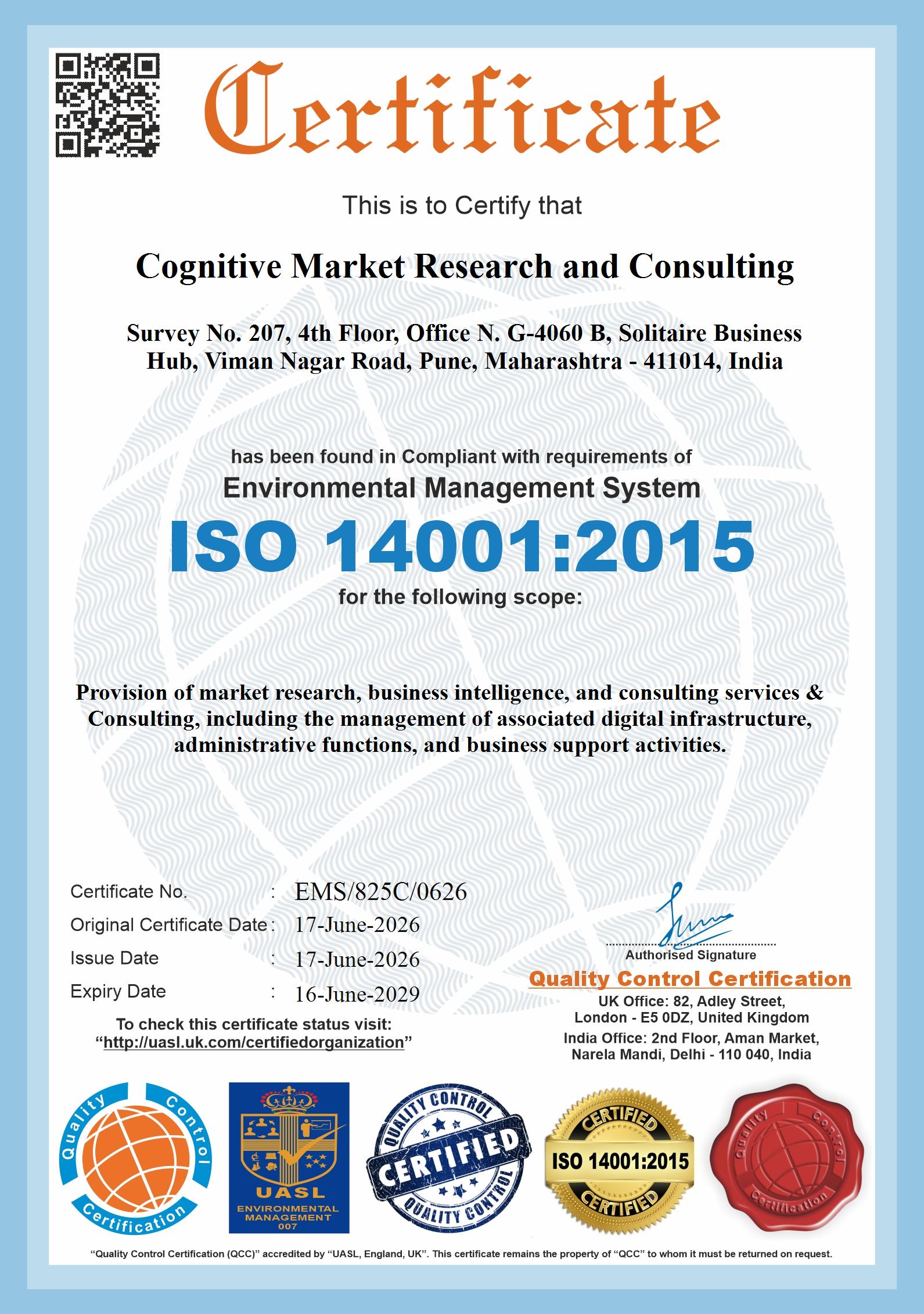
What these certifications mean to usA market figure is only as reliable as the system that produced it. That is why our accreditations cover the whole chain, not just the research step. ESOMAR and MRSI membership binds us to the professional codes that govern how respondents are recruited and how findings may be represented. ISO 20252 governs the research process itself; ISO 9001 and our quality control certification govern how consistently we repeat it. ISO 27001 and ISO 27701, alongside our GDPR, CCPA and DPDP compliance, govern what happens to your brief and your data once it reaches us; because a confidential scope is often more sensitive than the deliverable. ISO 14001, our D-U-N-S registration, Chamber of Commerce membership and DMCA protection speak to how the company itself is run and how its work is safeguarded.Our Clutch and Trustpilot profiles are deliberately listed next to them. They are the only signals on this page we do not issue ourselves, and they are the ones we would check first if we were you.
The global cement market will continue its upward trajectory, with a projected CAGR of 4.9% through 2033, underscoring its critical role in global economic development.
The Asia-Pacific region, led by China and a rapidly expanding India, will remain the epicenter of market demand and growth due to unparalleled infrastructure development and urbanization.
Sustainability has become a megatrend, forcing a paradigm shift towards green cement, lower carbon emissions, and circular economy practices across all regions, especially in Europe and North America.
While infrastructure investment is a universal driver, regional challenges such as regulatory pressures in Europe, overcapacity in parts of Asia, and instability in South America and Africa create a complex and varied global market landscape.