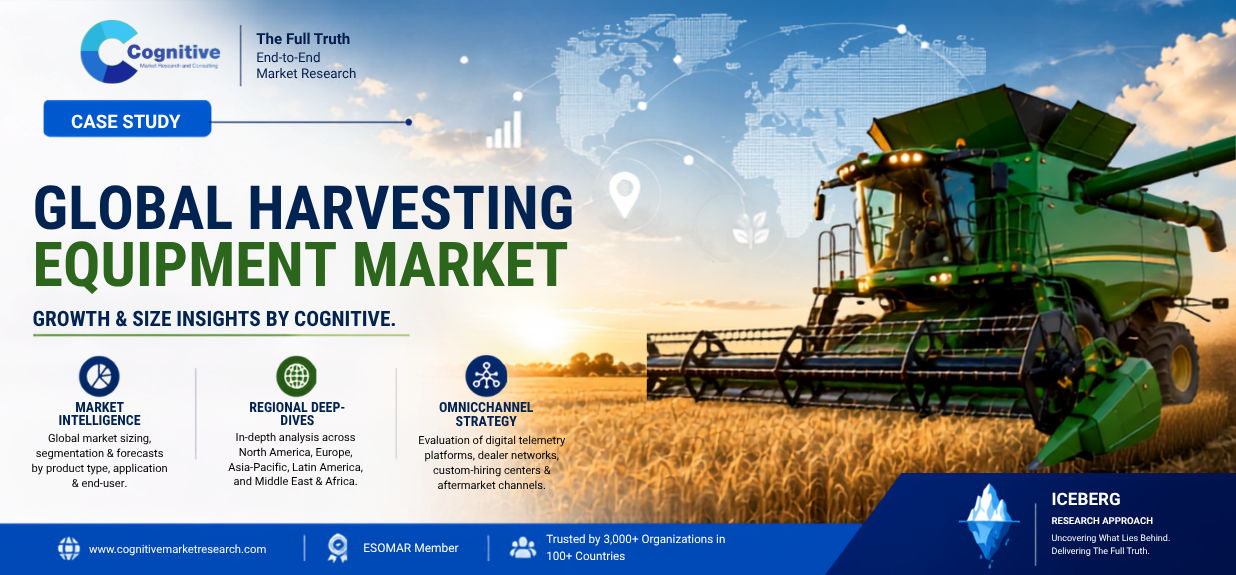
Case Study
Case Study Overview
A global agricultural machinery manufacturer with an established footprint in North America and Europe sought to expand its commercial reach and optimize its portfolio within the global harvesting equipment market. Facing shrinking rural labor pools, narrow harvest windows, and rapid technological disruption, the client required a comprehensive market intelligence and go-to-market strategy to enhance competitive positioning, prioritize high-growth regional territories, and accelerate the adoption of precision agriculture solutions.
Introduction
As global awareness of precision farming, agricultural mechanization, and autonomous fleet management continued to rise, the client aimed to establish an optimized, data-backed roadmap for international expansion and portfolio modernization.
However, the organization lacked clarity on:
- Product Category & Segment Dynamics: Which high-margin harvesting equipment categories such as high-capacity combine harvesters, forage harvesters, and specialty crop systems offered the strongest profitability and sustained growth potential.
- Geographic Prioritization: How regional demand variations across Asia-Pacific, North America, Europe, Latin America, and the Middle East & Africa should dictate resource allocation and capital expenditure.
- Omnichannel Distribution Integration: How to balance and optimize sales performance across direct dealer networks, custom-hiring centers, and digital telemetry/retrofit channels.
- Competitive Differentiation & Positioning: How to successfully benchmark against entrenched global OEMs like Deere, CNH Industrial, and CLAAS and refine their AI-driven automation and smart-farming differentiation strategies.
Leadership required a full-scale, integrated market intelligence framework to align with their strategic planning timelines, reduce cross-border expansion risks, and accelerate market penetration in the Global Harvesting Equipment Market.
Solution
Cognitive Market Research and Consulting delivered a customized, data-driven market entry and portfolio optimization framework. The solution integrated quantitative market sizing with regional deep-dives, distribution channel mapping, and competitive benchmarking to equip the client for long-term category leadership in the Global Harvesting Equipment Market.
Global Market Segmentation & Category Sizing
Quantified total addressable market (TAM) sizing with market baseline values and projections (reaching USD 80.03 billion by 2034 at a 7.61% CAGR), including:
- By Product Type / Segment: Segmentation analysis covering combine harvesters (generating nearly half of industry revenue), forage harvesters, sugarcane harvesters, and specialty crop systems.
- By Application & End-User: Application performance tracking across broadacre grain operations, commercial farms, smallholder farming systems, and custom-hiring rental fleets.
- Benchmarking & Projections: Detailed metrics tracking baseline values, premium autonomous niches, and standard volume machinery segments.
Regional & Country-Level Deep-Dives
Provided exhaustive regional market intelligence assessments across key territories in the Global Harvesting Equipment Market:
- North America & Europe: Key drivers including acute agricultural labor shortages, strict EU emissions standards (Stage V), precision Ag 4.0 technology adoption, and premium machinery engineering in the US, Canada, Germany, France, and the UK.
- Asia-Pacific: Growth dynamics, demographic shifts, and expanding adoption driven by massive cereal production, government subsidies, and cropland consolidation in China, India, and Japan.
- Latin America & Middle East & Africa: Localization, infrastructure, logistics, and regional opportunities centered on double-cropping agricultural expansion in Brazil and government efforts to reduce post-harvest losses.
Omnichannel Distribution Strategy
Evaluated distribution dynamics to streamline go-to-market execution across the Global Harvesting Equipment Market:
- Digital Commerce Tracking: Online telemetry systems, digital agronomic data platforms, and connected fleet management software.
- Offline Retail Performance: Dealership networks, custom-hiring centers, contract harvesting models, and physical agricultural machinery distribution hubs.
- Channel Integration Playbooks: Revenue split strategies across equipment sales, precision retrofit kits, and aftermarket support services.
Competitive Landscape Benchmarking
Conducted a structured assessment of established and emerging market participants in the Global Harvesting Equipment Market:
- Market Share & Financial Analysis: Competitor profiles, regional market shares, and annual revenues for leading OEMs including Deere & Company (21.5% share), CNH Industrial (15.5%), AGCO Corporation (8.2%), CLAAS KGaA mbH (6.8%), and Kubota Corporation (6.2%).
- Innovation & Deal Tracking: New product launches (NPLs) such as John Deere's 2026 combine updates with Predictive Ground Speed Automation and CLAAS's JAGUAR 1000 series forage harvester, alongside R&D investment tracking.
- Branding Strategy: Messaging, differentiation around autonomous navigation, AI-driven crop sensing, and sustainable alternative powertrain platforms.
Industry Impact
This engagement reflects broader structural shifts transforming the global agricultural machinery landscape:
- Mechanization Demand Shift: Shrinking rural labor pools and narrow harvesting timeframes are accelerating the global transition toward high-capacity mechanical harvesting and autonomous systems.
- Technological Evolution: Rapid integration of AI, vision-based sensing systems, stereo cameras, and predictive ground speed controls is redefining machinery productivity and grain quality.
- Digital Ecosystem Integration: Manufacturers are shifting from standalone iron machinery toward integrated digital ecosystems, real-time yield monitoring, and cloud-connected telemetry.
- Regional Volume Realignment: Emerging market expansion in Asia-Pacific and Latin America is reshaping global manufacturing footprints, balancing mature fleet replacement markets in North America and Europe.
Cognitive Market Research and Consulting Role
Cognitive Market Research played a crucial strategic role in enabling the client’s international expansion and omnichannel design within the Global Harvesting Equipment Market.
We:
- Quantified and Segmented the global addressable market across product types, applications, and end-user channels in the Global Harvesting Equipment Market.
- Executed Comprehensive Regional Assessments across key global territories to pinpoint high-CAGR growth geographies.
- Constructed Distribution Models detailing online telemetry systems vs. physical dealer and custom-hiring network performance.
- Evaluated Competitor Movements through specialized financial, product innovation, and strategic benchmarking.
- Delivered a Scalable Framework that translated complex regional data into an actionable growth playbook for corporate leadership.
Client Benefits
The engagement delivered highly actionable strategic and operational outcomes:
- Validated Expansion Strategies: Enabled leadership to confirm international demand patterns and prioritize high-growth target countries in the Global Harvesting Equipment Market.
- Optimized Channel Performance: Provided clear data to balance investments between digital telemetry platforms and physical dealer distribution networks.
- Data-Backed Product Innovation: Aligned R&D pipelines directly with evolving consumer demands for AI-driven automation and precision retrofit kits.
- Strengthened Competitive Position: Refined brand messaging and product differentiation strategies based on thorough competitor intelligence.
- Reduced Investment Risk: Replaced fragmented regional datasets with a unified, decision-ready intelligence ecosystem.
Conclusion
Through an integrated, data-driven intelligence solution, the client successfully established a predictable, scalable roadmap for expansion into the global Global Harvesting Equipment Market. By uniting category segmentation, regional deep-dives, omnichannel channel mapping, and competitive benchmarking, the organization built a solid foundation for long-term global growth. This engagement demonstrates how industry manufacturers navigating complex, cross-border markets can mitigate entry risks and outmaneuver entrenched competition by leveraging structured market intelligence.
 X
X
Article Details
-
Author Sneha Mali
-
Published 06 Aug 2026
-
Last Updated 06 Aug 2026
-
Reading Time~3 minutes
Get a Custom Report
Interested in a similar analysis for your market? Our experts can deliver a customized report.
Contact Our ExpertsMore Case Studies
Explore all published case studies across 30+ industry verticals.
View All Case Studies