Blog Content
Introduction: The Checkout Counter Mystery
Inside the controlled environment of a corporate focus group, consumer intent appears flawless. When asked about their upcoming grocery runs, everyday shoppers confidently declare a commitment to wellness, pledging to buy organic kale, low-sodium plant-based proteins, and zero-sugar functional beverages. On paper, their decision-making looks rational, predictable, and perfectly documented.
Yet, step into the real world less than forty-eight hours later, and the reality at the retail checkout counter tells a radically different story. Exhausted after a demanding workday, overwhelmed by restless toddlers, or facing sudden localized inflation pressures, those exact same shoppers routinely abandon their stated hypotheses. Instead, they pivot to practical, impulsive choices: a sugary energy bar, a comforting snack brand from their childhood, or a heavily discounted item placed strategically at eye level.
This mismatch highlights a recurring enigma in modern retail execution. Why do individuals explicitly voice a desire for premium, healthy alternatives, yet consistently reach for instant comfort snacks when standing at the cash register? For global brand manufacturers and corporate executives, this behavioral disconnect is far more than a quirky psychological shortcut it is a multi-million-dollar behavioral blind spot. Left unaddressed, it leads directly to misallocated capital investments, stalled product launches, and massive inventory stagnation across the supply chain.
Traditional market research firms routinely build complex, expensive growth strategies solely around what consumers claim they will do. However, human decision-making is rarely purely logical. To truly decode modern purchasing intent, corporate leaders must look past surface-level declarations and actively dive beneath the waterline of human behavior. This is where Cognitive Market Research and Consulting transforms standard market risk mitigation from guesswork into absolute commercial confidence.
Why Do Visible Metrics Carry Such a High Financial Cost?
In an increasingly volatile global economy, relying exclusively on visible metrics such as historic sales data, general point-of-sale tracking, or surface-level consumer questionnaires is like navigating a modern cargo ship through an Arctic ice field using nothing but binoculars. You only see what is visible above the surface, completely oblivious to the massive structural shifts moving underneath.
When a brand misreads consumer sentiment, the operational consequences echo across the entire supply chain. Manufacturing facilities overproduce niche products based on abstract surveys, distribution networks get clogged with slow-moving stock, and marketing budgets are wasted on campaigns that fail to trigger actual purchases.
For the everyday consumer, this disconnect results in frustrating retail experiences: empty shelves for products they actually need, an overabundance of items they don’t want, or sudden price spikes driven by operational waste. Truly understanding consumer psychology is the ultimate tool for Market Risk Mitigation. By understanding why shoppers make split-second trade-offs between their idealistic aspirations and their immediate convenience needs, enterprise brands can align their production systems well ahead of shifting demand trajectories.
Main Insights: Unpacking the Cognitive Methodology
1. The Iceberg Model: Mapping Stated Intent vs. Unconscious Anxiety
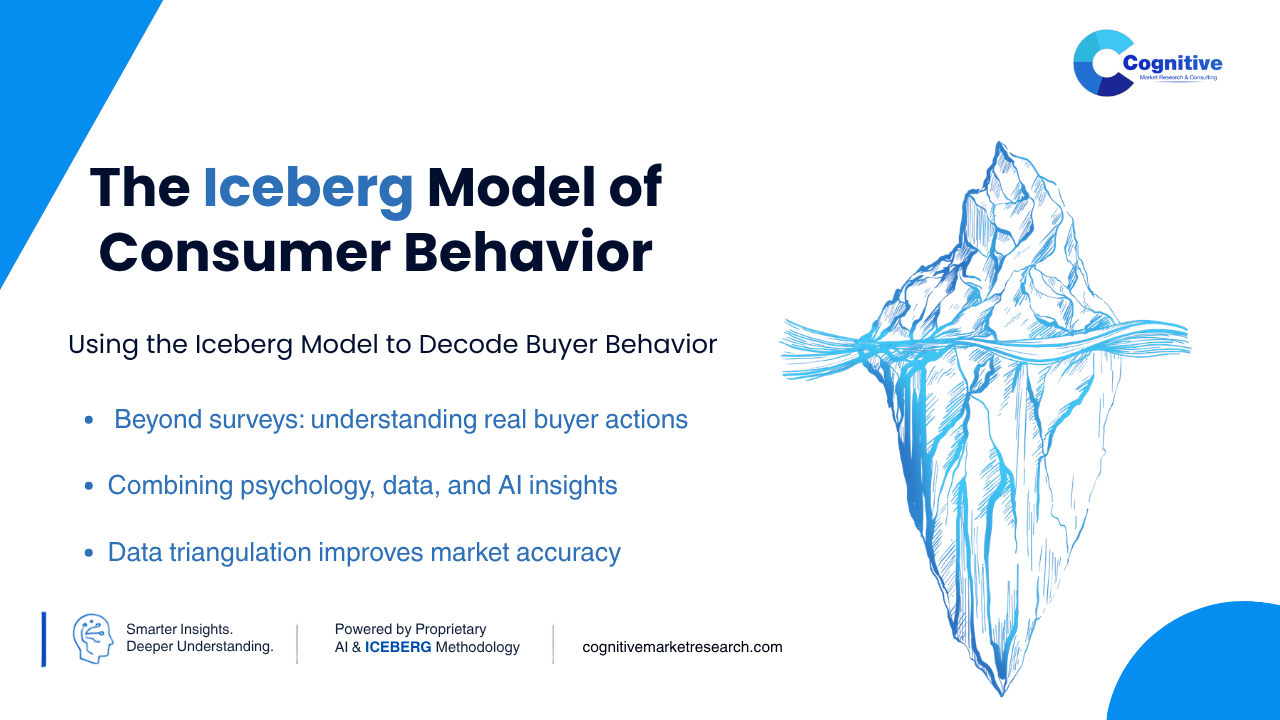
Traditional research captures the tip of the iceberg the visible, conscious declarations made by consumers in controlled environments. The Iceberg Model utilized by Cognitive Market Research and Consulting forces an active look beneath the waterline.
While the top 10% of the iceberg represents rationalized, socially acceptable preferences (like health, sustainability, and brand loyalty), the submerged 90% contains the real catalysts for purchasing decisions: deep-seated subconscious anxieties, immediate convenience priorities, emotional exhaustion, and localized purchasing power pressures. Our tailored consulting frameworks map these hidden drivers, showing brands exactly how split-second psychological shortcuts override long-term intentions at the point of sale.
2. Eliminating the Behavioral Blind Spot
Every human being carries a behavioral blind spot a gap between who they believe they are as a buyer and how they actually behave in real-world retail environments. When focus groups ask consumers about their future habits, they are inadvertently interviewing an idealized version of that person.
Our specialized cognitive.consultation frameworks correct for this by analyzing behavioral friction points. We study the environmental stressors, time constraints, and psychological triggers that turn an aspirational health-conscious consumer into an impulsive comfort buyer, transforming unpredictable retail anomalies into highly accurate predictive models.
3. The Triangulation Method: Overcoming Single-Data Failures
Relying on a single data source is one of the most common errors in modern market analysis. To achieve absolute commercial confidence, Cognitive Market Research and Consulting utilizes a rigorous Triangulation Method. This framework cross-references three distinct operational data streams:
- Quantified Consumer Intelligence: Large-scale, empirical market survey data capturing regional demographics and baseline purchasing patterns.
- Qualitative Consumer Psychology: Deep-dive ethnographic and psychological profiling that uncovers the hidden motives below the waterline.
- Empirical Retail Tracking: Real-time behavioral validation that observes how consumers interact with physical and digital shelves when nobody is watching.
By triangulating these metrics, we eliminate boardroom bias and ensure corporate strategies are fully stress-tested against real-world market conditions.
4. Athenaeum AI : Filtering Unstructured Data Noise
In the era of continuous intelligence, brands are drowning in data but starving for actionable insight. Every day, millions of unstructured data points from social media comments and forum discussions to customer service logs and regional retail reviews are generated across the web.
Our proprietary technology engine, Athenaeum AI, is specifically engineered to process these massive volumes of unstructured data in real time. It cleanly filters out passing internet fads, viral digital noise, and artificial online trends, allowing manufacturers to identify stable, long-term consumer demand trajectories and protect their capital investments from short-term market distortions.
5. Preventing Inventory Stagnation and Supply Chain Friction
When a product launch fails, it is rarely due to poor manufacturing quality; it is almost always due to an assumption mistake regarding consumer behavior. By mapping convenience priorities and hidden economic stressors before factory tooling even begins, our data-backed consulting guarantees that every phase of corporate development actively supports actual consumer needs. This level of precision prevents inventory stagnation, optimizes retail shelf space, and ensures complete synchronicity across the entire supply chain.
Expert Perspective: The Big Four Consultation View
From a premier consultancy standpoint, the modern marketplace no longer rewards retrospective analysis. Historically, corporate strategy teams would review quarterly or annual reports to set next year's operational goals. In today's hyper-fragmented retail ecosystem, that approach is the equivalent of trying to win a grand prix race by looking exclusively through the rearview mirror.
True market validation isn’t about confirming your existing corporate hypothesis; it is about actively stress-testing and disproving it before your competitors do. The brands achieving standout momentum across global markets are those that replace historical assumptions with real-world, real-time consumer intelligence. Moving beyond static PDFs allows enterprise leadership to translate macro noise into micro-segment precision.
Practical Takeaways for Global Brand Leaders
Audit Your Data Streams
Review your current market intelligence framework. If more than 70% of your strategy relies on stated consumer intent surveys or historical sales data, your operation is highly exposed to behavioral blind spots.
Map the Waterline Friction
Identify the exact moments where your consumer's aspirational goals clash with their real-world convenience priorities. Redesign packaging, shelf placement, and messaging to serve the subconscious mind, not just the rationalized intent.
Implement Continuous Triangulation
Stop evaluating product success in isolation. Continuously cross-reference raw volume metrics with qualitative consumer sentiment tracking to spot emerging channel corrections before they impact your bottom line.
Leverage Predictive AI Tools
Use advanced unstructured data analytics to separate temporary social media hype from permanent, structural shifts in localized purchasing power.
Future Outlook: The Era of Behavioral Prediction
The future of global commerce belongs entirely to those who view consumer preferences not as an unreadable enigma, but as an actionable, beautifully detailed roadmap. As automated supply chains and smart logistics infrastructure continue to advance, the window of time available to respond to market changes will shrink from months to days.
The next generation of industry leaders will not wait for sales data to decline before shifting their production lines. Instead, by leveraging connected intelligence networks and deep-dive psychological modeling, they will anticipate shifting consumer anxiety and economic pressures well in advance, securing their market footprint while traditional competitors are still decoding their quarterly reports.
Conclusion: Turning Hidden Risks Into Commercial Confidence
The mystery of the checkout counter isn't an unsolvable problem it is a clear signal that human psychology operates on multiple levels. When brands base their entire financial future solely on the visible top 10% of the consumer mindset, they invite unnecessary risk and operational failure.
By choosing Cognitive Market Research and Consulting, global brands gain access to specialized methodologies like the Iceberg Model, Triangulation frameworks, and Athenaeum AI processing power. Grounding your critical strategic choices in verified consumer sentiment allows your enterprise to confidently navigate market complexities, optimize operational footprints, and cultivate lasting, generational trust with the global consumer base.
About Cognitive Market Research & Consulting
Cognitive Market Research & Consulting is a leading global advisory firm specializing in turning complex human psychology into clear commercial advantages. Utilizing our massive database and an interconnected network of specialized analytical portals, our team of principal market analysts helps enterprise clients and global brand manufacturers de-risk new market opportunities. Through our core pillars including specialized cognitive.consultation, integrated end-to-end solutions, and Athenaeum AI analytics we deliver the verified intelligence required to secure tomorrow's market opportunities today.
FAQs: Understanding the Iceberg Model
Why do traditional focus groups consistently misread consumer purchasing intent?
Traditional focus groups operate in artificial, controlled environments where participants are highly prone to social compliance and confirmation bias. This causes them to share their idealized, rationalized intentions rather than the practical, real-world trade-offs they make under real retail stressors.
What exactly is the waterline in the Iceberg Model?
The waterline represents the boundary between conscious, stated consumer intent and the subconscious emotional drivers underneath. Above the waterline are visible metrics like stated brand preferences; below it are hidden factors like immediate convenience needs, financial anxieties, and environmental habits.
How does the Triangulation Method protect a brand's capital investments?
The Triangulation Method prevents a company from making major investments based on a single, potentially biased data source. By cross-referencing public market surveys, deep qualitative psychology, and real-time behavioral validation, it ensures a brand's strategic roadmap is fully stress-tested against actual consumer behavior.
How does Athenaeum AI identify true consumer demand trajectories?
Athenaeum AI uses advanced unstructured data processing to scan thousands of regional digital data streams simultaneously. It filters out short-term viral noise and passing digital fads, allowing analysts to isolate permanent behavioral patterns and evolving demand trajectories.