Blog Content
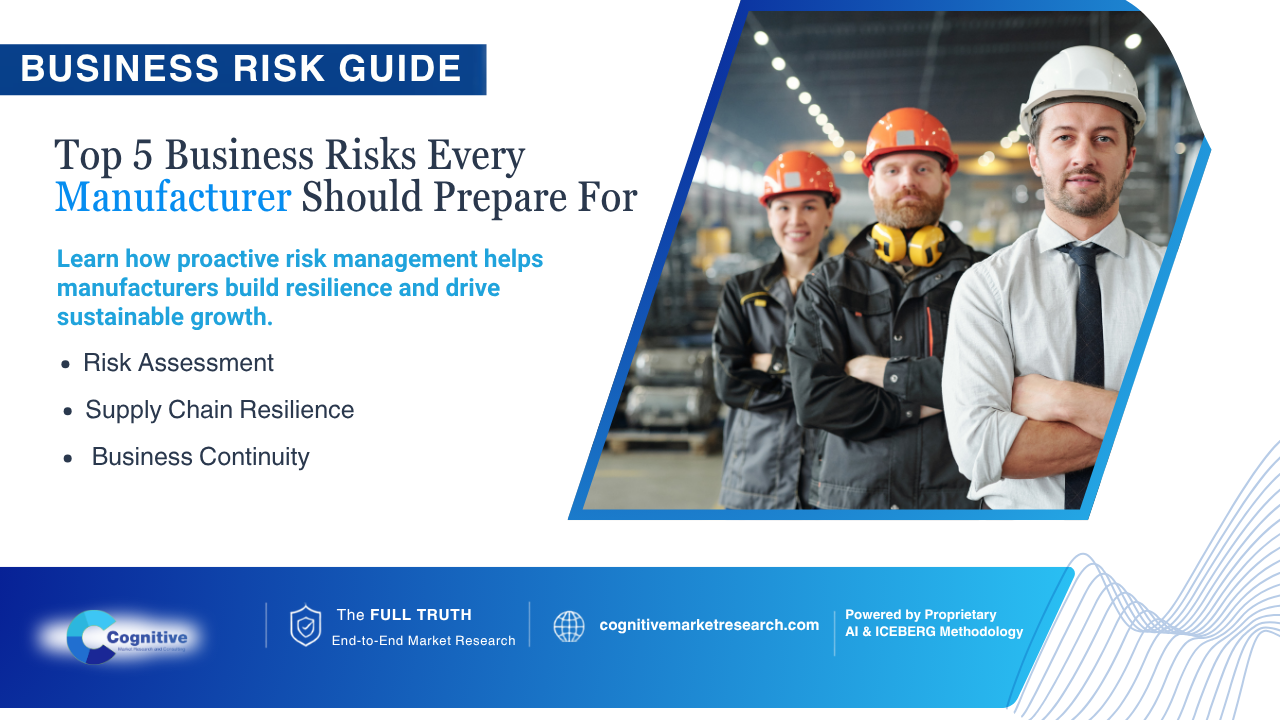
Top 5 Risks in Business and Solutions: A Playbook for Manufacturers and Decision-Makers
Introduction: Navigating Uncertainty and Risk in Business Today
In the high-stakes world of modern manufacturing and enterprise leadership, standing still is the ultimate hazard. Whether you are a plant floor manufacturer managing complex assembly lines, a C-suite decision-maker allocating capital, or a business strategist protecting profit margins, confronting risk in business is an everyday reality.
Every strategic decision carries an inherent business risk. However, the most successful organizations do not attempt to eliminate every variable; instead, they implement structural solutions that transform uncertainty into a competitive advantage. This educational and strategic guide breaks down the theoretical principles of enterprise risk, analyzes the top 5 operational hazards threatening industrial ecosystems today, and explores how advanced intelligence frameworks such as those delivered by Cognitive Market Research and Consulting provide the clarity needed to conquer them.
1.Theoretical Foundations: Understanding Enterprise Risk Management (ERM)
Before analyzing specific industrial threats, it is vital to ground our approach in established organizational theory. Modern risk management has evolved from a siloed compliance checklist into a holistic, enterprise-wide discipline.
The ISO 31000 Standard and Principles of Risk
According to international guidelines such as the ISO 31000 risk management framework, risk is formally defined as "the effect of uncertainty on objectives". This definition carries profound educational and practical implications: it dictates that risk management is not a one-off corporate audit, but a continuous, iterative governance process. The framework emphasizes that effective risk strategies must create value, be integrated into core decision-making, and address human and cultural factors across all operational tiers.
Separating Upside Opportunity from Downside Exposure
A common misconception among business students and junior executives is that all risk is purely negative. In reality, advanced Enterprise Risk Management (ERM) recognizes both downside risk (threats, financial loss, and operational failures) and upside risk (calculated gambles on innovation, market expansion, and new technologies). Managing risk in business successfully means optimizing this balance suppressing avoidable hazards while embracing calculated exposures that drive long-term growth.
2. Risk #1: Global Supply Chain Disruptions & Material Volatility
The Real-World Impact on Factory Floors
For modern manufacturers, a sudden shortage of a single raw material—such as semiconductor chips, specialized aerospace alloys, or eco-friendly packaging polymers can bring an entire multi-million-dollar production line to a grinding halt. When geopolitical tensions or regional energy crises disrupt Tier-2 and Tier-3 suppliers, internal production schedules implode..
The Solution: Proactive Mapping and Cognitive Market Intelligence
To mitigate this major business risk, leaders must move beyond reactive firefighting. Implementing a resilient risk in business framework requires real-time supply chain telemetry and localized sourcing maps.
Example: A heavy machinery manufacturer facing sudden component tariffs uses localized market data to quickly pivot procurement to certified domestic suppliers before inventory reserves run dry. Cognitive Market Research and Consulting provides critical regional intelligence and supply chain vulnerability indices that allow decision-makers to secure raw materials months ahead of market spikes.
3. Risk #2: The Trap of Rear-View Mirror Analytics and Bad Data
Why Historical Trends Fail Modern Manufacturers
A common business risk for data-driven companies is relying too heavily on outdated historical reports. Predictive models trained entirely on past economic cycles often fail to account for structural market shifts, sudden inflation spikes, or rapid automation adoption. Trusting black box algorithms without human context can cause an enterprise to pull the plug on a profitable production line or miscalculate future inventory.
The Solution: Real-Time Data Validation and Decision Intelligence
Decision-makers must enforce rigorous data validation protocols. By pairing automated data feeds with expert human oversight, organizations avoid the trap of automated confirmation bias.
Example: Before investing millions in new factory tooling based on algorithmic forecasts, a consumer electronics maker utilizes expert validation layers to stress-test market demand projections. Cognitive Market Research and Consulting assists executive teams by filtering out noise, ensuring that every financial outlay is backed by verified, primary-sourced market sentiment.
4. Risk #3: Rapidly Escalating Compliance and Regulatory Pressures
Navigating Strict Environmental and Trade Mandates
As global economies shift toward strict net-zero carbon targets, tighter international trade laws, and evolving ISO standards, compliance failure represents a catastrophic risk in business. A single overlooked environmental regulation or customs misclassification can trigger severe financial penalties, product recalls, and long-term brand damage.
The Solution: Integrated Risk Frameworks and Expert Oversight
Compliance cannot be treated as an afterthought handled only at the legal level; it must be embedded directly into plant floor operations.
Example: An automotive parts supplier scaling operations into a new international market aligns its internal systems with unified compliance frameworks (such as ISO 9001, ISO 31000, and NIST RMF). Cognitive Market Research and Consulting delivers tailored regulatory impact studies that help decision-makers anticipate legislative shifts and adjust factory workflows proactively
5. Risk #4: Workforce Skill Gaps and Operational Bottlenecks
The Engineering Talent Shortage
Advanced manufacturing and Industry 5.0 environments require highly specialized technical skills. A persistent business risk across industrial hubs is the severe shortage of skilled CNC programmers, robotics technicians, and data-literate floor supervisors. When experienced talent retires without proper succession planning, machinery downtime increases and error rates climb.
The Solution: Automation Alignment and Cross-Functional Training
Forward-thinking manufacturers combat this vulnerability by investing in continuous upskilling programs and user-friendly operational software that reduces manual complexity.
Example: A precision metal fabrication plant experiencing high training friction implements digital standard operating procedures and partners with industry training networks. By utilizing workforce intelligence reports, leadership can precisely forecast staffing requirements and deploy targeted training programs before output suffers.
6. Risk #5: Strategic Drift and Innovation Stagnation
Building Products for Yesterday's Market
The final hidden business risk is listening too closely to what current customers say they want today, leading to incremental tweaks rather than true innovation. This phenomenon known as strategic drift causes companies to lose market share to disruptive competitors who solve customer problems before clients even articulate them.
The Solution: Uncovering Market White Spaces
Manufacturers must look beyond immediate client echo chambers to identify emerging industry white spaces.
Example: An industrial packaging firm utilizes niche technical forum data and competitor patent tracking to identify an emerging demand for biodegradable shipping containers. Cognitive Market Research and Consulting helps decision-makers map out these untapped commercial segments, enabling R&D teams to design category-defining products with guaranteed market alignment.
Conclusion & Strategic Takeaways
Managing risk in business is no longer about avoiding all threats; it is about building the organizational agility to absorb shocks and execute faster than the competition. For manufacturers and business decision-makers navigating complex industrial environments, relying on verified intelligence is the ultimate safeguard against costly missteps.
Ready to eliminate operational blind spots and secure your next capital investment? Connect with the experts at Cognitive Market Research and Consulting today to turn enterprise risk into measurable competitive advantage.