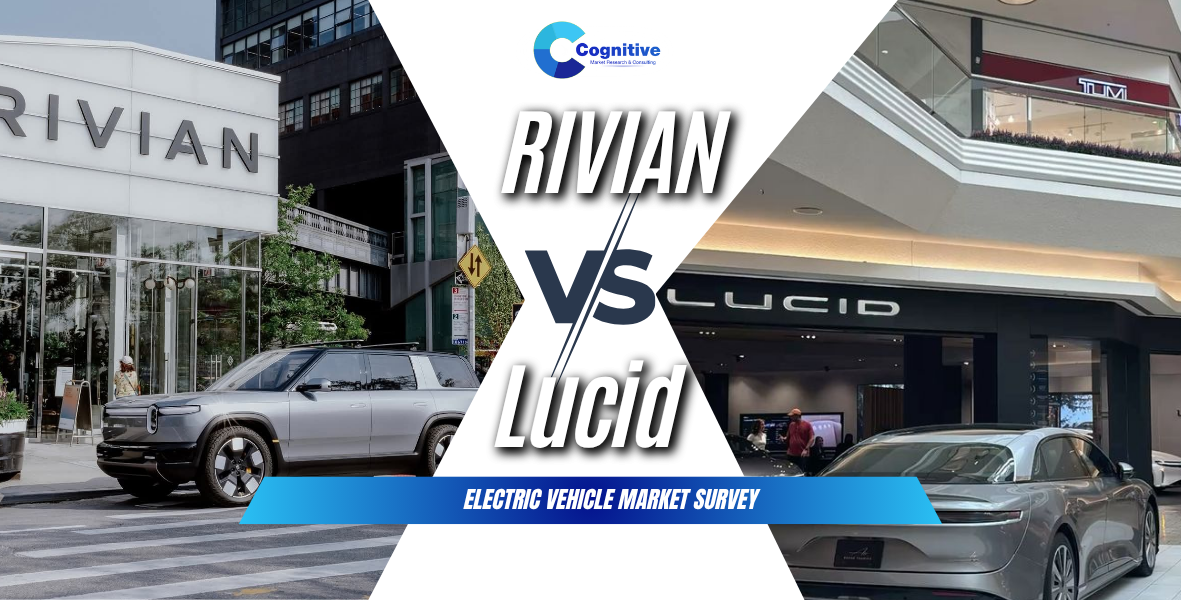
Blog Content
Rivian vs. Lucid Motors: What 1,000+ EV Owners Say About the Electric Vehicle Market in 2026
Key Takeaways
- The adventure-utility EV platform (Rivian) scored 83/100 on the Global Vehicle Versatility and Lifestyle Brand Integration Index, backed by annualized revenues exceeding $5.5 billion and a 10.4% annual growth rate.
- The luxury-efficiency EV platform (Lucid) scored 78/100 on the Luxury Interior Satisfaction and Hyper-Efficiency Index, with consolidated revenues topping $1.35 billion and production guidance of 25,000–27,000 vehicles.
- 71% of EV buyers now rank charging infrastructure reliability and OTA software update frequency alongside range as top purchase factors.
- The global electric vehicle market reached $394.6 billion and is projected to hit $485.5 billion in 2026, growing toward $1.51 trillion by 2035 at a CAGR of 11.24%.
- Vehicle-to-home (V2H) bidirectional charging helped drive an 11.1% increase in premium sedan deliveries in early 2026.
- The broader clean transport sector is projected to reach $890.5 billion by 2035.
Introduction: Two Visions of the Electric Future
The electric vehicle market in 2026 isn't a single race with one winner. It's two very different competitions running on the same road.
One manufacturer built its identity around rugged outdoor utility the go-anywhere family truck that doubles as a mobile power station. The other built around aerodynamic precision and executive luxury the electric sedan that holds highway range records and turns heads in business-class parking garages.
To move past showroom impressions and EV influencer opinions, Cognitive Market Research and Consulting deployed its Electric Vehicle Startup Consumer Voice and Brand Equity Survey, auditing 1,000+ active EV consumers, regional charging infrastructure installers, and automotive logistics managers throughout the first half of 2026.
The result is a data-backed comparison that fleet managers, automotive supply chain executives, and everyday car buyers can use to make smarter decisions. Cross-reference these findings with our Cognitive Consumer Transportation and Lifestyle Preference Surveys and Cognitive Electric Vehicle Industry Analysis and Intelligence Pages the full picture.
Rugged Versatility vs. Aerodynamic Luxury: What Buyers Actually Prioritize
The market separates cleanly along a single axis: lifestyle utility versus powertrain perfection.
Adventure-Forward, High-Utility EV Platforms (Rivian)
Buyers prioritizing all-weather traction, high ground clearance, and genuine outdoor capability gravitated strongly toward the adventure-utility segment. In Cognitive's 2026 Consumer Voice Matrix, this platform scored 83/100 on the Global Vehicle Versatility and Lifestyle Brand Integration Index tracked extensively.
Active families, overlanding enthusiasts, and last-mile commercial operators all contributed to this segment's strength. The financial picture matches the sentiment: annualized global revenues have climbed past a $5.5 billion baseline, growing at a consistent 10.4% annual rate. That kind of sustained commercial health doesn't happen by accident it reflects what happens when a brand builds something people can genuinely imagine using every weekend.
Who this fits: active families, outdoor adventure drivers, commercial delivery operators, fleet managers in suburban and rural corridors.
Buyers prioritizing all-weather traction, high ground clearance, and genuine outdoor capability gravitated strongly toward the adventure-utility segment. In Cognitive's 2026 Consumer Voice Matrix, this platform scored 83/100 on the Global Vehicle Versatility and Lifestyle Brand Integration Index tracked extensively in our Cognitive Commercial Electric Vehicle Market Reports.
Active families, overlanding enthusiasts, and last-mile commercial operators all contributed to this segment's strength. The financial picture matches the sentiment: annualized global revenues have climbed past a $5.5 billion baseline, growing at a consistent 10.4% annual rate. That kind of sustained commercial health doesn't happen by accident it reflects what happens when a brand builds something people can genuinely imagine using every weekend.
Who this fits: active families, outdoor adventure drivers, commercial delivery operators, fleet managers in suburban and rural corridors.
A family of four in Colorado planning ski weekends, camping trips, and school runs needs towing capacity, ground clearance, and enough range to reach a trailhead without range anxiety. The adventure-utility EV solves all three in one vehicle.
Precision Efficiency and Executive Luxury EV Platforms (Lucid)
Buyers seeking world-class highway range, motor miniaturization, and a refined executive cabin experience consistently selected the powertrain-efficiency model. Survey respondents rated this segment 78/100 on the Luxury Interior Satisfaction and Hyper-Efficiency Index.
Consolidated revenues across this segment's broader electronic and propulsion sub-industries crossed $1.35 billion in the latest fiscal cycle, with annual production guidance ramping to 25,000–27,000 vehicles. That production scaling signals a brand moving from proof-of-concept to real market presence still smaller than its utility-focused counterpart, but accelerating.
Who this fits: tech-forward professionals, long-distance highway commuters, executive fleet operators, buyers prioritizing state-of-the-art charging speeds and interior refinement.
A tech executive commuting 200 miles round-trip three times a week needs a car that charges fast, rides quietly, and arrives looking premium. The efficiency-luxury EV covers that without compromise.
Software, Charging, and the New Loyalty Drivers
Range used to be the only EV metric that mattered to buyers. In 2026, that's no longer true.
Our survey data shows that over-the-air (OTA) software updates, smart route planning, bidirectional charging, and connected service ecosystems now influence purchase decisions as significantly as raw battery range.
The market reflects this shift. The global electric vehicle market reached $394.6 billion and is forecast to grow to $485.5 billion in 2026, on a trajectory toward $1.51 trillion by 2035 at an 11.24% CAGR — growth driven not just by battery technology, but by the software ecosystems layered on top of it.
Connected Software Ecosystems Are Now Revenue Drivers
The adventure-utility segment's connected software subscription packages and technical partnerships now account for a meaningful share of recurring service revenue in mature urban markets. Buyers don't just want the vehicle anymore they want the app, the route planner, and the battery preconditioning that works before they even get in the car.
Bidirectional Charging Is Converting Buyers
Vehicle-to-home (V2H) integration and automated parking advancements on the efficiency-luxury side helped drive an 11.1% increase in premium sedan custom deliveries in early 2026. When your car can power your home during a grid outage or export energy back to the grid, the value proposition expands well beyond transportation.
Key takeaway: EV brands competing only on horsepower and range are already behind. The new loyalty battleground is software update frequency, V2H capability, and how seamlessly the vehicle integrates with a buyer's digital life.
Manufacturing Innovation and Long-Term Cost Resilience
Fleet managers and supply chain evaluators thinking beyond the purchase price care about two things: how efficiently the vehicle is built and how reliably parts can be sourced.
Our survey data links both factors directly to buyer confidence.
Manufacturers using zonal electronics architectures, automated robotic welding arrays, and integrated mega-casting processes report a 15–28% reduction in factory production hours and unplanned assembly downtime over multi-year cycles. That efficiency cushion matters most when lithium, nickel, and rare earth material costs shift it's the difference between protecting margins and absorbing losses.
For detailed factory overhead projections, see our Cognitive Advanced Automotive Manufacturing Economics and Factory Automation Studies
Supply chain localization compounds the benefit. Brands coordinating closely with local battery cell cooperatives and regional electric motor networks ensure that high-capacity modules, electronic drive units, and sensor arrays reach assembly hubs without logistics delays. That speed keeps delivery schedules tight and inventory gaps narrow both of which feed directly into customer satisfaction scores.
The Bigger Picture: Clean Transport Market to 2035
Both brands operate inside a market undergoing structural expansion, not just cyclical growth.
The broader clean transportation sector spanning personal EVs, commercial electric fleets, and electric delivery infrastructure is projected to reach a standalone valuation of $890.5 billion by 2035. Much of that growth depends on expanded charging infrastructure, continued battery cost reduction, and regulatory tailwinds across North America, Europe, and Asia-Pacific.
Our 2026 Global Brand Health Index shows that manufacturers aligning early with modular platform scaling, carbon-neutral assembly practices, and next-generation product lines (midsize SUVs, electric delivery vans, urban mobility vehicles) are best positioned to capture that expansion. These trends are tracked in real time across our Cognitive Electronic Powertrain Infrastructure Reports.
The Analyst's Verdict: Match the Vehicle to the Life, Not the Other Way Around
From Cognitive Market Research and Consulting's perspective, the 2026 EV market doesn't have a winner it has two very well-executed strategies aimed at different buyers.
Choose the adventure-utility segment (Rivian) if you need:
- Off-road traction, high ground clearance, and towing capacity
- A vehicle that doubles as a worksite power source
- Brand recognition in outdoor, active lifestyle communities
- Confidence from a $5.5 billion revenue base and proven commercial scale
Choose the efficiency-luxury segment (Lucid) if you need:
- Best-in-class highway range and ultra-efficient powertrain architecture
- Executive-grade interior refinement and aerodynamic design
- Cutting-edge V2H charging and premium software integration
- A vehicle that signals both environmental responsibility and technical sophistication
Both are succeeding because they're solving real, distinct problems for real, distinct buyers. The global electric vehicle market is large enough and growing fast enough to support both approaches at scale.
