Blog Content
Was AI Used? New Transparency Rules for Market Research
AI transparency in market research has moved from a nice idea to a standard the industry is expected to meet. Three developments have landed within a few weeks of each other. On 2 August 2026, the EU AI Act's Article 50 transparency and information obligations became generally applicable and enforceable by national authorities across the EU. A month later, ESOMAR set up an AI Alliance to bring together industry experts and community voices to develop guidance and shared perspectives on the responsible use of AI in research, insights and analytics. In India, the industry's own code now asks the same thing.
For anyone who buys market research, this is good news. You now have a clear, simple question to ask every provider: was AI used, and how?
What changed in September 2026?
The ESOMAR Congress in Valencia (1–4 September) made AI governance the main topic of the year. The new Alliance reflects ESOMAR's decision to make AI one of the two key pillars of its Strategy 2030 mission. Its first workstream covers ethics, the Code and quality, including alignment with the ICC/Esomar Code and principles around transparency, consent, bias, governance and quality.
The discussion has also become more practical. One attendee reported that ESOMAR is already developing guidance on working with synthetic populations and digital twins and on assessing their quality, as the conversation shifts from Can we do this? to When can we trust it?
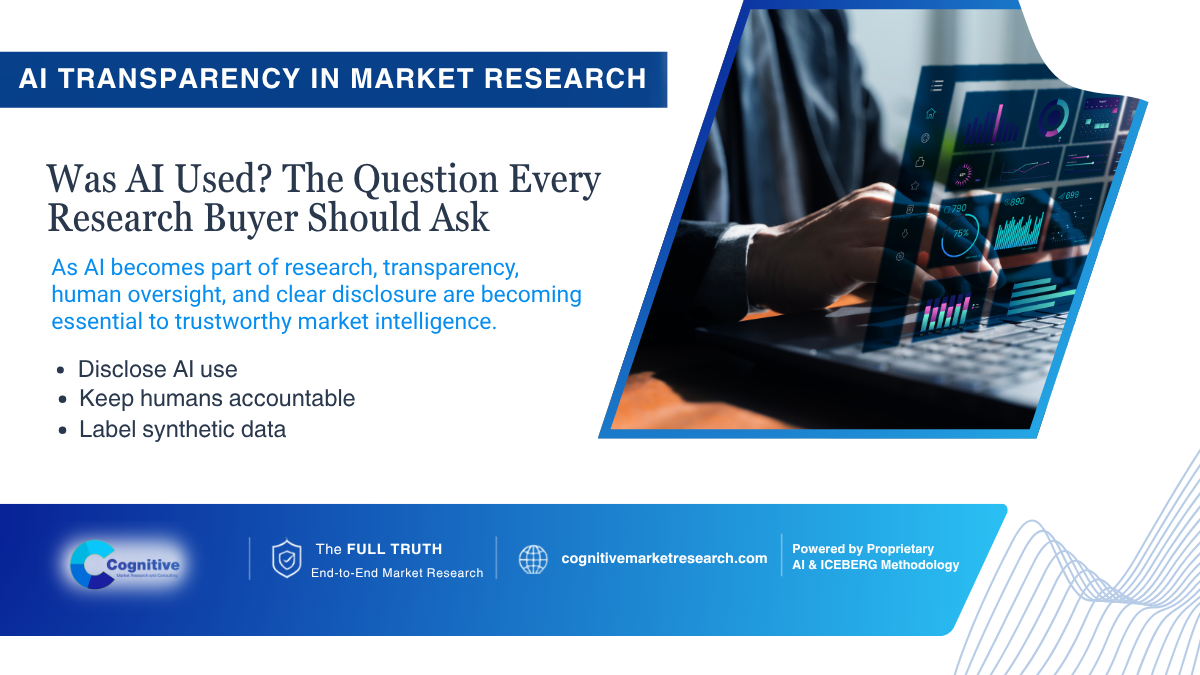
Key takeaway: Using AI in research is not the risk. Hiding it is.
What does the ESOMAR Code require?
The global ethics code for research was rewritten in 2025. It was formally adopted at ESOMAR's AGM, validated by the ICC Executive Board, and is the most substantial revision to the Code in nearly a decade.
The most important clause for buyers is short. Under the Code, clients must be told when AI or other emerging technologies are used to compile datasets, analyse, report or interpret findings, including synthetic data and synthetic personas, and the extent of human oversight must be stated. Researchers must also keep research data and client materials confidential when they are processed by AI tools.
The Code also spreads responsibility across everyone involved. Ethical accountability can no longer be outsourced: clients, researchers, platforms and subcontractors are each responsible for upholding the Code within their part of the process.
Why does this matter for Indian research buyers?
India is already on board. The Market Research Society of India (MRSI) has adopted the ICC/ESOMAR International Code 2025, which takes into account the growing use of AI, synthetic and secondary data, and the need for high levels of trust in market research.
Among the MRSI-highlighted updates, data minimisation limits collection to what the research purpose needs and requires personal data to be anonymised after use, and the fit-for-purpose principle requires research designs that accurately reflect the population being studied, including when self-service platforms are used.
India's privacy law is moving in the same direction. The DPDP framework is being introduced in three phases: the Data Protection Board from November 2025, the consent manager framework from November 2026, and all remaining substantive compliance obligations from May 2027. Taken together, the Code and the law tell research firms the same thing: collect less, explain more, and document everything.

Where does the EU AI Act fit in?
Article 50 is narrower than many headlines suggest, but it matters for research that uses chatbots or generative tools. Its duties apply to any product that talks to users or generates images, audio, video or text, whether or not the system is classified as high-risk. For research, that most directly affects AI-moderated interviews and chatbot-style surveys, where participants should know they are talking to a machine.
There is one timing detail. A limited grace period until 2 December 2026 applies only to AI systems already on the market before 2 August 2026, and only for the obligation to mark AI-generated content.
Much of the coverage focused on delays to other parts of the Act. The Digital Omnibus pushed high-risk Annex III deadlines to December 2027, but it explicitly left Article 50 unchanged. Indian firms that serve EU clients or interview EU respondents should check their exposure with legal counsel.
How should market research be done the right way?
At Cognitive Market Research, we see AI as a way to speed up research, not a replacement for judgement. This is how responsible AI-assisted research works in practice:
- Humans set the question. Analysts define the scope, segmentation and assumptions before any tool is used.
- Real data comes first. Primary interviews, company filings, trade data and verified secondary sources form the evidence base. AI helps organise that evidence and speed up analysis, but it does not produce the evidence.
- Synthetic data is labelled, never passed off as real. When modelling or synthetic boosting is used for hard-to-reach segments, it is disclosed and checked against real benchmarks.
- Every number gets a human sign-off. Market sizes, CAGRs and forecasts are cross-checked by analysts through triangulation (top-down, bottom-up and supply-side).
- Confidential inputs stay protected. Client and respondent data is not entered into AI tools unless there are safeguards in place.
Done this way, AI makes research faster and more consistent while people remain accountable for the conclusions.
What should you ask before buying a research report?

For manufacturers, whose capacity plans, pricing and market-entry decisions rest on forecasts, the most important question is whether a human validated the numbers. For buyers and end-users choosing suppliers or technologies, the question is whether findings came from real market evidence or from modelled assumptions.
A credible provider should be able to answer all five questions in writing. Transparency is quickly becoming a way to tell good research apart from the rest.
How we researched this article: We reviewed the published ICC/ESOMAR Code text, European Commission guidance on Article 50, MRSI's adoption announcement, India's notified DPDP timelines, and industry reporting from the ESOMAR Congress 2026. We cross-checked each date against at least one primary or legal source.
The bottom line
AI transparency in market research is not a burden. It gives buyers a reason to trust the findings. Standards bodies, regulators and India's own research society now agree on the basics: disclose AI use, label synthetic data, and keep a human accountable.
Planning a product launch, expansion or procurement decision? Talk to Cognitive Market Research and Consulting for analyst-validated market intelligence, with clear disclosure of how every insight was built.