Article
Introduction of Satellite Payload Market / Industry:
The satellite payload market is witnessing significant expansion, driven by the increasing deployment of satellites for communications, Earth observation, navigation, and scientific research. According to Cognitive Market Research, the market is valued at USD 4,124.5 million in 2024 and is projected to expand at a compound annual growth rate (CAGR) of 25.20%, reaching USD 24,900.4 million by 2032. Satellite payloads, comprising mission-specific instruments such as transponders, sensors, and scientific payloads, play a critical role in enhancing satellite functionality across various applications. The rising demand for high-speed connectivity, growing investments in space exploration, and advancements in miniaturized satellite technologies are key drivers fueling market growth. Increasing private-sector participation, alongside government-led space initiatives, is fostering innovation and accelerating the deployment of advanced satellite payloads. The surge in low Earth orbit (LEO) satellite constellations for broadband internet services, driven by companies such as SpaceX and Amazon, is significantly boosting market expansion. Additionally, the growing importance of geospatial intelligence, climate monitoring, and defense surveillance has led to increased adoption of high-resolution imaging and signal intelligence payloads. Leading players are investing in R&D to develop lightweight, high-performance payloads with enhanced power efficiency and communication capabilities. The Asia-Pacific region, with emerging space programs in China, India, and Japan, presents substantial growth opportunities, while North America and Europe continue to lead in satellite innovation and government-backed space missions. As the market evolves, the integration of artificial intelligence (AI), quantum communication, and advanced sensor technologies in satellite payloads will redefine industry competition. Companies focusing on payload miniaturization, cost-effective manufacturing, and strategic partnerships will drive the future of the satellite payload market.
Top Companies Operating in the Satellite Payload Industry Worldwide
- Lockheed Martin Corporation
- Northrop Grumman
- Raytheon Technologies Corporation
- Thales Alenia Space
- L3Harris Technologies, Inc
- Airbus Defence and Space
- Sierra Nevada Corporation
- SpaceX
- The Boeing Company
- Honeywell International Inc.
Criteria for Comparing Companies in the Satellite Payload Market:
Cognitive Market Research has assessed companies in the satellite payload market using key parameters that emphasize their competitive positioning and performance within the industry. Revenue and market share serve as primary indicators of a company's financial health and market leadership. A higher revenue reflects strong sales performance, underscoring the high demand for the company’s offerings in a competitive marketplace. The product portfolio of each company is evaluated based on the variety and quality of satellite payloads they offer, including communication, navigation, remote sensing, and scientific payloads. Detailed attention is given to product features such as frequency bandwidth, power efficiency, weight optimization, and adaptability for different satellite orbits, including geostationary (GEO), medium Earth orbit (MEO), and low Earth orbit (LEO). Companies excelling in developing high-performance, miniaturized, and AI-integrated payloads gain a competitive edge. Technological innovations and product characteristics are critical in assessing a company's ability to meet evolving industry standards. Firms investing in advanced digital payloads, optical communication systems, and high-throughput satellite (HTS) technologies demonstrate their capacity for innovation. Companies offering customized solutions for emerging trends, such as deep-space exploration, space-based data analytics, and quantum encryption communication, stand out. Another crucial factor is global presence, reflecting a company's capability to serve diverse markets effectively and maintain a strong customer base across regions. Firms with extensive partnerships with space agencies such as NASA, ESA, and ISRO, as well as private satellite operators, are better positioned to capitalize on regional opportunities. Investment in research and development (R&D) highlights a company's commitment to innovation and adaptability to changing market demands. Companies with significant R&D expenditures often lead in developing next-generation payload technologies that enhance satellite efficiency, performance, and operational lifespan. Additionally, strategic alliances and collaborations with space launch service providers, satellite manufacturers, and telecommunications companies are essential for expanding market reach and improving product offerings. Partnerships with emerging commercial space firms also enhance growth prospects. Analyzing companies based on these parameters provides a comprehensive understanding of their strengths, competitive advantages, and growth potential in the dynamic satellite payload market. Businesses prioritizing technological advancements, cost-effective production, and strategic collaborations are best positioned to thrive in this evolving landscape.
Top Manufacturing Companies of Satellite Payload:
Lockheed Martin Corporation, Northrop Grumman, Raytheon Technologies Corporation, Thales Alenia Space, and L3Harris Technologies, Inc. are the key players in the Satellite Payload Market
Lockheed Martin Corporation
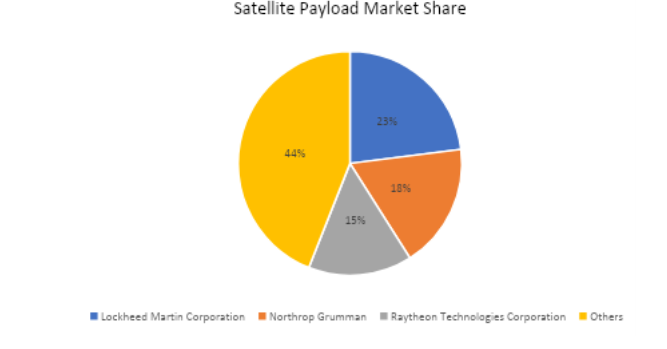
Lockheed Martin Corporation is the leading player in the global satellite payload market, holding a dominant market share of 23%. The company’s strong position is driven by its advanced payload technologies, robust space infrastructure, and extensive government and commercial contracts. Lockheed Martin designs and manufactures high-performance satellite payloads that support a broad range of applications, including communications, Earth observation, remote sensing, and defense. The company’s flagship payload solutions, such as the A2100 satellite bus and LM 400 series, offer unparalleled flexibility, high power efficiency, and advanced signal processing capabilities.
Northrop Grumman Corporation
Northrop Grumman Corporation holds a significant 18% market share in the satellite payload industry, leveraging its expertise in high-performance sensor technologies, secure communications payloads, and cutting-edge space exploration systems. The company plays a crucial role in providing payloads for both defense and commercial applications, including intelligence, surveillance, reconnaissance (ISR), and environmental monitoring. Its payload solutions, such as the highly adaptable ESPAStar platform, are widely used in national security satellites and commercial communication systems.
Raytheon Technologies Corporation
Raytheon Technologies Corporation holds a robust 15% market share in the global satellite payload market, driven by its expertise in radar, electro-optical, and hyperspectral imaging payloads. The company provides critical payloads for government, military, and commercial satellite applications, supporting key areas such as missile defense, space-based surveillance, and environmental monitoring. Raytheon’s signature payload offerings, including the Advanced GPS OCX system and space-based infrared sensors, have set industry standards for precision, reliability, and secure data transmission.
Thales Alenia Space
Thales Alenia Space holds a 7% market share in the satellite payload market, specializing in high-performance telecommunications, Earth observation, and navigation payloads. As a joint venture between Thales Group and Leonardo S.p.A., the company benefits from strong European aerospace expertise and a well-established global presence. Thales Alenia Space has been a key supplier of payloads for major satellite constellations, including Galileo, Iridium NEXT, and SES broadband satellites.
L3Harris Technologies, Inc.
L3Harris Technologies, Inc. holds a 5% market share in the satellite payload industry, specializing in ISR, secure communications, and defense-grade imaging payloads. The company is recognized for its expertise in developing payloads for military and intelligence agencies, as well as its contributions to commercial space missions. L3Harris has been a key provider of sensor payloads for the U.S. Space Force and NASA, supporting critical missions related to missile detection, climate monitoring, and deep-space exploration.
Potential Threats to Top Five Players in the Satellite Payload Market:
CMR found emerging players in the satellite payload market, such as Airbus Defence and Space, Sierra Nevada Corporation, SpaceX, The Boeing Company, and Honeywell International Inc., are increasingly positioning themselves as significant threats to the dominance of the top five companies. These firms are leveraging innovation, regional expansions, and strategic collaborations to carve out competitive advantages and challenge established market leaders.
Airbus Defence and Space, a European aerospace giant, is renowned for its advanced satellite payload technologies, including high-resolution imaging and secure communication systems. The company’s focus on expanding its capabilities in geostationary and low Earth orbit (LEO) satellites, coupled with significant investments in AI-driven data processing, positions it as a formidable competitor. Sierra Nevada Corporation is another rising challenger, with its strong emphasis on modular and scalable satellite payload solutions. The company has made notable advancements in space-based sensors and communication payloads, catering to both commercial and defense sectors. Its partnerships with governmental agencies and private space organizations further bolster its market position. SpaceX has emerged as a disruptive force in the satellite payload market, leveraging its Starlink constellation and rapid deployment capabilities. The company’s vertically integrated approach, cost-efficient reusable rocket technology, and continuous advancements in satellite miniaturization are reshaping industry dynamics and challenging incumbents.
The Boeing Company continues to strengthen its presence in the satellite payload sector through its expertise in high-throughput communications and space-based surveillance systems. Recent investments in next-generation satellite bus platforms and proprietary payload technologies enhance its ability to cater to evolving market demands. Honeywell International Inc. is gaining traction with its innovative satellite payload solutions, particularly in secure communications and navigation systems. The company’s commitment to R&D and strategic collaborations with key space agencies position it as a competitive player in the market. These emerging companies are gaining traction through innovation, cost efficiency, sustainability, and strategic market expansions. Their ability to offer high-performance products tailored to evolving market demands, coupled with increasing global footprints, positions them as significant threats to the top five players in the satellite payload market. As they continue to invest in R&D, expand capacities, and forge strategic collaborations, these firms are well-equipped to disrupt the market dynamics and challenge the incumbents’ dominance.
Conclusion
Focus on R&D Capabilities and Product Diversification to Drive Growth in the Satellite Payload Market.
The satellite payload market is undergoing significant transformation, with robust growth potential and evolving competitive dynamics that present both opportunities and challenges. Valued at USD 4,124.5 million in 2024, the market is projected to reach USD 24,900.4 million by 2032, expanding at a CAGR of 25.20%. Key drivers of this growth include the increasing demand for high-throughput satellite communications, advancements in Earth observation technologies, and rising investments in space exploration and security. The competitive landscape in the satellite payload market is a mix of consolidation and fragmentation. Leading players such as Lockheed Martin Corporation, Northrop Grumman Corporation, Thales Alenia Space, L3Harris Technologies Inc., and Raytheon Technologies Corporation hold significant market shares and benefit from their strong R&D capabilities, extensive product portfolios, and established global presence. These major players continue to invest in advanced payload technologies, including AI-driven processing, optical communication, and quantum encryption, to meet the growing demand for high-performance satellite systems. Looking ahead, companies that can effectively balance innovation with cost efficiency, expand their product offerings, and adapt to shifting global trends, such as the rise of mega-constellations and software-defined satellites, will be well-positioned for success. The ability to invest in R&D and diversify product portfolios focusing on high-performance, scalable, and secure satellite payloads will be critical for companies to maintain their competitive edge and drive long-term growth in this evolving market. As demand for next-generation satellite payloads continues to rise, the market will present a dynamic environment where innovation and strategic expansion will determine the leaders of tomorrow.

 X
X
Article Details
-
Author Anushka Gore
-
Published 14 Mar 2025
-
Last Updated 05 Jul 2025
-
Reading Time~3 minutes
Related Reports
Get a Custom Report
Interested in a similar analysis for your market? Our experts can deliver a customized report.
Contact Our ExpertsMore Articles
Explore all published articles across 30+ industry verticals.
View All Articles