Article
Introduction to the Cattle Feed Market
The global cattle feed market is expanding steadily, driven by rising global meat and dairy consumption, growing livestock populations, and an increasing focus on enhancing animal health, nutrition, and productivity. According to Cognitive Market Research, the market size for cattle feed is projected to reach USD 93,524.8 million in 2024 and is anticipated to grow to USD 124,109.4 million by 2032, reflecting a compound annual growth rate (CAGR) of 3.60%. This steady growth indicates the fundamental role cattle feed plays in the modern livestock sector and highlights its importance in meeting food security and efficiency goals. The increasing shift toward intensive livestock farming practices, particularly in emerging economies, continues to generate strong demand for scientifically formulated and nutritionally balanced feed products tailored to specific production outcomes. Cattle feed serves a crucial role in livestock nutrition, providing essential energy, proteins, minerals, and vitamins required to support animal growth, reproductive health, and disease resistance. As consumer expectations for higher-quality meat and dairy products rise especially in urban and export markets producers are adopting advanced feeding strategies to achieve superior output while ensuring animal welfare and environmental compliance. The gradual replacement of traditional feeding methods with commercial compound feeds, as well as the incorporation of feed additives that boost digestion, improve immunity, and reduce emissions, is further enhancing the value and importance of this market. Innovations in feed technology and increasing awareness of animal health have led to greater product differentiation and improved feed efficiency across global markets.
Top Companies Operating in the Cattle Feed Industry Worldwide
- Cargill Inc
- ADM
- ForFarmers Inc.
- De Heus
- Land O'Lakes, Inc.
- Nutreco
- Alltech
- Charoen Pokphand Group
- Purina Animal Nutrition
- Godrej Agrovet
Criteria for Comparing Companies in the Cattle Feed Market
According to Cognitive Market Research, companies in the cattle feed industry are evaluated based on several competitive criteria, including the nutritional performance of their feed products, diversity and specialization in their feed formulations, raw material sourcing strategies, and adherence to international safety, traceability, and quality standards. Market leaders are distinguished by their ability to offer customized solutions for different livestock breeds and production systems, whether focused on dairy or beef cattle, pasture-based or confined operations, or region-specific requirements. Advanced feed players are also embracing sustainability, offering formulations that lower methane emissions, improve feed conversion ratios, and contribute to long-term animal health. R&D capabilities and innovation in functional additives such as enzymes, probiotics, essential oils, and amino acid blends are emerging as key competitive differentiators. Companies such as Cargill, Archer Daniels Midland (ADM), Alltech, and Land O’Lakes are expanding their global footprint by developing high-performance feeds backed by animal nutrition science and precision livestock technologies. These firms are also leveraging digital platforms to deliver tailored feeding programs, real-time analytics, and technical services to support livestock productivity at the farm level. Furthermore, their investments in sustainable sourcing and circular agriculture practices are helping meet growing regulatory and consumer demands for environmentally responsible animal protein production. As the market evolves, companies that offer cost-effective, efficient, and sustainable feed solutions with strong technical and after-sales support are poised to lead the cattle feed sector through the coming decade.
Manufacturing Companies of Cattle Feed:
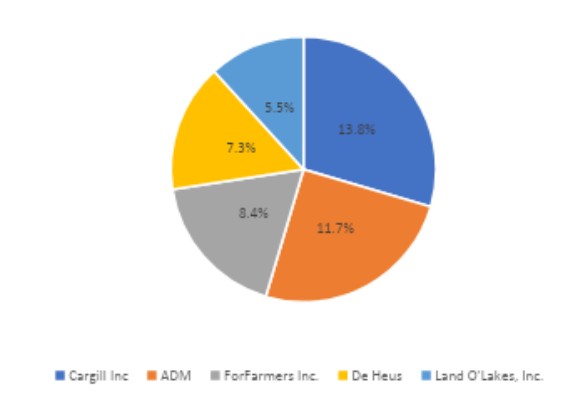
Cargill Inc., ADM, ForFarmers Inc., De Heus, and Land O'Lakes, Inc. are the key players in the Cattle Feed Market
Cargill Inc
Cargill Inc. leads the Cattle Feed Market with a substantial 13.8% market share, reflecting its position as a global agribusiness powerhouse with a diversified and innovative portfolio of animal nutrition products. The company provides a wide range of feed formulations tailored for beef and dairy cattle, including complete feeds, concentrates, premixes, and mineral blends. Cargill leverages advanced research in animal health and performance, ensuring its products enhance digestibility, growth rate, immune function, and milk yield.
ADM (Archer Daniels Midland Company)
ADM ranks as a close second with an 11.7% share in the Cattle Feed Market, backed by its wide-ranging capabilities in ingredient processing, feed formulation, and livestock nutrition science. The company offers high-quality feed products developed through cutting-edge research into cattle metabolism, rumen health, and nutrient absorption. ADM’s cattle feed portfolio includes customized blends for various production stages, from calves to lactating and finishing cattle, ensuring optimal productivity and animal welfare.
ForFarmers Inc.
Holding an 8.4% market share, ForFarmers Inc. is a major force in the European cattle feed sector, delivering comprehensive nutritional solutions that promote animal health, farm profitability, and sustainable production. The company offers specialized feeds for dairy and beef cattle, covering compound feed, blends, and co-products designed to meet varying needs across the lifecycle.
De Heus
De Heus commands a solid 7.3% share in the Cattle Feed Market, renowned for its global reach and tailored livestock feed offerings. The company has a strong footprint in both emerging and developed markets, with operations spanning Europe, Asia, Africa, and Latin America. De Heus provides complete and customized nutrition solutions for dairy and beef cattle, built on extensive R&D and local market knowledge.
Land O'Lakes, Inc.
Land O'Lakes, Inc., through its Purina Animal Nutrition division, holds a 5.5% market share, focusing on delivering value-added feed solutions primarily in North America. The company specializes in innovative cattle feed products, including texturized feeds, supplements, calf starters, and mineral mixes, developed with the help of a proprietary research farm and state-of-the-art laboratories.
Potential Threats to Top Five Players in the Cattle Feed Market:
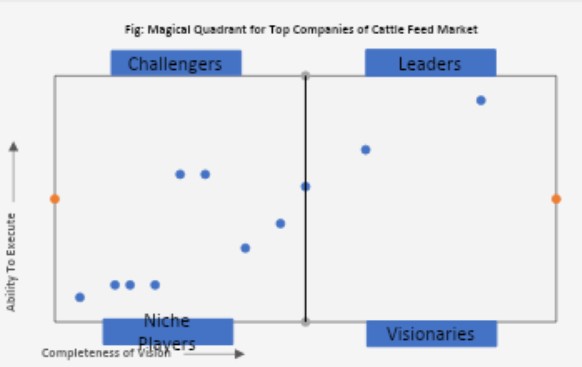
CMR identified a group of emerging companies in the cattle feed market Nutreco, Alltech, Charoen Pokphand Group, Purina Animal Nutrition, and Godrej Agrovet that are rapidly positioning themselves as significant threats to established leaders. Based in the Netherlands, Nutreco is recognized globally for its expertise in animal nutrition and aquafeed. Through its subsidiaries such as Trouw Nutrition, Nutreco emphasizes innovation in feed efficiency, animal health, and sustainable agriculture. Its commitment to reducing the carbon footprint in feed production and expanding operations in Asia and Latin America enhances its strategic position and competitive threat. U.S.-based Alltech leverages advanced nutritional technologies and fermentation-based products to deliver high-performance cattle feed. The company’s research-driven approach, combined with its focus on trace mineral management and gut health, enables it to offer differentiated solutions tailored to modern livestock challenges. Alltech’s global footprint, including its strong presence in North America, Asia-Pacific, and Europe, further strengthens its position against traditional feed giants.
Charoen Pokphand Group, headquartered in Thailand, has established a massive integrated agri-food supply chain across Asia. The company is investing heavily in livestock nutrition, precision farming, and feed production technologies, allowing it to offer competitively priced and customized feed solutions. Its aggressive expansion into countries like India, Vietnam, and China reflects its intent to dominate the cattle feed segment across emerging markets. Purina Animal Nutrition, a subsidiary of Land O’Lakes, focuses on delivering performance-based animal feed products. With a strong distribution network in the United States and an extensive R&D infrastructure, Purina continues to innovate formulations to improve cattle productivity and health outcomes. Their focus on advanced digital tools to monitor cattle performance adds a smart-tech edge that challenges traditional competitors. India-based Godrej Agrovet is expanding its footprint in the domestic and regional cattle feed markets. Leveraging its deep understanding of local agricultural practices, the company offers cost-effective and nutrient-optimized feed products for dairy and beef cattle. With a growing emphasis on sustainable sourcing and farmer education, Godrej Agrovet is emerging as a serious challenger to multinational feed providers. These emerging players are disrupting the cattle feed market through innovation, regional expansion, and tailored nutrition solutions. By focusing on sustainability, affordability, and modern farming practices, they are challenging the dominance of traditional leaders and influencing the competitive dynamics of the industry.
Conclusion
Focus Towards Sustainable Nutrition and Technology Integration to Fuel Growth in the Cattle Feed Market
The global cattle feed market is on a steady upward trajectory, projected to grow from USD 93,524.8 million in 2024 to USD 124,109.4 million by 2032, at a CAGR of 3.60%. This growth is driven by rising global demand for dairy and beef products, coupled with increased awareness about livestock health and productivity. As regulatory scrutiny intensifies and consumers prioritize traceable, safe, and sustainable animal products, the role of high-quality cattle feed becomes increasingly crucial. Top companies such as Cargill, Archer Daniels Midland (ADM), De Heus Animal Nutrition, ForFarmers, and Land O’Lakes are leading the market through strong R&D, extensive distribution networks, and innovative product portfolios. Their ability to integrate digital technologies and maintain close relationships with large farming operations enables them to remain ahead in this evolving landscape. However, emerging players like Nutreco, Alltech, and Charoen Pokphand Group are rapidly closing the gap by delivering disruptive technologies, locally adapted formulations, and sustainability-focused products. The market’s dynamic nature is creating ample space for innovation and niche offerings, especially in rapidly developing regions. For new entrants, the path to success lies in leveraging advanced nutritional science, building local partnerships, and embracing sustainable and smart farming practices. The future of the cattle feed market is deeply tied to its ability to support food security, enhance animal welfare, and reduce the environmental impact of livestock farming. In this context, collaboration among feed manufacturers, technology providers, and regulators will be instrumental in shaping a resilient and inclusive cattle feed ecosystem.

 X
X
Article Details
-
Author Pratik Shirsath
-
Published 06 Jun 2025
-
Last Updated 16 Jun 2025
-
Reading Time~3 minutes
Related Reports
Get a Custom Report
Interested in a similar analysis for your market? Our experts can deliver a customized report.
Contact Our ExpertsMore Articles
Explore all published articles across 30+ industry verticals.
View All Articles