Article
Advanced Chemicals Market: How Top Manufacturers Are Growing Through Capacity and Partnerships
The advanced chemicals market is moving toward regional capacity, partnerships and portfolio focus, and top manufacturers are showing how those moves work in practice. Cognitive Market Research values the market at USD 166.4 million in 2025, with demand drivers including electric vehicles, 5G and sustainability rules.
Verification method and date window for this advanced chemicals market analysis
Sources were weighted in this order: company announcements and investor disclosures first, then regulator filings, then reputable business news. Developments were limited to January through November 2026, and each one is dated and tied to the company that announced it.
Market figures come from the Cognitive Market Research report on this market, and its headline values are stated in USD million, so those values are used throughout. Any deal value, capacity or revenue figure that a company did not disclose has been left out. Several companies in the report's listed set had no dated development that could be confirmed in this window, so they appear only where verified facts exist. The published research methodology describes how this underlying data is gathered.
Which strategies are top manufacturers using in the advanced chemicals market?
Industry-level context for these moves sits in the specialty chemicals industry analysis. The strategies in use include capacity additions, regional localization, distribution partnerships, mergers and divestments, joint ventures and product launches in adjacent applications. Each fits different conditions, including capital position, regulation, customer proximity and supply chain access.
When do capacity additions suit an advanced chemicals manufacturer?
Capacity additions tend to fit producers with a strong capital position, predictable permitting, proximity to end customers and dependable feedstock access. Most projects are tied to a named product line and a customer region. Arkema's March 2026 plan adds 20 percent to Kynar PVDF output at Changshu, China, with start-up expected in 2028, aimed at battery, coatings and electronics demand.
How does regional localization fit the Asia Pacific opportunity?
The report places Asia Pacific at 36.5 percent of 2025 global market value, with industrialization in China and India cited as a core driver. Localization fits manufacturers that need fast delivery or must meet local rules. An investment agreement for a new electronic materials production site in Nanjing, China, was signed by BASF in November 2026 under its local-for-local approach.
Distribution partnerships for advanced chemicals market entry
Distribution partnerships suit manufacturers that want coverage in a new country without building a full sales team. They work best when the product needs technical support and the partner already has local customer access. Evonik's VISIOMER specialty methacrylates now reach US formulators through a broader IMCD arrangement, announced in March 2026 and extending an earlier collaboration in Brazil and Canada. A streamlined North American distribution network for Evonik Coating Additives took effect on 1 May 2026, with an exclusive partner named for Canada.
When do mergers and acquisitions fit advanced chemicals portfolio goals?
Mergers and acquisitions fit when a manufacturer needs a specific technology, a faster route into a market or a sharper portfolio. Divestments can fund core lines in the same way. Evonik moved Hanau-based production assets for pharmaceutical ingredients to ProChem on 19 June 2026, a step the company tied to streamlining its asset footprint and focusing investment.
How do joint ventures with regional partners work in specialty chemicals?
Joint ventures spread capital and local know-how across partners. They fit when a regional player brings plant capacity, permits or customers. A non-ionic surfactant site in Seosan, Korea, was inaugurated in March 2026 by BASF Hannong Chemicals Solutions, a joint venture of BASF and Hannong Chemicals.
Product launches in adjacent specialty chemicals applications
Launches in adjacent applications let a manufacturer enter new demand without a new plant. They depend on application testing and customer trials. Coating equipment for UV-curable release products was refreshed by Evonik at its Shanghai innovation park in June 2026.
What recent developments are top manufacturers announcing in the advanced chemicals market?
The developments below are limited to verified, dated announcements, and manufacturers are listed alphabetically. Each company is linked to its website for further context.
Arkema: PVDF and acrylics capacity in the advanced chemicals market
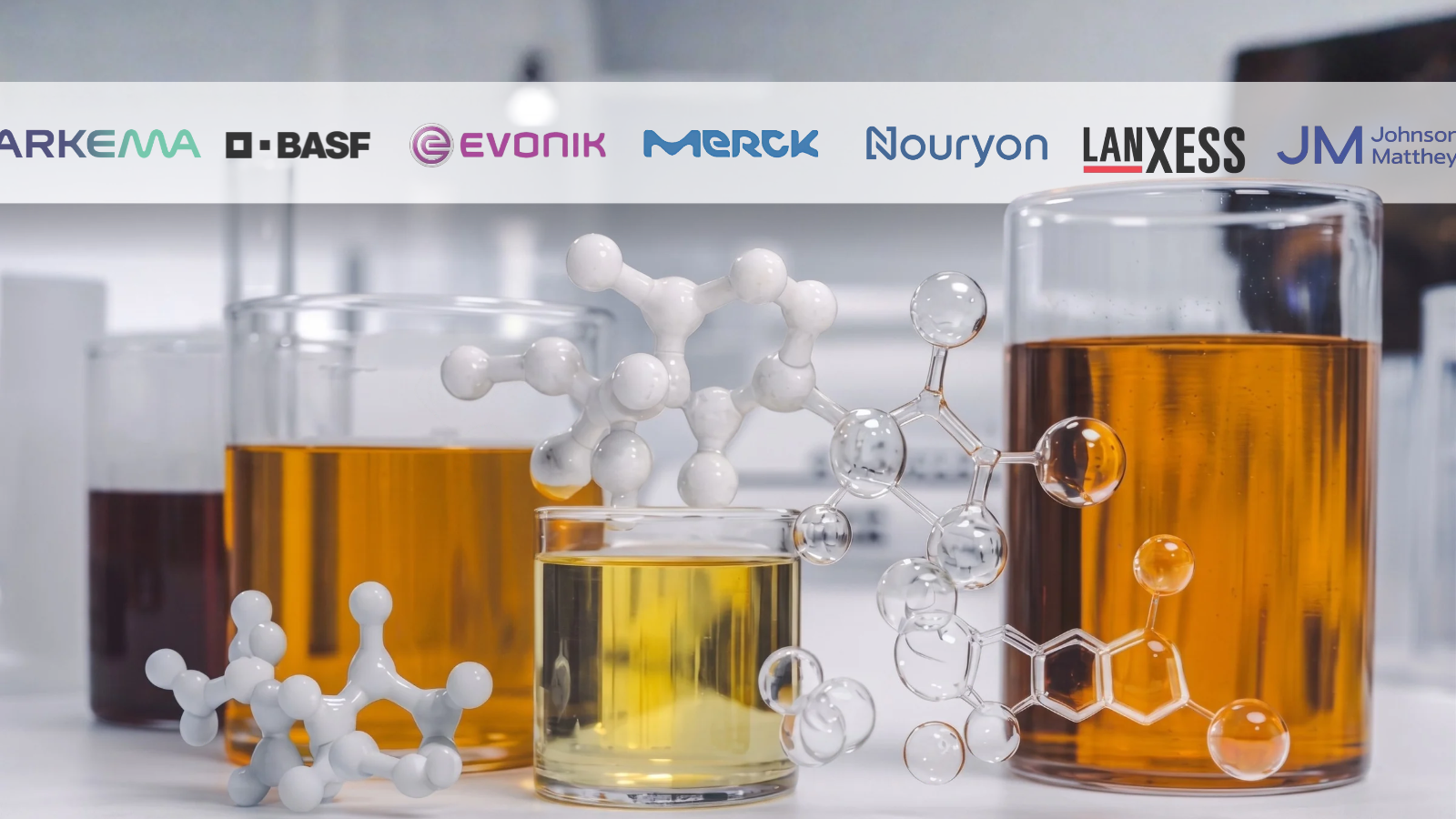
Arkema has concentrated recent moves on fluoropolymers and acrylic monomers. Arkema said in its February 2026 full-year 2025 results that three capacity expansions, two in the United States and one in Asia, started up on schedule and within budget, while sales in key growth markets rose 16 percent year on year. In June 2026, Arkema said its Calvert City, Kentucky, PVDF site had completed a 15 percent capacity increase, with an investment of about USD 20 million first announced in February 2025. Tank storage of 3,000 cubic metres for glacial acrylic acid was added at the Ulsan terminal in Korea in September 2026 by Arkema.
What has BASF announced across Asia, Europe and North America?
BASF has spread recent investments across three regions. BASF's Zhanjiang Verbund site in China was inaugurated in March 2026, after a project completed on schedule and well below the original budget, with an investment of around EUR 8.7 billion. A new emollients plant in Düsseldorf, Germany, opened in July 2026 as a BASF project, with an investment in the mid double-digit million-euro range. BASF's wholly owned MDI plant at Geismar, Louisiana, was completed on time in November 2026 at a total volume of about USD 1 billion. A modernized acid chlorides and chloroformates plant at BASF's Ludwigshafen site was formally opened in September 2026, after a low three-digit million-euro investment.
Evonik Industries: specialty chemicals capacity and distribution moves
Evonik Industries reports on specialty chemicals as its core focus. Evonik said in its March 2026 annual results release that it met 2025 profit guidance while keeping its focus on specialty chemicals. Evonik's expanded specialty amine plant in Nanjing, China, was commissioned in April 2026, in a double-digit million-euro investment. Construction was completed in April 2026 on a specialty-grade hydrogen peroxide plant in Leshan, China, run by an Evonik and Fuhua Tongda Chemicals venture, with 20,000 tons of planned annual capacity. Evonik expanded its Essen, Germany, organomodified silicone capacity in November 2026 with an investment of EUR 52 million.
Johnson Matthey: catalyst portfolio reshaping and acquisition
Johnson Matthey is focusing its portfolio around catalysts and precious metals expertise. The sale of Johnson Matthey's Catalyst Technologies business to Honeywell was completed on 17 July 2026, at an enterprise value of GBP 1,325 million. Cormetech, a US maker of selective catalytic reduction catalysts, was agreed for acquisition by Johnson Matthey on 28 May 2026 at an enterprise value of USD 360 million.
LANXESS: specialty additives cost program and product launch
LANXESS pairs a cost program with product launches. Tire protection now has an anti-aging option positioned as an alternative to 6PPD, introduced by LANXESS in September 2026. A 2026 cost program at LANXESS, disclosed in March 2026, aims to deliver roughly EUR 100 million in lasting yearly savings by late 2028.
Merck KGaA: semiconductor materials growth in specialty chemicals
Merck KGaA has linked its electronics growth to semiconductor materials. For 2025, the Semiconductor Materials unit of Merck KGaA delivered high single-digit organic growth, according to results published in May 2026. Merck KGaA's first-quarter 2026 report, dated 13 May 2026, credited Semiconductor Materials and Process Solutions for driving growth. Merck KGaA raised its full-year 2026 guidance in its second-quarter update of 8 June 2026.
What has Nouryon announced in China's specialty chemicals capacity?
Nouryon has focused its China investments on colloidal silica and polymer specialties. Nouryon expanded premium Levasil colloidal silica output at Guangzhou, China, in April 2026, aimed at emissions catalysts, coatings and cookware. Nouryon's plan to begin MMAO production at Jiaxing, China, in the first half of 2028 was reported in November 2026.
Reading competitor moves as advanced chemicals market signals
A single announcement rarely explains a strategy. Several moves in the same region or product family usually do, so tracking patterns matters more than individual headlines.
Which indicators should a quarterly watchlist track?
Track these five indicators each quarter, along with what each usually signals:
- New capacity near customer clusters: usually signals a bet on regional demand and shorter lead times.
- Distributor appointments and channel consolidation: usually signals market entry or deeper coverage without new plants.
- Joint ventures and local partner sites: usually signals shared-risk entry where a partner brings permits or customers.
- Divestments and asset streamlining: usually signals a move toward higher-value, focused lines and freed capital.
- Launches of alternatives in adjacent applications: usually signals demand for substitute ingredients as regulation or cost shifts the mix.
What these moves mean for manufacturers in the advanced chemicals market
The report puts North America at 27.9 percent of 2025 value and Europe at 20.3 percent, with South America at 7.1 percent, the Middle East at 5.3 percent and Africa at 2.9 percent. Regional share helps show where capacity and partnerships are most actionable.
Opportunities for larger manufacturers
Larger manufacturers can fund multi-region capacity and run a network of local sites that serve nearby customers. Europe's focus on sustainability and regulation favors bio-based and recyclable chemicals, so portfolio shifts toward greener grades are a clear route. Demand for lower-carbon inputs is also tracked in the low-carbon ferrochrome market report.
Opportunities for mid-sized manufacturers
Mid-sized manufacturers can compete through specialty grades, technical service and distribution partnerships rather than scale alone. The report links the market's shift toward specialty, high-value, low-volume chemicals to focused producers. Process-chemistry niches, such as those in the chemical purging compound market report, offer a starting point for growth that needs less new capacity.
Decision framework for advanced chemicals manufacturers: build, partner, license or acquire
Work through these six steps before choosing an entry or expansion route, and answer the question at each step before moving on.
- Confirm the demand signal. Which application and region show verified growth across several years?
- Test capital position and timing. Can cash flow fund a build, and would a plant start before demand moves? If not, partnering or licensing may fit better.
- Check regulation and permits. How long will approvals take, and do incentives or environmental rules favor a local site?
- Measure customer proximity and supply access. Would a local plant shorten lead times, and are feedstocks secure?
- Choose the entry route. Build when capital, permits and supply align. Partner when a regional player holds customers or permits. License when the technology travels but a plant does not. Acquire when a target brings capacity or customers faster than building would.
- Set a review point. Which quarterly indicators would change the plan, and at what threshold would you reverse the decision?
Expert research for advanced chemicals market decisions
Decisions like these depend on data that holds up under scrutiny. Cognitive Market Research and Consulting supports this work through primary survey design, triangulation of primary research with secondary sources, data validation and growth consultation, drawing on a library of more than 200,000 reports.
Triangulation checks a company's own assumptions against market-level data, while validation tests whether a forecast still holds when inputs change. A mining and metals case study shows how segment, region and channel analysis can frame an expansion decision. Consultation is most useful before capital is committed, and it supports rather than replaces a manufacturer's own judgment.
Key Takeaways
- Top manufacturers in the advanced chemicals market combine capacity additions, regional localization, partnerships and portfolio moves rather than relying on one route.
- Cognitive Market Research values the advanced chemicals market at USD 166.4 million in 2025 and projects a 5.7 percent CAGR from 2025 to 2033.
- Verified 2026 developments show capacity placed close to customers in China, Korea and Germany, alongside joint ventures and distribution changes.
- Johnson Matthey's Catalyst Technologies sale and its Cormetech agreement show divestments and acquisitions running in parallel.
- A quarterly watchlist covering capacity, distribution, joint ventures, divestments and launches helps teams read competitor moves early.
- Build, partner, license or acquire decisions work best when tested against demand, capital, regulation and supply access.
Frequently Asked Questions About Advanced Chemicals Market
What is the size of the advanced chemicals market?
Cognitive Market Research values the advanced chemicals market at USD 166.4 million in 2025 and projects USD 259.271 million by 2033. The report puts the compound annual growth rate at 5.7 percent for 2025 to 2033. Figures are stated in USD million, the unit used for the report's headline values.
How is the advanced chemicals market split by region?
Asia Pacific accounts for 36.5 percent of 2025 global market value, North America for 27.9 percent and Europe for 20.3 percent. South America holds 7.1 percent, the Middle East 5.3 percent and Africa 2.9 percent. Regional shares matter for planning because capacity, permits and customer access differ sharply by region.
Which strategies are top manufacturers using in this market?
The strategies in use include capacity additions, regional localization, distribution partnerships, mergers and divestments, joint ventures and product launches in adjacent applications. Each fits different conditions, including capital position, regulation, customer proximity and supply chain access. The right choice usually depends on which constraint matters most for the specific product.
How should manufacturers decide between building and partnering?
Start by checking capital, permits and supply access. Build when those conditions are firmly in place and demand is verified over several years. Partner when a regional player holds customers, permits or plant capacity that would take years to replicate. The decision framework in this article walks through each check.
Conclusion
Manufacturers that want to grow in the advanced chemicals market are not limited to one playbook. Capacity near customers, regional partners, distribution reach and focused portfolios all appear in the verified record for 2026. The practical next step is to match each option to demand, capital and supply conditions, then track competitor moves each quarter, and build that evidence base with expert research before committing capital.

 X
Article Details
-
Author Chidanand Bilagi
-
Published 24 Nov 2026
-
Last Updated 25 Nov 2026
-
Reading Time~3 minutes
Related Reports
Get a Custom Report
Interested in a similar analysis for your market? Our experts can deliver a customized report.
Contact Our ExpertsMore Articles
Explore all published articles across 30+ industry verticals.
View All Articles