Article
Introduction
Market research has entered a new phase. Enterprises today have access to more information than ever, yet finding information they can genuinely trust has become increasingly difficult. Automated search systems, AI-generated summaries, fragmented databases, and large volumes of online content can provide answers quickly, but speed does not always translate into accuracy or strategic value.
For enterprise decision-makers, the real challenge is not simply collecting more data. It is identifying reliable information, understanding the context behind it, and converting it into insights that can support investments, expansion plans, product strategies, supply chain decisions, and long-term growth.
This is creating significant opportunities for the evolution of the market research tool. The next generation of research platforms is moving beyond static reports and basic dashboards toward solutions that combine human expertise, verified data, artificial intelligence, interactive visualization, and enterprise-level accessibility.
The Changing Role of Market Research Tools
raditional market research has typically involved reports, spreadsheets, presentations, interviews, surveys, and extensive analyst studies. These resources remain valuable, particularly when businesses need detailed market sizing, segmentation, competitive intelligence, supply chain analysis, and strategic recommendations.
However, enterprise users increasingly expect research to be easier to access and interact with.
Instead of searching through hundreds of pages to locate one particular statistic, decision-makers want to ask a question and quickly identify the relevant information. They also want to compare regions, examine market segments, identify emerging trends, and visualize information according to their specific business requirements.
This shift is creating a new role for the market research tool: not replacing research, but making high-quality research easier to consume and apply.
Key Trends Shaping Market Research Tools
1. Human-Led Research Is Becoming a Competitive Advantage
One of the most important trends is the growing importance of human validation.
AI can process enormous quantities of information, but enterprise research often requires more than information retrieval. Analysts need to understand whether a source is credible, interpret conflicting information, validate market developments, and speak with people who actually participate in an industry.
Primary research involving manufacturers, suppliers, buyers, executives, distributors, and subject-matter experts can provide context that automated systems may not capture.
This is why the future of the market research tool is likely to be increasingly human-led and technology-enabled. Technology can accelerate access to research, while experienced analysts remain responsible for understanding and validating the underlying intelligence.
2. AI Is Moving From Content Generation to Research Interaction
Another major opportunity is the integration of AI into research platforms.
Rather than using AI simply to generate generic summaries, modern market research tools can use AI as an interface for interacting with existing research assets.
For example, an enterprise user could ask:
"Which regions are showing the strongest opportunity for this market?"
Instead of manually reviewing multiple chapters, tables, and charts, an intelligent research platform could identify the relevant information and present it in a concise format.
The important distinction is that the AI should work with verified research data, rather than presenting unverified internet information as fact.
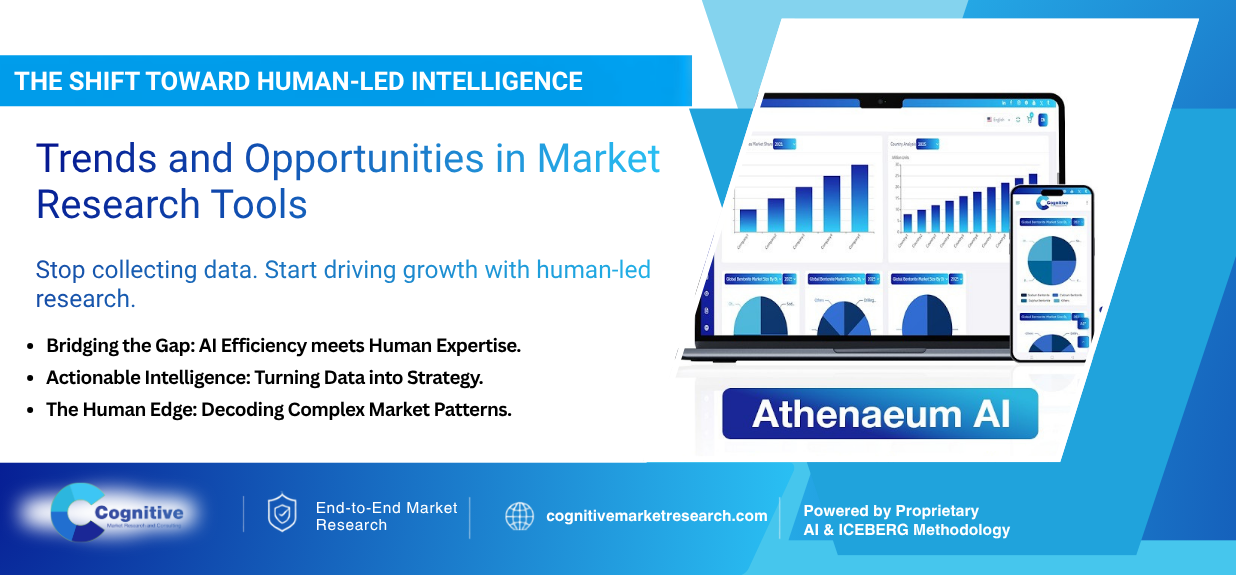
Athenaeum AI provides an example of this approach. Developed by Cognitive Market Research and Consulting, the platform combines human-led research with AI-assisted access, allowing enterprise users to interact with purchased research and retrieve relevant information more efficiently.
The opportunity is therefore not simply "AI-powered research." It is AI-assisted access to trusted research.
3. Interactive Data Visualization Is Becoming Essential
Enterprise users increasingly need to understand relationships between different datasets rather than simply read individual statistics.
This is driving demand for advanced visualization capabilities within market research tools.
Interactive dashboards can allow users to examine information by geography, market segment, application, industry, supply chain stage, or other relevant variables. Instead of relying entirely on static charts, users can explore different scenarios and identify patterns based on their business questions.
For example, a manufacturing company could use an interactive dashboard to compare regional demand, supplier activity, production trends, and market opportunities within a single research environment.
This makes data visualization more than a presentation feature. It becomes part of the decision-making process.
4. Research Platforms Are Becoming Enterprise Workspaces
Another emerging trend is the transformation of market research platforms from document repositories into collaborative enterprise workspaces.
Large organizations often have multiple departments using the same research. Marketing may need market trends, strategy teams may require competitive intelligence, procurement may examine suppliers, and senior management may focus on investment opportunities.
A modern platform can bring these requirements into one environment while providing different users with access to relevant information.
Features such as corporate accounts, sub-accounts, digital research libraries, dashboards, downloadable files, and AI-assisted search can make research accessible across departments without requiring every employee to interpret a lengthy research document independently.
Opportunities for Enterprises
These developments create several opportunities for businesses that invest in advanced market research tools.
Faster Research Consumption
The first opportunity is time efficiency. Research can contain thousands of data points, but an executive may only need a few specific insights to support an immediate decision.
A conversational interface and structured research environment can reduce the time required to locate relevant information.
Better Strategic Visibility
Enterprises can also gain a broader view of markets by connecting different research dimensions. Instead of examining market size independently from supply chains, competitors, regions, and customer segments, organizations can analyze these elements together.
This creates a more comprehensive understanding of where opportunities and risks exist.
More Confident Decision-Making
The value of a market research tool ultimately depends on the quality of the decisions it supports.
Human-verified research combined with AI-assisted access can help organizations reduce dependence on fragmented online information and make decisions using a stronger evidence base.
For high-value strategic decisions, this distinction matters. A fast answer is useful, but a fast answer supported by credible research is significantly more valuable.
The Emerging Human + AI Model
The future of market research should not be viewed as a competition between analysts and artificial intelligence.
Instead, the strongest model is likely to combine the strengths of both.
Human researchers can conduct interviews, validate information, understand industry dynamics, challenge assumptions, and interpret complex market conditions. AI can help users navigate large research datasets, identify relevant information, summarize findings, and make data easier to explore.
Athenaeum AI illustrates this model by placing AI functionality around human-led research rather than treating AI as the original source of market intelligence.
This distinction is particularly important for enterprises. When research supports major investments, expansion decisions, operational changes, or competitive strategies, businesses need technology that improves accessibility without weakening data integrity.
What Enterprises Should Look for in a Market Research Tool
As the market develops, enterprises should evaluate research platforms based on more than AI capabilities or attractive dashboards.
The underlying research methodology matters. Data validation, primary research, analyst expertise, transparency, segmentation depth, visualization capabilities, security, scalability, and ease of access should all be considered.
A useful market research tool should help an organization answer three fundamental questions:
- Is the information reliable?
- Can we access and understand it efficiently?
- Can we use it to make better business decisions?
Tools that address all three areas are positioned to deliver greater enterprise value than platforms focused solely on automated information retrieval.
Conclusion
The market research tool is evolving from a static destination for reports into an intelligent environment for exploring verified market intelligence.
The strongest opportunities are emerging around human-led research, AI-assisted discovery, interactive data visualization, enterprise collaboration, and faster access to strategic insights. These developments can help organizations move from simply possessing research to actively using it across their decision-making processes.
The future is therefore unlikely to belong to technology that simply produces more information. It will belong to platforms that help enterprises understand which information matters, why it matters, and how confidently they can act on it.
Human expertise provides the foundation. AI improves accessibility. Data visualization creates clarity. Together, they can transform the way enterprises consume and apply market intelligence.
Athenaeum AI is one example of how this model can be applied, demonstrating how a market research tool can bring human-verified research and modern digital capabilities together without making technology a substitute for research expertise.
For enterprises navigating increasingly complex markets, that combination represents one of the most significant opportunities in the future of market research.

 X
X
Article Details
-
Author Kalyani Raje
-
Published 12 Aug 2026
-
Last Updated 14 Aug 2026
-
Reading Time~3 minutes
Related Reports
Get a Custom Report
Interested in a similar analysis for your market? Our experts can deliver a customized report.
Contact Our ExpertsMore Articles
Explore all published articles across 30+ industry verticals.
View All Articles