Article
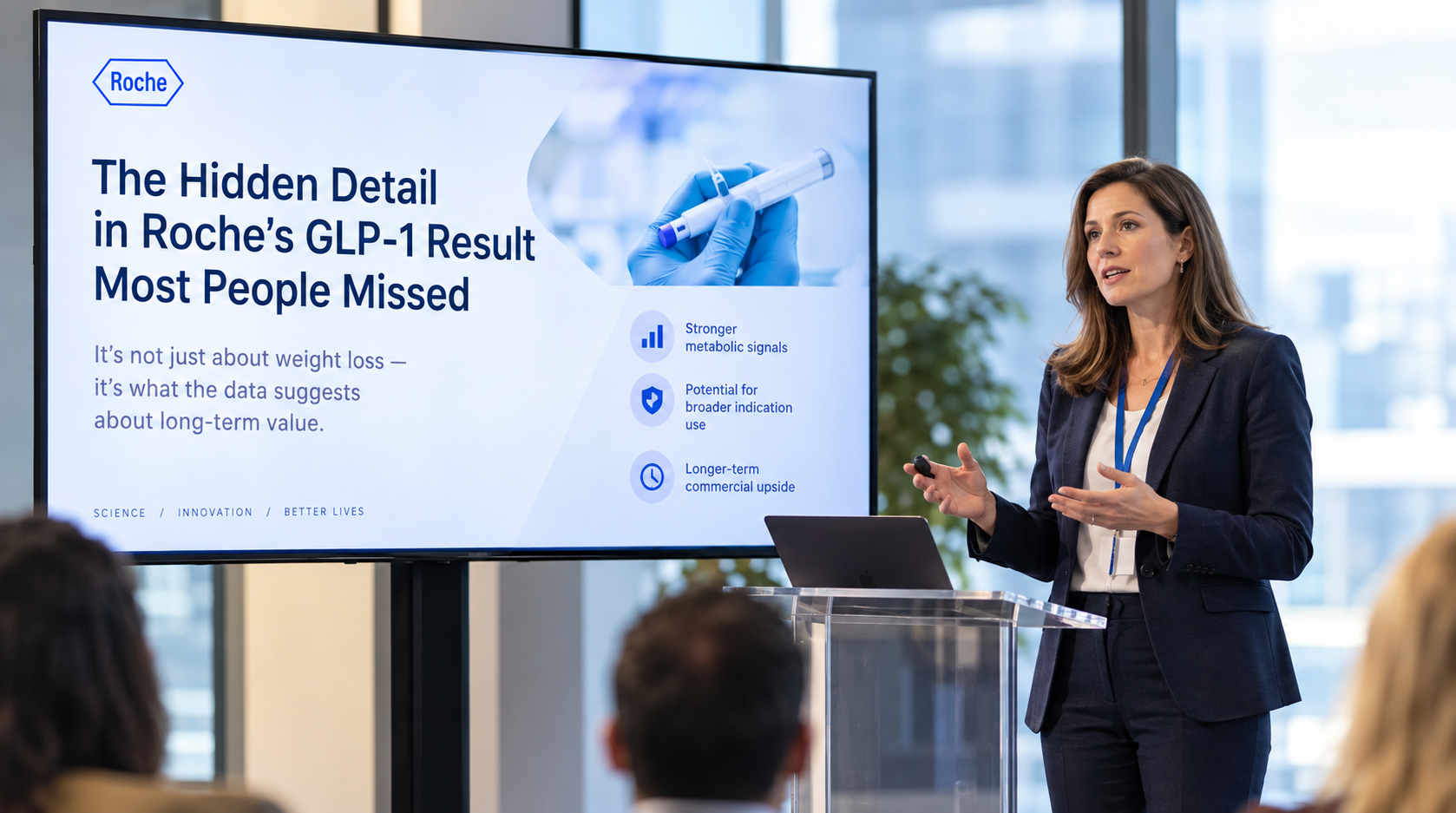
Why Roches 15.5% Weight-Loss Number Is Bigger Than It Looks
At first glance, 15.5% weight loss doesn't sound like headline news. Some newer obesity drugs claim far more. But look closer at who lost that weight, and Roche's latest result becomes one of the more interesting moments in the GLP-1 market this year.
On September 22, Roche reported that its experimental once-weekly shot, enicepatide, helped overweight or obese patients with type 2 diabetes lower blood sugar and lose an average of 15.5% of their body weight in a mid-stage trial. The detail most people scroll past is the patient group. And that changes everything.
Why is weight loss harder for people with diabetes?
Here's the hidden catch in obesity drug trials. People with type 2 diabetes almost always lose less weight on these medicines than people without diabetes, often by several percentage points.
That's why the leading drugs post their most eye-catching numbers in non-diabetic trials. Put them in a diabetic population, and the figures shrink.
So when a drug delivers 15.5% in diabetic patients, analysts pay attention. At the highest 24 mg dose, the weight loss had not plateaued at 48 weeks. In other words, patients may not have finished losing weight when the trial ended.

The result that surprised us more than the weight loss
In our review of the data, the blood sugar numbers were even more striking.
What the 24 mg dose achieved in 48 weeks:
- HbA1c drop: 2.65 points, from a baseline of 8.1%
- Below the diabetes line: 90% reached an HbA1c of 6.5% or lower, the diagnostic threshold for type 2 diabetes
- Back to normal: 62% reached normal, non-diabetic blood sugar levels
- Hardest cases: In patients with poor starting control (HbA1c above 8.5%), HbA1c fell by 4.13 points
Think about that for a moment. Nearly two in three patients ended the trial with blood sugar in the non-diabetic range. That's a very different story from "just another weight-loss shot."
On safety, side effects were mostly mild-to-moderate gastrointestinal events, and only 2.0% of enicepatide patients stopped due to side effects.
How does 15.5% compare with Ozempic-class and Mounjaro-class drugs?

Our analysts compared enicepatide against published results from the two leading drugs in their own diabetes-focused trials.
Semaglutide 2.4 mg delivered about 9.6% at 68 weeks in STEP 2. Tirzepatide 15 mg delivered about 14.7% at 72 weeks in SURMOUNT-2. Enicepatide reached 15.5% in just 48 weeks.
An important caution: these are separate trials with different designs, so this is not a head-to-head result. Phase II data also needs Phase III confirmation. Still, the direction is hard to ignore.
Can anyone really challenge Lilly and Novo?

That's the billion-dollar question, literally. In Q2 2026, Mounjaro sales jumped 91% to $9.94 billion, Zepbound earned $4.93 billion, and Novo's GLP-1 portfolio brought in about $9.16 billion.
Roche isn't alone in chasing that prize. It's racing AstraZeneca and Amgen to break into
and take on the two leaders. And the long-term pie keeps growing: oral options alone are expected to capture about 20% of an $80 billion obesity GLP-1 market by 2030.
What happens when this race reaches India?
India may be the toughest test of all. Indian drugmakers have already launched 26 semaglutide brands competing directly with Ozempic and Wegovy, and Novo responded by cutting prices by 38% and 48%.
Novo's brands now start at ?5,660 a month, compared with about ?4,200 for higher-end generics, and some generics cost as little as ?1,290.
With about 100 million people living with diabetes and nearly a quarter of the population overweight or obese, India is enormous. But it's also price-sensitive. A newcomer will need a strong clinical story to justify premium pricing. A drug that brings most diabetic patients back to near-normal blood sugar could be exactly that story.

What should manufacturers and buyers watch next?
The timeline: Roche plans a late-stage study on blood sugar and cardiovascular outcomes in the first half of 2027, while two Phase III weight-management trials are already underway.
For manufacturers and suppliers: Every new late-stage GLP-1 program adds demand for peptide APIs, injection pens, autoinjectors, and fill-finish capacity. Contract manufacturers and device makers should expect new partnership opportunities as challengers scale.
For healthcare buyers and patients: More competition means more choice and more pressure on prices. Diabetic patients living with obesity may soon have options designed around both conditions at once.
Our view: Enicepatide won't dent Lilly or Novo's revenue before the late 2020s. But it answers a question the industry has been asking: the next winners in the GLP-1 market may compete on metabolic outcomes, not just the biggest weight-loss number.
How we researched this: Our analysts reviewed Roche's September 22 trial announcement, the registered trial design, Q2 2026 sales disclosures, India pricing data, and published pivotal trial results for approved GLP-1 therapies, cross-checked against Cognitive Market Research's ongoing obesity and diabetes market tracking.
The bottom line
Roche's 15.5% is bigger than it looks because of who achieved it and what happened to their blood sugar along the way. For the GLP-1 market, it's another sign that the Lilly–Novo era is turning into a crowded, competitive race.
Want the full picture? Explore Cognitive Market Research and Consulting's GLP-1 and obesity drug market reports for market sizing, competitive benchmarking, and regional forecasts.
 X
X
Article Details
-
Author Anushka Gore
-
Published 24 Sep 2026
-
Last Updated 28 Sep 2026
-
Reading Time~3 minutes
Related Reports
Get a Custom Report
Interested in a similar analysis for your market? Our experts can deliver a customized report.
Contact Our ExpertsMore Articles
Explore all published articles across 30+ industry verticals.
View All Articles