Article
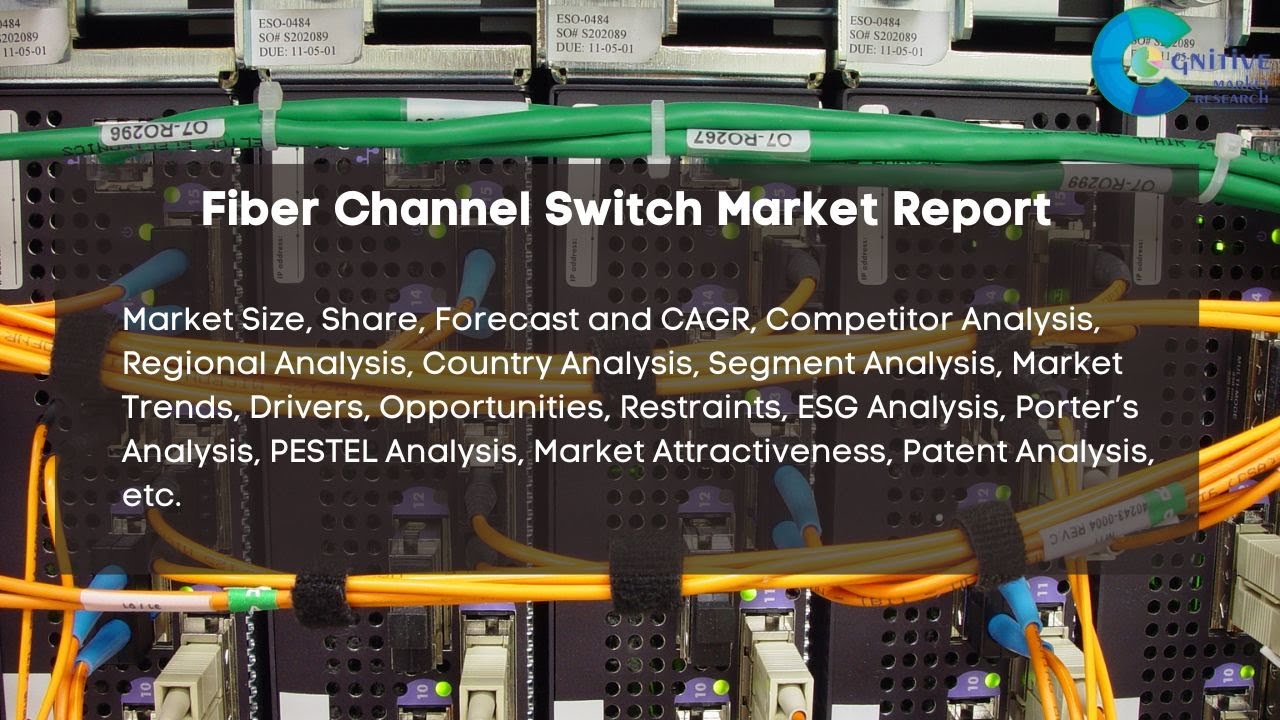
Fiber Channel Switch Market: 2026 Strategic Outlook and Manufacturing Opportunities
As we move through 2026, the Fiber Channel Switch (FCS) market has transitioned from a traditional storage component to a high-performance cornerstone of the automated industrial era. For manufacturers and infrastructure providers, the landscape is no longer defined solely by speed, but by the integration of intelligence, energy efficiency, and the demands of decentralized data processing. Cognitive Market Research evaluates the current trajectory of the market, providing actionable insights for B2B stakeholders aiming to capitalize on the next wave of storage networking.
Current Market Dynamics: The 2026 Landscape
The global Fiber Channel Switch market continues its robust expansion, underpinned by the massive migration toward autonomous data centers and the 2026 surge in Generative AI (GenAI) workloads. In 2024, the market was valued at USD 9,214.5 million, and it remains on a clear path to exceed USD 26,656 million by 2032. For manufacturers, the primary driver in 2026 is the Latency-Zero initiative. Industries such as high-tech manufacturing, telecommunications, and automated finance now demand sub-millisecond response times that only dedicated Fiber Channel (FC) architectures can reliably provide. While Ethernet remains a versatile competitor, Fiber Channel’s lossless nature and deterministic performance have secured its 47% share of the storage network switch market this year.
Key Manufacturing and Technology Trends
1. The Dominance of Gen 7 and the Emergence of Gen 8
By 2026, Gen 7 Fiber Channel (64G) has become the standard for enterprise-grade deployments. However, the manufacturing focus has shifted toward the early-stage prototyping and pilot testing of Gen 8 (128G) solutions. Manufacturers are prioritizing backward compatibility as a critical value proposition, allowing clients to scale bandwidth without undergoing disruptive rip-and-replace cycles.
2. AI-Integrated Fabric Management
A significant shift in 2026 is the embedding of Artificial Intelligence directly into the switch silicon. Modern switches now feature Self-Healing Fabric capabilities. For our manufacturing clients, this means producing hardware that can predict port failures or congestion hotspots before they occur, reducing unplanned downtime in mission-critical environments by an estimated 25% compared to 2023 levels.
3. Sustainability and Green Silicon Requirements
Environmental, Social, and Governance (ESG) mandates are now a decisive factor in B2B procurement. Manufacturers are responding by developing switches with Dynamic Power Scaling. These units adjust power consumption based on real-time traffic loads. In 2026, the ability to demonstrate a 15-20% reduction in thermal output is no longer a luxury but a requirement for securing large-scale government and enterprise contracts.
Challenges: Navigating the 2026 Hurdles
Despite growth, the market faces specific pressures that manufacturers must address:
Total Cost of Ownership (TCO): While performance is superior, the initial CapEx for FC remains higher than iSCSI or NVMe-over-Fabrics (NVMe-oF) on Ethernet. Manufacturers are pivoting toward Consumption-Based Models or Storage-as-a-Service (STaaS) partnerships to lower the entry barrier for mid-sized industrial clients.
Skill Gaps: The specialized nature of Fiber Channel requires specific expertise. Manufacturers who provide comprehensive automated configuration tools and simplified management interfaces are gaining a competitive edge over those offering complex, manual systems.
Future Opportunities for Manufacturers
Edge Industrialization
The proliferation of Smart Factories and Edge Computing in 2026 has created a demand for ruggedized, compact Fiber Channel switches. Processing vast amounts of sensor data at the Edge before syncing with the central cloud requires localized, high-speed storage networks. This represents a high-growth niche for manufacturers capable of producing durable, small-form-factor FC hardware.
Cyber-Resilient Storage Networking
With the rise of sophisticated ransomware, the storage switch is now a line of defense. 2026 trends show a surge in demand for switches with hardware-level encryption and Air-Gapped orchestration features. Manufacturers who integrate security protocols directly into the switch firmware are seeing higher adoption rates in the defense and healthcare sectors.
Conclusion
The Fiber Channel Switch market in 2026 is defined by its resilience and adaptation. For manufacturers, the path to leadership lies in three areas: escalating port speeds (Gen 7/8), integrating AI-driven predictive maintenance, and adhering to strict energy-efficiency standards. At Cognitive Market Research, we observe that the successful manufacturers of 2026 are those who no longer sell just connectivity, but rather guaranteed data availability. As the backbone of the digital economy, Fiber Channel switches remain an indispensable investment for any organization prioritizing reliability over mere convenience.

 X
X
Article Details
-
Author Kalyani Raje
-
Published 06 Feb 2025
-
Last Updated 17 Mar 2026
-
Reading Time~3 minutes
Related Reports
Get a Custom Report
Interested in a similar analysis for your market? Our experts can deliver a customized report.
Contact Our ExpertsMore Articles
Explore all published articles across 30+ industry verticals.
View All Articles