Article
Automotive Powertrain Market: Strategic Trends and Future Opportunities
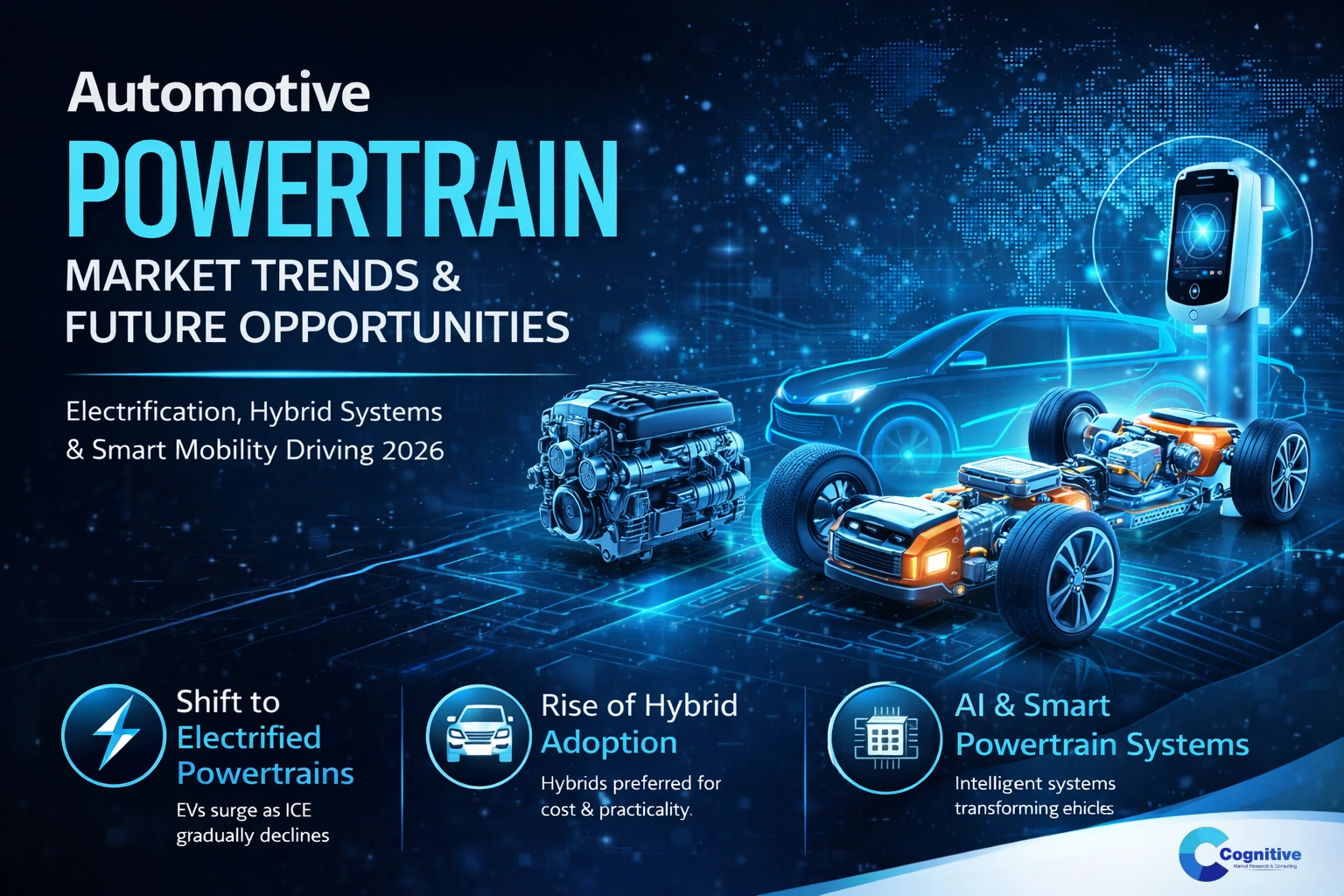
We have reached a bit of a crossroads in 2026. For those of us in the manufacturing trenches, the automotive powertrain isn't just a collection of mechanical parts anymore it’s essentially become a high-tech, software-governed power plant on wheels. The old silos between mechanical teams and electronics experts have pretty much vanished. Back in 2024, our team at Cognitive Market Research valued this space at around USD 812 billion. Now, even with some economic cooling, the trajectory toward a USD 2.8 trillion valuation by 2032 remains solid, clipping along at a 17.20% CAGR. But for the manufacturers reading this, the real story isn't just the growth; it’s the shift in where the money is going. We’re seeing a Great Diversification where the smart capital is moving toward 800V architectures and integrated drive units, even while we keep the lights on with high-efficiency internal combustion engine (ICE) tech in certain markets.
Current 2026 Industry Trends for Manufacturers
The High-Voltage Pivot (800V & SiC):
If 2024 was about talking about 800V systems, 2026 is about scaling them. For mid-to-high-end segments, this is the new baseline. For your supply chains, this means a heavy reliance on Silicon Carbide (SiC) semiconductors. They’re tougher and more efficient than the old silicon versions, which is exactly what’s needed to deliver the 15-minute charge that buyers are now demanding as standard.
Integrated All-in-One Drive Units:
From a production standpoint, the move toward integrated Electric Drive Units (EDUs) is a game-changer. We’re seeing 3-in-1 or even 4-in-1 systems that pack the motor, inverter, transmission, and onboard charger into one housing. It’s leaner, lighter, and once the lines are dialed in much cheaper to assemble than piecing together separate components.
The Hybrid Reality Check:
There was a time when everyone thought we’d be 100% electric by now, but 2026 has brought a healthy dose of reality. Plug-in Hybrids (PHEVs) and Range-Extended vehicles (REEVs) have made a massive comeback. They’re the bridge for regions where the charging grid is still a work in progress. For manufacturers, this means you can’t just walk away from ICE expertise yet; you need to be a multilingual producer of both traditional and electric tech.
Software-First Powertrains:
The hardware is now only half the story. Today, a powertrain’s performance is often unlocked or tuned via Over-the-Air (OTA) updates. We’re seeing manufacturers move into the software space to manage torque, battery life, and regenerative braking long after the car has left the factory.
Regional Market Dynamics
North America (35% Market Share):
It’s all about the trucks and SUVs here. The push is for domestic battery production to keep up with regional trade rules, with a focus on high-torque electric setups that don’t sacrifice towing power.
Europe (30% Market Share):
With Euro 7 standards in full swing, the pressure is on. This region is the testing ground for hydrogen fuel cells in heavy-duty shipping and long-haul trucking.
Asia-Pacific (Growing to 29% Market Share):
This is still the world’s battery factory. In 2026, the focus in China and India is on affordable electrification finding ways to make powertrains for the mass market without breaking the bank.
Manufacturing Challenges and How to Handle Them
The Cost of Green Materials: Battery materials and rare-earth magnets are still expensive. We’re seeing a lot of interest in magnet-free motors and cell-to-chassis designs that simplify the car’s structure to save on weight and material costs.
The Flexible Factory Challenge: Converting an old engine plant is a massive headache. The most successful manufacturers right now are using flexible assembly lines that can build a hybrid engine in the morning and a full electric drive unit in the afternoon.
Future Opportunities: What’s Next?
Hydrogen-Powered Engines (H2-ICE): This is a huge second life for engine plants. By tweaking existing designs to burn hydrogen, heavy-duty manufacturers are finding a way to hit zero-emissions targets without throwing away decades of engineering knowledge.
Solid-State Batteries: We’re starting to see the first premium vehicles with semi-solid-state tech. It’s still early days, but the manufacturers who are in the room for these pilot programs are the ones who will own the next decade.
Designing for Second Life: With new right to repair and recycling laws, there’s a growing B2B market for remanufacturing. Designing a motor so it can be easily taken apart and refurbished is no longer just a nice to have it’s a business strategy.
Conclusion
The takeaway for 2026 is that there isn’t one winning powertrain. It’s a multi-pathway world. Success right now belongs to the manufacturers who can bridge the gap between the reliable ICE past and the high-voltage, software-driven future. It’s about being flexible, localized, and ready to update your tech as fast as a smartphone.

 X
X
Article Details
-
Author Kalyani Raje
-
Published 15 Nov 2024
-
Last Updated 14 Sep 2026
-
Reading Time~3 minutes
Related Reports
Get a Custom Report
Interested in a similar analysis for your market? Our experts can deliver a customized report.
Contact Our ExpertsMore Articles
Explore all published articles across 30+ industry verticals.
View All Articles