Article
Introduction and Current Market Scenario of the Automatic Test Equipment Industry
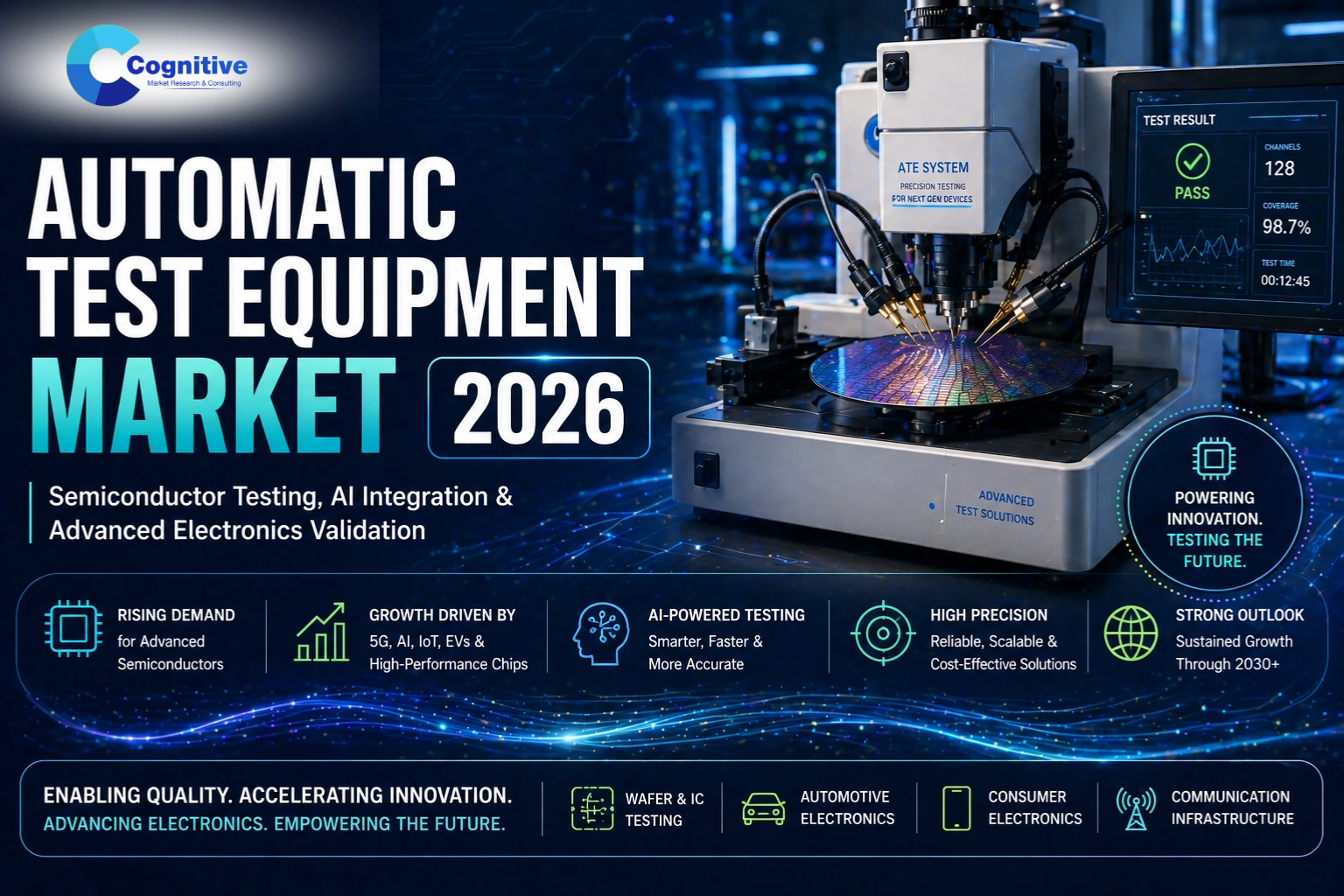
The Automatic Test Equipment (ATE) market includes systems that perform automated testing on electronic devices and systems to ensure functionality, performance, and dependability. ATE ranges from simple test sets to complicated systems built for high-volume production testing, including hardware and software components suited to specific applications. The market is driven by rising demand for electronic devices in a variety of industries, including telecommunications, automotive, aerospace, and consumer electronics. The desire for higher quality and shorter production cycles accelerates ATE adoption, as firms strive to improve efficiency and eliminate human error. As technology progresses, the use of artificial intelligence and machine learning in ATE will probably to drive market expansion.
Cognitive Market Research noticed that the demand for Automatic Test Equipment in a variety of industries, including automotive, aerospace and defense, telecommunications, and medical devices, is the primary driver of significant growth in the global automatic test equipment market. The Automatic Test Equipment market was estimated to be worth approximately USD 7815.2 million in 2024 and is projected to increase to USD 10695.64084 million by 2032, with a compound annual growth rate (CAGR) of 4.0% during the forecast period, according to a recent market analysis. Airties introduced Orbit, a continuous test automation solution built exclusively for managed Wi-Fi networks. This new platform is intended to improve the efficacy and precision of testing procedures for system-on-chip (SoC) makers, customer premises equipment (CPE) suppliers, and broadband service providers.
The 2026 Market Pulse: Where the Money is Moving
We’re looking at a global ATE market that has matured into an $8.5 billion powerhouse. While the growth rate is steady at about 8.6%, the nature of that spend has changed. We’re seeing a massive pivot toward the Asia-Pacific and North American corridors as reshoring efforts finally reach full scale. Manufacturers aren't just buying machines; they’re buying insurance against the massive costs of field failures and recalls.
What’s Actually Driving the Floor Today?
1. Moving Beyond the AI Hype to Real Application
In 2026, we’ve stopped talking about AI as a buzzword and started using it to solve the test time problem. The sheer volume of data coming off a modern SoC (System on Chip) is too much for a human to analyze in real-time. We’re seeing our clients adopt Adaptive Testing. This is where the equipment actually learns from the first thousand units and starts narrowing its focus on the trouble spots for the next ten thousand. It’s cutting down test times by double digits without sacrificing an ounce of quality.
2. The 5G-Advanced and 6G Reality Check
We’re right in the thick of the 5G-Advanced rollout, and 6G prototyping is already hitting the labs. For anyone in the RF space, this is a headache. You’re dealing with frequencies that were considered experimental just a few years ago. The ATE we’re recommending now has to be modular. If you buy a closed system in 2026, you’ll be replacing it by 2028. You need hardware that can handle the leap to Terahertz bands through simple module swaps.
3. The EV Safety First Mandate
Automotive is no longer just about logic chips; it’s about power. Testing a 12V system is child's play compared to the 800V architectures becoming standard in 2026 EVs. Our clients are asking for ATE that can handle massive thermal stress testing and high-voltage isolation simultaneously. If an EV chip fails, it’s not just a blue screen it’s a safety crisis. That’s why we’re seeing a huge surge in multi-site testing, where you can run rigorous, high-voltage checks on multiple parts at once to keep up with the breakneck speed of the automotive assembly lines.
Strategic Opportunities: Where to Pivot
The Rise of Non-Memory Testing: While memory is still huge, the real growth is in Logic and Mixed-Signal ATE. As every device gets smarter and more connected, the need to test the interaction between analog signals and digital logic has exploded. This segment now represents nearly half the market.
Early Detection via WLCSP: We are pushing our clients hard toward Wafer-Level Chip-Scale Packaging (WLCSP) testing. Why wait until a chip is housed in expensive ceramic or plastic to find out it’s a dud? Testing at the wafer level is the single best way to protect your bottom line in 2026.
Solving the Talent Gap with Low-Code: Let’s be honest: finding expert test engineers is harder than ever. The trend this year is toward Scriptless Test Environments. We’re seeing a move to visual drag-and-drop interfaces that allow a production lead to tweak a test flow without needing a PhD in computer science.
Conclusion
The biggest risk in 2026 isn't just a bad batch of parts—it’s technological stagnation. The cost of these systems is high (often north of $1 million for top-tier setups), which is why we’re seeing a shift toward modular scaling. At Cognitive Market Research, our advice is simple: don't buy for what you’re making today; buy for what your customers will demand in eighteen months. Whether that’s 6G readiness or AI-driven diagnostics, your ATE needs to be as flexible as your factory floor.

 X
X
Article Details
-
Author Kalyani Raje
-
Published 29 Oct 2024
-
Last Updated 29 Apr 2026
-
Reading Time~3 minutes
Related Reports
Get a Custom Report
Interested in a similar analysis for your market? Our experts can deliver a customized report.
Contact Our ExpertsMore Articles
Explore all published articles across 30+ industry verticals.
View All Articles