Blog Content
Data Privacy as a Strategic Asset in Market Research
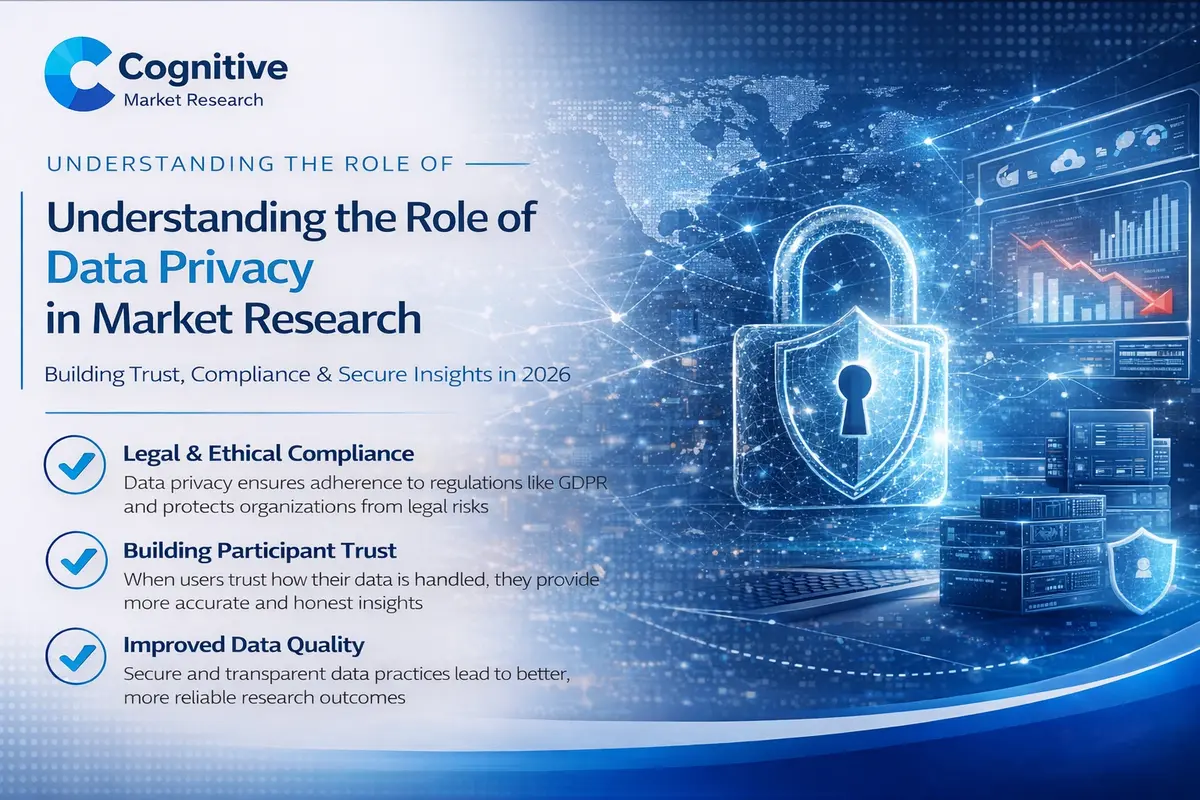
In the current industrial landscape, data is the fuel for innovation. However, for manufacturers navigating 2026, that fuel is now highly regulated. As we integrate AI into consumer insights and smart factory analytics, the boundary between useful data and protected information has become thinner than ever. At Cognitive Market Research, we believe that understanding this shift is the difference between a successful product launch and a multi-million dollar compliance failure.
The 2026 Privacy Landscape: What Has Changed?
1. The Move Toward Privacy-by-Design Manufacturing
In 2026, privacy is no longer an afterthought added by the legal department; it is baked into the R&D phase. Manufacturers of smart appliances, wearables, and connected industrial equipment are now required to prove Privacy-by-Design. This means that any market research conducted to improve these products must use anonymization protocols that are irreversible. Our B2B clients are increasingly moving toward synthetic data sets to simulate consumer behavior without ever touching Personally Identifiable Information (PII).
2. Beyond GDPR: The Rise of Sovereign Data Zones
While GDPR set the stage, 2026 is defined by regional data sovereignty. We are seeing strict localized mandates in India, Brazil, and several U.S. states that require manufacturing market research data to be stored and processed within specific borders. For a global manufacturer, this means your research partner must have a decentralized infrastructure to ensure that a consumer insight gathered in Berlin doesn't violate a protocol when analyzed in a Chicago headquarters.
3. The End of Third-Party Cookies and the First-Party Gold Rush
The total deprecation of third-party tracking has reached its peak in 2026. For manufacturers, this has turned market research into a hunt for First-Party Data. To understand your end-user, you can no longer buy generalized datasets. You must build direct-to-consumer (DTC) feedback loops. This shift makes transparent, consent-based research platforms more valuable than ever, as they provide the only clean way to map the customer journey.
Strategic Implications for B2B Manufacturers
Zero-Party Data: The Ultimate Truth
The most successful manufacturers in 2026 are leveraging Zero-Party Data information that customers intentionally and proactively share with a brand. In our consultation sessions, we emphasize that research built on transparency (e.g., Tell us your preferences so we can build a better thermostat for you) creates a dual benefit: high-quality R&D data and deep brand trust.
AI Governance and Algorithmic Transparency
As manufacturers use AI to predict market trends, the Black Box problem has become a liability. 2026 regulations now demand that if an AI-driven research report influences a production pivot, the data used to train that AI must be audit-ready. Manufacturers must ensure their research partners like us at Cognitive Market Research utilize Explainable AI (XAI) frameworks that respect respondent anonymity while providing verifiable insights.
Safeguarding Your Competitive Edge
For our manufacturing clients, a data breach isn't just a PR nightmare; it’s the potential loss of proprietary IP and sensitive consumer profiles. To stay ahead in 2026, your research strategy should prioritize:
Differential Privacy: Adding mathematical noise to datasets so that individual patterns remain invisible while aggregate trends stay crystal clear.
Encrypted Multi-Party Computation: Allowing different departments or partners to analyze combined data without ever actually seeing each other’s raw inputs.
Ethical Data Sourcing: Ensuring that every data point in your market analysis has a clear, timestamped consent trail that survives the entire lifecycle of the product.
Conclusion
Data privacy in 2026 is the new Quality Control. Just as you wouldn't release a product with a structural flaw, you cannot build a market strategy on dirty or non-compliant data. At Cognitive Market Research, we provide the rigorous frameworks necessary to ensure your insights are as secure as they are actionable.