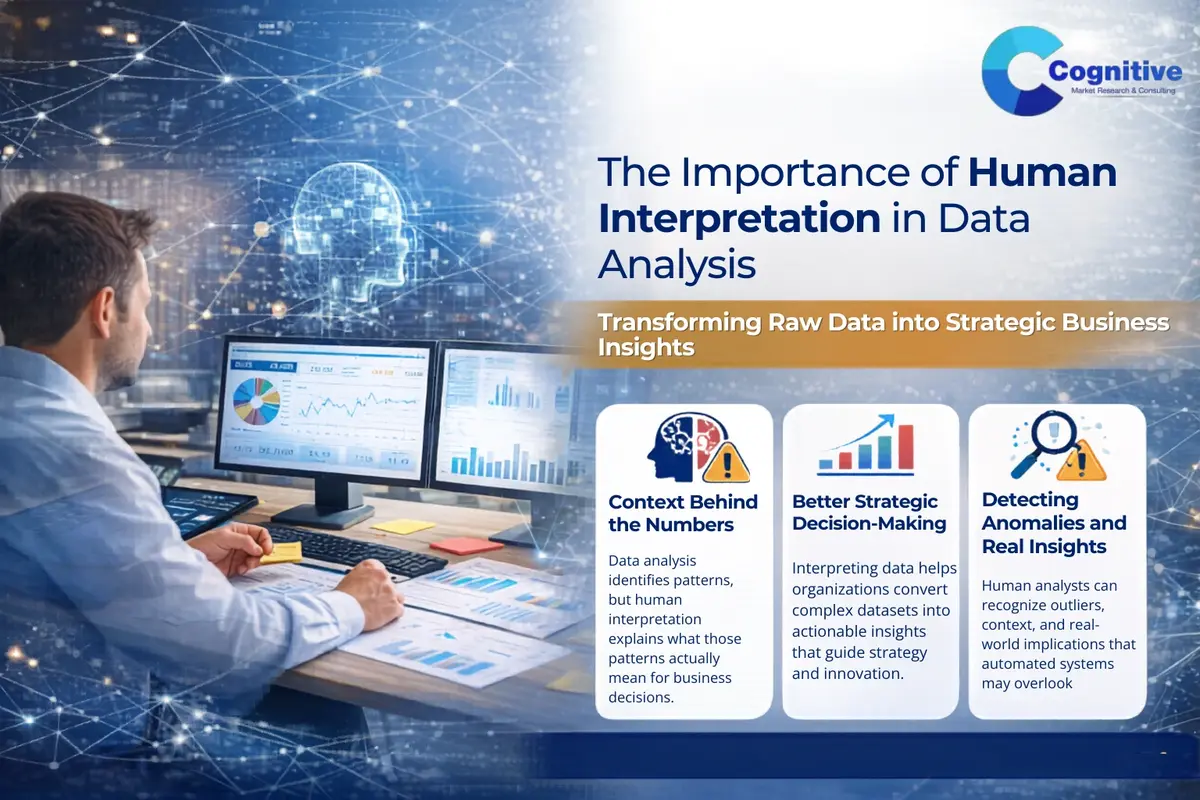
Blog Content
Why Human Context Defines Manufacturing Success in 2026
In the current fiscal year, the manufacturing world is awash in data. From IoT-enabled smart switches on the factory floor to real-time mineral tracking in the mining sector, the sheer volume of intelligence available is staggering. However, as we move through 2026, a critical truth has emerged for B2B leaders: Data provides the What, but only human interpretation provides the So What? At Cognitive Market Research, we are seeing a growing intelligence gap where companies possess world-class analytics software but struggle to make localized, high-stakes decisions. Here is why the human element is the ultimate competitive advantage for manufacturers this year.
1. Navigating the Black Swan of 2026
AI models are inherently backward-looking; they predict the future based on the patterns of the past. But in 2026, the industrial landscape is defined by Black Swan events sudden regulatory shifts in carbon-border adjustments or unexpected breakthroughs in solid-state battery manufacturing.
The Human Edge: An analyst understands the intent behind a new EU trade policy or the subtle shift in a competitor’s boardroom sentiment. We translate raw data into Strategic Foresight, helping manufacturers pivot production before the AI even recognizes a trend change.
2. The Nuance of B2B Relationships
In the consumer world, data can predict a purchase. In the B2B manufacturing world, decisions are made through complex hierarchies, long-term trust, and risk mitigation.
The Contextual Layer: A data dashboard might show a decline in demand for traditional digital cinema screens. However, a human analyst identifies that this isn't a market contraction, but a transition period where buyers are waiting for specific modular LED standards to be finalized. We provide the Why that prevents our clients from exiting a lucrative market prematurely.
3. Ethical AI and Algorithmic Bias
By 2026, Automated Research has hit a wall. Many AI tools have begun to hallucinate or replicate biases found in historical supply chain data, often overlooking emerging manufacturing hubs in Southeast Asia or Africa because the data isn't there yet.
The Validation Pillar: At Cognitive Market Research, our analysts act as the Ethics and Accuracy Filter. We cross-reference automated data with primary on-the-ground interviews. We ensure that your 2026 expansion strategy isn't built on a flawed digital hallucination, but on verified industrial reality.
4. Turning Information into Actionable Consultation
A manufacturer doesn't need a 500-page spreadsheet; they need to know whether to invest $50 million into a new copper leaching facility or a smart-switch assembly line.
The Synthesis: Human interpretation filters out the noise. We synthesize data from disparate sectors like how a shortage in semiconductor neon gas will impact high-end cinema projector production—to give you a cohesive, 360-degree view of your operational risks.
Conclusion
In 2026, technology is the engine, but human interpretation is the steering wheel. As a B2B manufacturer, your goal shouldn't be to have the most data, but the most insightful data. In an era where every competitor has access to the same AI tools, the only way to achieve an Alpha return on your research investment is through the experience, intuition, and contextual brilliance of a human analyst who understands the smell of the factory floor as well as the logic of the spreadsheet.
