Blog Content
Introduction
In the high-stakes world of B2B decision-making, good enough data is often the most dangerous thing in the room. When you're looking at multi-million dollar contracts, eighteen-month sales cycles, and product roadmaps that take years to build, your market intelligence is the only thing standing between a brilliant pivot and a total wash.
A robust methodology isn't just a fancy way of saying we talked to a lot of people. It’s about the structural integrity of the process. To get to the truth, B2B companies have to look past surface-level survey results and build a framework that respects the messiness of professional buying committees, niche technical markets, and the jargon that comes with them.
The Pillars of Reliability in B2B Research
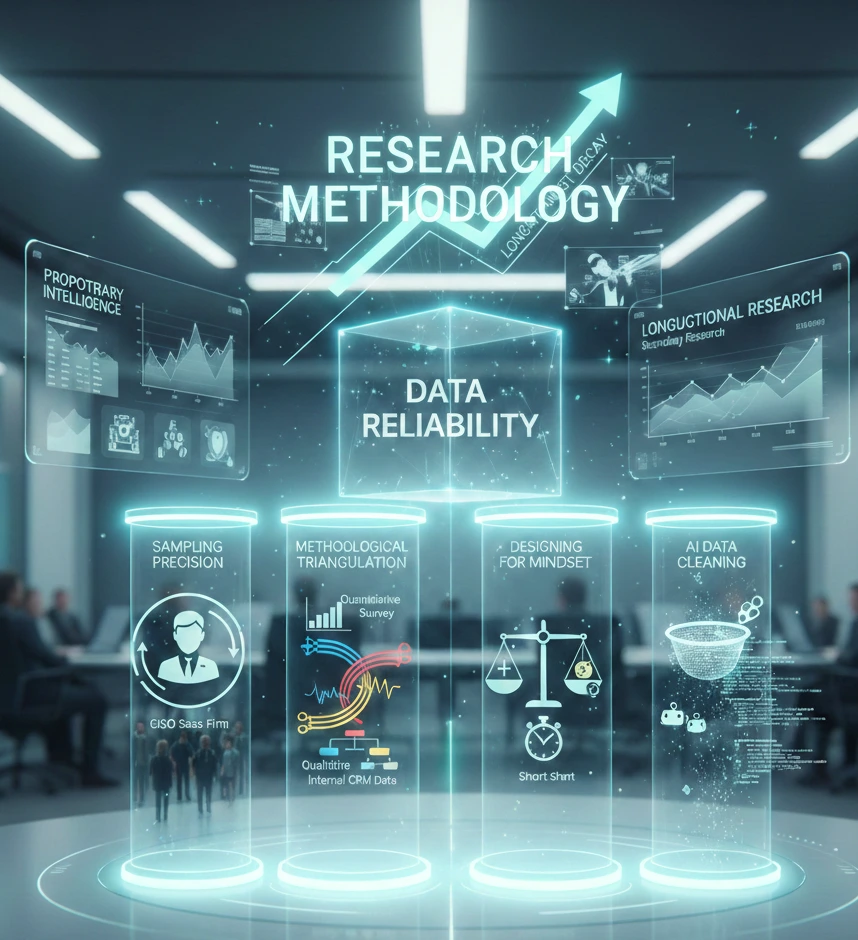
Reliability isn't a checkbox you tick at the end of a project; it’s the result of several high-friction practices working together. In B2B, where the buyer is usually a group of people with conflicting KPIs, these four pillars are non-negotiable.
1. Precision Over Reach in Sampling
In the consumer world, you might target people who buy shoes. In B2B, that’s a recipe for disaster. You need the Chief Information Security Officer at a mid-market SaaS firm currently migrating to the cloud and you need them to be honest. Reliability dies when researchers use generic consumer panels to solve specialized business problems. True integrity starts with verifying the professional identity and actual decision-making power of every single participant before they even see a question.
2. The Power of Methodological Triangulation
If you rely on one data source, you’re only seeing one dimension of the truth. A sophisticated methodology uses triangulation crossing different data streams to see if they tell the same story. A quantitative survey might show that 60% of your market hates your new pricing, but it won't tell you why. That’s where qualitative, in-depth interviews (IDIs) come in. When the hard numbers and the deep conversations align, you have more than just data you have conviction.
3. Designing for the Professional Mindset
The way you ask a question can accidentally rig the answer. Leading bias is the silent killer of research. We focus on neutral, open-ended framing that doesn't bait the participant. More importantly, we respect their time. Respondent fatigue is a real threat to data quality; if a survey is a twenty-minute slog, people start clicking randomly just to get it over with. In B2B, a thoughtful five-minute interaction yields far better data than a grueling marathon session.
4. The Janitorial Work: Data Cleaning
Raw data is rarely clean. A robust methodology requires a rigorous cleaning phase to scrub out the noise. This means hunting down speeders (people who finish in 30 seconds), straight-liners (people who pick 'C' for every answer), and contradictory logic. Especially in 2026, this involves using AI-driven checks to block bot-generated nonsense, ensuring that the insights you’re betting your budget on actually came from a human being.
Fighting Data Decay in Real-Time
The biggest threat to B2B intelligence is its shelf life. Corporate structures shift, stakeholders play musical chairs, and industry trends can pivot on a single news cycle. A snapshot report from six months ago might as well be from six years ago.
To solve this, we’re moving toward longitudinal research. Instead of a one-off project, we track the same metrics over several quarters. This helps you distinguish between a temporary market hiccup and a fundamental shift in how your customers think. When research becomes an ongoing conversation, your strategy stays agile rather than reactive.
Conclusion
A robust methodology is less of a checklist and more of a commitment to finding the truth, even when it’s inconvenient. In an age where AI can churn out endless reports at the touch of a button, the value of verified, human-centric, and methodologically sound insight is at an all-time high. By obsessing over sampling precision and data integrity, B2B organizations can stop gut-feeling their way through the quarter and start moving with the confidence that only real evidence can provide.
Analyst Perspective
If I’m being candid, the biggest mistake I see B2B leaders make is over-valuing Secondary Research. The market is drowning in repackaged PDF reports and industry stats that your competitors already have on their hard drives.
In 2026, the real edge is proprietary intelligence. The companies winning right now are those investing in custom methodologies that blend their internal CRM data with external qualitative voice of the customer work. My advice? Stop chasing the biggest dataset and start chasing the cleanest one. Reliability doesn't scale with the number of rows in your spreadsheet; it scales with the relevance of the people you spoke to and the honesty of the questions you asked.