Article
Key Takeaways
- Agentic AI is moving from pilot projects to real deployment on the factory floor.
- Predictive maintenance is turning equipment data into a subscription revenue opportunity.
- Equipment-as-a-service is reshaping how machinery gets bought and sold.
- Sustainability requirements are creating a retrofit and certification market.
- Cobots need integration expertise just as much as hardware.
- Reshoring is opening real opportunities for domestic suppliers.
- Cybersecurity for industrial systems is an underserved and urgent niche.
- Digital twins offer a growing software opportunity beyond enterprise giants.
- Workforce upskilling is the biggest bottleneck in the industry and one of its biggest opportunities.
- Aftermarket data services remain one of the least crowded corners of the entire industry.
Machinery Industry Trends 2026: 10 Trends & Opportunities
The machinery and equipment world isn't just changing it's being rebuilt in real time. Sensors that used to just log data now predict failures before they happen. Robots that once stayed behind safety cages now work shoulder-to-shoulder with people. The question every manufacturer, supplier, and investor is asking has shifted too. It's no longer what's coming next? It's how do I actually make money from it?
Most trend reports stop at the first question. They'll tell you AI is transforming the factory floor, then move on to the next bullet point without answering the one that matters: what do you actually do about it?
This guide covers the 10 biggest trends in machinery and equipment for 2026. More importantly, it pairs each one with a concrete business opportunity. Whether you manufacture equipment, supply parts, or invest in the sector, you'll find something actionable here not just observational.
What's Driving Change in the Machinery & Equipment Industry in 2026?
Three forces are pushing the entire industry forward at once, reshaping how machinery gets designed, built, sold, and serviced this year.
Macroeconomic Pressures: Tariffs, Reshoring, and Interest Rates
Trade policy is no longer background noise for machinery makers. It's a line item in every strategic plan. Tariff volatility is pushing companies to rethink where they source components and where they build final products. At the same time, elevated interest rates are making buyers more cautious about large capital purchases. That caution is a big reason usage-based ownership models, covered below, are gaining ground.
Labor Shortages and Workforce Shifts
The skilled labor gap in machinery and manufacturing isn't a future problem. It's a present one. Experienced technicians are retiring faster than replacements are being trained, and the incoming workforce needs different skills less manual wrenching, more data literacy. In a 2025 survey of 600 manufacturing executives, equipping workers with the skills to maximize smart manufacturing was the top concern for more than a third of respondents. Companies that solve this now will hold a durable advantage over those that wait.
The AI and Automation Inflection Point
2026 marks a shift from piloting AI to actually running it in production. Agentic AI systems that can take autonomous action, not just generate insights is moving from proof-of-concept to the shop floor. It's the single biggest driver behind most of the trends below.
The Top 10 Machinery & Equipment Trends for 2026
Each trend below comes with a specific opportunity where the money, the niche, or the competitive edge actually sits.
1. Agentic AI and Autonomous Operations
AI in machinery used to mean dashboards and alerts. In 2026, it means systems that act approving warranty claims, rerouting a robot around an obstacle, adjusting a production line without a human clicking approve.This is agentic AI, and it's the foundation for a wave of physical AI: robotic dogs doing inspections, humanoid robots handling parts transport, and more autonomy across the shop floor.
The opportunity: Smaller players who can't compete with big OEMs on hardware can still win on software. Aftermarket AI services, retrofit kits for machines that weren't built with autonomy in mind, and integration consulting for companies that bought the technology but don't know how to deploy it are all wide open.
2. Predictive Maintenance and IoT-Connected Equipment
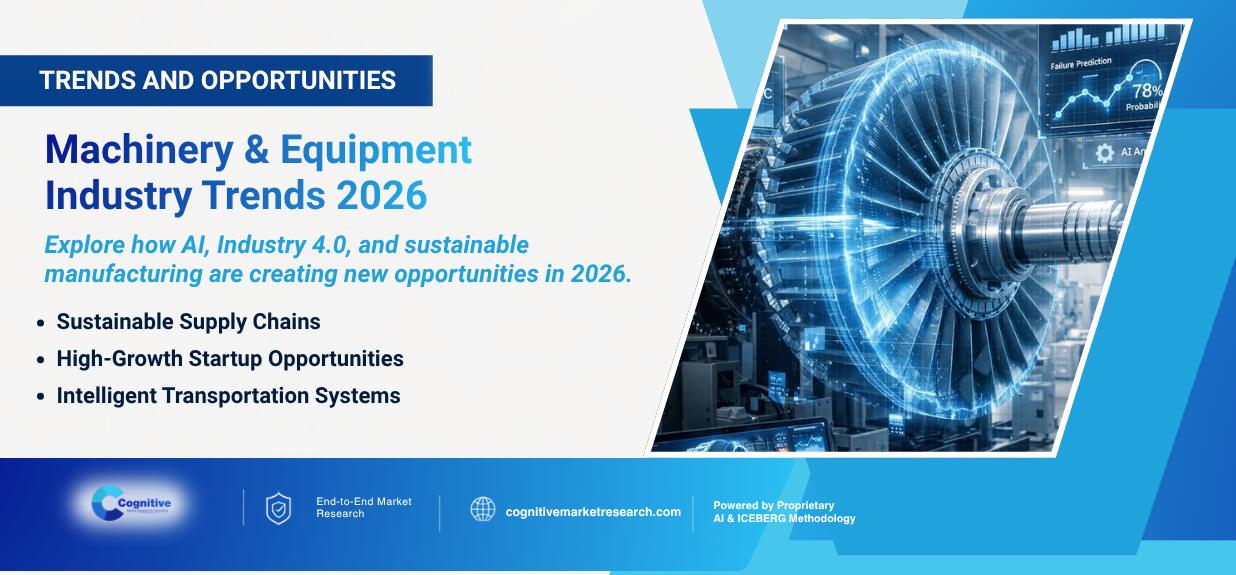
Sensors on machinery no longer just record temperature and vibration. They feed AI models that flag a failing bearing weeks before it breaks.According to Cognitive Market Research and Condulting, The unplanned equipment failures cost the industrial machinery sector an estimated $50 billion a year, a 30% reduction in downtime is a meaningful win not a marginal one.
The opportunity: Sell the ongoing data analysis as a subscription, not just the sensor as a one-time purchase. It's one of the clearest paths to predictable income in an industry historically built on single equipment sales.
3. Equipment-as-a-Service (EaaS) and New Business Models
When interest rates are high and demand is uncertain, a $2 million equipment purchase is a hard sell. That's accelerating the shift toward equipment-as-a-service, where customers pay for usage, uptime, or output instead of ownership, the machinery equivalent of subscribing to software instead of buying it outright.
The opportunity: OEMs can design pricing around performance and utilization instead of a single upfront sale, turning a one-time transaction into years of income. Smaller players can build leasing and financing services tailored specifically to industrial equipment.
4. Sustainability and Energy-Efficient Machinery
Regulatory pressure and customer expectations are pushing machinery makers toward carbon-neutral production and energy-efficient designs new motor technology, lower-emission builds, and ESG reporting that buyers increasingly ask for before signing a contract.
The opportunity: Not every company can build new energy-efficient machines from scratch. Many will pay to retrofit existing fleets or earn third-party ESG certification that helps them win contracts with sustainability-conscious buyers.
5. Collaborative Robots (Cobots) and Human-Robot Synergy
Cobots robots designed to work safely alongside people rather than behind a cage are becoming standard on assembly and packaging lines. They're not replacing workers so much as absorbing repetitive, injury-prone tasks and freeing people for higher-value work.
The opportunity: A company can buy a cobot in an afternoon. Folding it safely and efficiently into an existing workflow takes real expertise and that gap supports a genuine integration and training niche.
6. Reshoring and Supply Chain Localization
Geopolitical tension and tariff unpredictability are pushing manufacturers to rebuild domestic capacity rather than depend on long, fragile global supply chains. This isn't a full reversal of globalization. It's a meaningful shift toward just in case sourcing over just in time.
The opportunity: Suppliers who can offer reliable, local alternatives to overseas parts even at a slightly higher price are winning contracts on supply chain security alone.
7. Cybersecurity for Industrial Systems
As machinery gets more connected, it also gets more exposed. Manufacturers have overtaken financial services as the most-targeted industry for cyberattacks, largely because legacy equipment and unpatched systems weren't built for today's threat landscape.
The opportunity: Operational technology (OT) security remains underserved compared to traditional IT security. Companies offering machinery-specific audits, monitoring, and compliance tools have a real head start in a market that's only getting more urgent.
8. Digital Twins and Simulation-Driven Design
Digital twins virtual replicas of physical machines and production lines let companies test changes, troubleshoot problems, and simulate new designs before touching a physical part. That saves money and avoids costly production downtime.
The opportunity: Enterprise-grade digital twin platforms are built for giants. Mid-sized manufacturers are underserved, leaving room for a scaled-down, industry-specific offering.
9. Workforce Upskilling and the AI-Ready Technician
The manufacturing labor shortage could leave close to 4 million roles unfilled by 2030 roughly a 30% skills gap if current trends hold. This isn't just a headcount problem. It's a skills problem: the industry needs workers who can operate alongside robots, read data dashboards, and troubleshoot digital systems, not just run machines manually.
The opportunity: Training platforms and certification programs built specifically for machinery and equipment careers face very little competition compared to broader corporate training markets and manufacturers are hungry for qualified talent right now.
10. Data-Driven Aftermarket and Parts Services
Only a small fraction of equipment makers describe their aftermarket operations as digitally advanced. That's a problem for them and an opening for everyone else. The parts and service business, powered by real usage data, is becoming one of the most valuable and most neglected parts of the machinery lifecycle.
The opportunity: Analytics platforms that help OEMs price parts dynamically, predict demand, and personalize service based on real usage data. This is one of the least crowded corners of the entire industry.
Challenges to Watch Alongside These Trends
No trend list is complete without the honest caveats.
Talent Shortages
Even the best technology strategy stalls without people who can implement and run it. The skills gap above is arguably the single biggest risk to how fast any of these trends actually materialize.
High Capital Costs of Adoption
AI, digital twins, and robotics all require real investment. Not every company especially in the middle market has the budget or risk appetite to move fast. Expect adoption to stay uneven, with smaller players lagging behind large OEMs.
Regulatory and Tariff Uncertainty
Trade policy can shift adoption timelines overnight. Companies betting heavily on a specific sourcing or manufacturing strategy need built-in flexibility, because the rules of the game may change mid-year.
Frequently Asked Questions
What are the biggest trends in the machinery industry right now?
The biggest trends in 2026 include agentic AI and autonomous operations, predictive maintenance, equipment-as-a-service business models, cobots, and growing investment in cybersecurity for connected industrial systems.
What business opportunities exist in the equipment industry in 2026?
Key opportunities include subscription-based maintenance services, retrofit kits for older machinery, domestic parts sourcing, OT cybersecurity services, and software platforms like digital twins and fleet management tools.
Is AI replacing jobs in machinery manufacturing?
Not entirely. AI is changing what jobs look like more than eliminating them outright. Roles are shifting from manual operation toward oversight, troubleshooting, and data-driven decision-making. That shift is exactly why workforce upskilling is such a major trend.
Which machinery sectors are growing the fastest?
Industrial and factory machinery is furthest along in AI adoption. Construction and material handling are seeing the fastest growth in autonomous and semi-autonomous equipment.
How can small suppliers compete with large OEMs on these trends?
Focus on the gaps OEMs move too slowly to fill: retrofit solutions, niche integration services, domestic sourcing, and specialized software tools, rather than trying to compete on hardware manufacturing scale.

 X
X
Article Details
-
Author Pratik Shirsath
-
Published 03 Jul 2026
-
Last Updated 07 Jul 2026
-
Reading Time~3 minutes
Related Reports
Get a Custom Report
Interested in a similar analysis for your market? Our experts can deliver a customized report.
Contact Our ExpertsMore Articles
Explore all published articles across 30+ industry verticals.
View All Articles