Article
Industrial Wireless Remote Controller Market: Trends and Future Opportunities
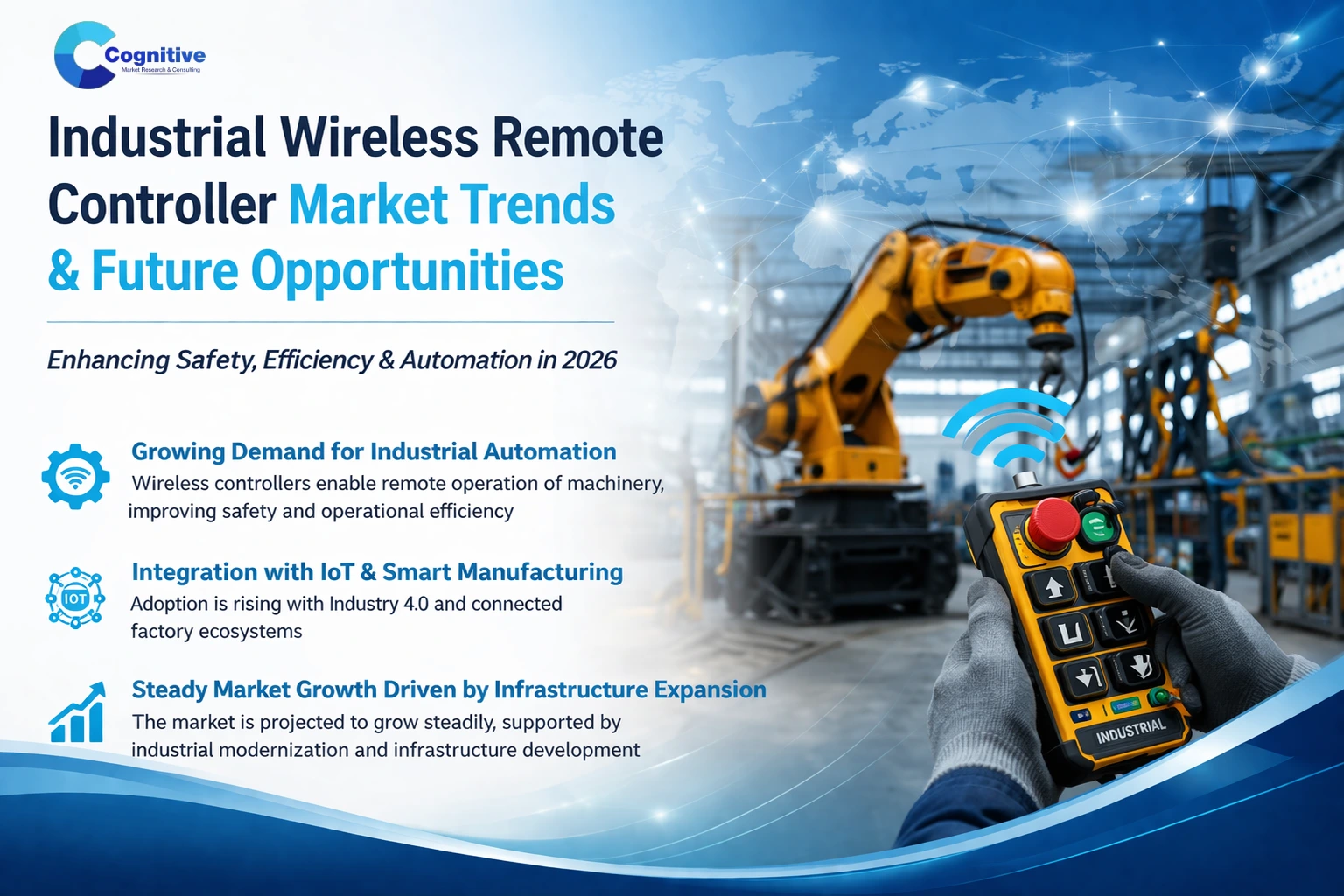
By 2026, we’re seeing the global industrial wireless remote controller market hit a valuation of roughly USD 0.73 billion, and it’s on a steady climb toward USD 1.17 billion by 2035. That’s a solid CAGR of 6.1%, but the real story is where that money is flowing. The flight to precision is the defining theme of the year. While basic pushbutton remotes are still moving in high volumes for simple warehouse tasks, the high-margin growth is almost entirely in Joystick-type controllers. These have become the gold standard for anyone operating complex mobile hydraulics or massive construction cranes where a mistake of a few centimeters can be a disaster.
Key Strategic Trends
1. The 5G and UWB Revolution
For years, the biggest headache in our industry was signal interference too much metal and too many other devices in the factory floor competing for bandwidth. In 2026, we’ve largely solved this by moving toward private 5G networks and Ultra-Wideband (UWB) tech. This has brought latency down to basically zero. For our clients in mining or semiconductor cleanrooms, this kind of precision is a game-changer, allowing for sub-centimeter accuracy that was impossible just a few years ago.
2. Remotes as Smart Nodes with Haptic Feedback
A remote in 2026 is no longer just a transmitter; it’s an edge-computing device. We’re seeing modern controllers loaded with haptic feedback, full-color touchscreens, and real-time telemetry. Instead of an operator having to look away at a separate monitor, the controller in their hands vibrates or displays a warning about engine heat, load-weight limits, or battery life. It’s about keeping the operator’s eyes on the machine, which drastically cuts down on accidents.
3. Biometrics and Safety as a Service
The regulatory environment has gotten a lot tougher this year. Security is a huge concern, so we’re seeing a big trend toward integrated biometric scanners think fingerprint or facial recognition built right into the hardware. This ensures that only a certified, trained operator can even turn the machine on. On top of that, Intrinsically Safe and explosion-proof ratings (like ATEX/IECEx) are no longer optional extras if you want to play in the oil, gas, or chemical sectors.
4. Energy Harvesting and Sustainability
A newer trend we’re tracking for 2026 is the move away from traditional batteries. Some of the most innovative manufacturers are now using energy harvesting capturing kinetic energy from the operator's movements or ambient RF signals—to power the controllers. Not only does this reduce the environmental footprint, but it also eliminates the downtime of swapping batteries mid-shift.
Where the Growth Pockets Are
Construction and Mining: This is still the big dog of the industry, taking up over 40% of the market. The focus in 2026 is on Long-Range Mesh tech that lets an operator control a rig from over a kilometer away, keeping them well out of the danger zone in hazardous environments.
Logistics and Warehousing: With the explosion of automated fulfillment centers, everyone wants lightweight, wearable, hands-free controllers. These have to play nice with robotic arms and AGVs (automated guided vehicles).
Agriculture: This has been a bit of a surprise for us. Precision farming is booming. Wireless remotes are being used for everything from calibrated irrigation to automated harvesting, where being rugged enough to handle dust and rain is the main selling point.
My Recommendations for Manufacturers
Ergonomics is Your Secret Weapon: Shifts are getting longer and skilled labor is harder to find. Operators are choosing the gear that doesn't leave them with wrist fatigue or eyestrain. Investing in glove-friendly screens and better weight distribution will win you the replacement market every time.
Master Hybrid Connectivity: To protect against signal drops, the winners in 2026 are building hardware that can automatically hop between Bluetooth, Wi-Fi, and RF depending on the environment.
Selling the Solution, Not the Box: Most end-users are overwhelmed by the setup. If you offer Wireless Integration as a service including installation, network mapping, and predictive maintenance you’re going to double the lifetime value of that customer.
Conclusion
For those of us at Cognitive Market Research, it’s clear that the 2026 market isn't a race to the bottom on price. It’s a race toward integration. The remote controller is effectively the hand of the modern industrial body. To succeed, your hardware needs to be as intelligent and connected as the rest of the digital factory. Success today means building a tool that doesn't just send commands but actively participates in the factory’s digital nervous system. It’s an exciting time to be in manufacturing, provided you’re willing to trade the standard for the smart.
 X
X
Article Details
-
Author Anushka Gore
-
Published 13 Feb 2025
-
Last Updated 02 Apr 2026
-
Reading Time~3 minutes
Related Reports
Get a Custom Report
Interested in a similar analysis for your market? Our experts can deliver a customized report.
Contact Our ExpertsMore Articles
Explore all published articles across 30+ industry verticals.
View All Articles